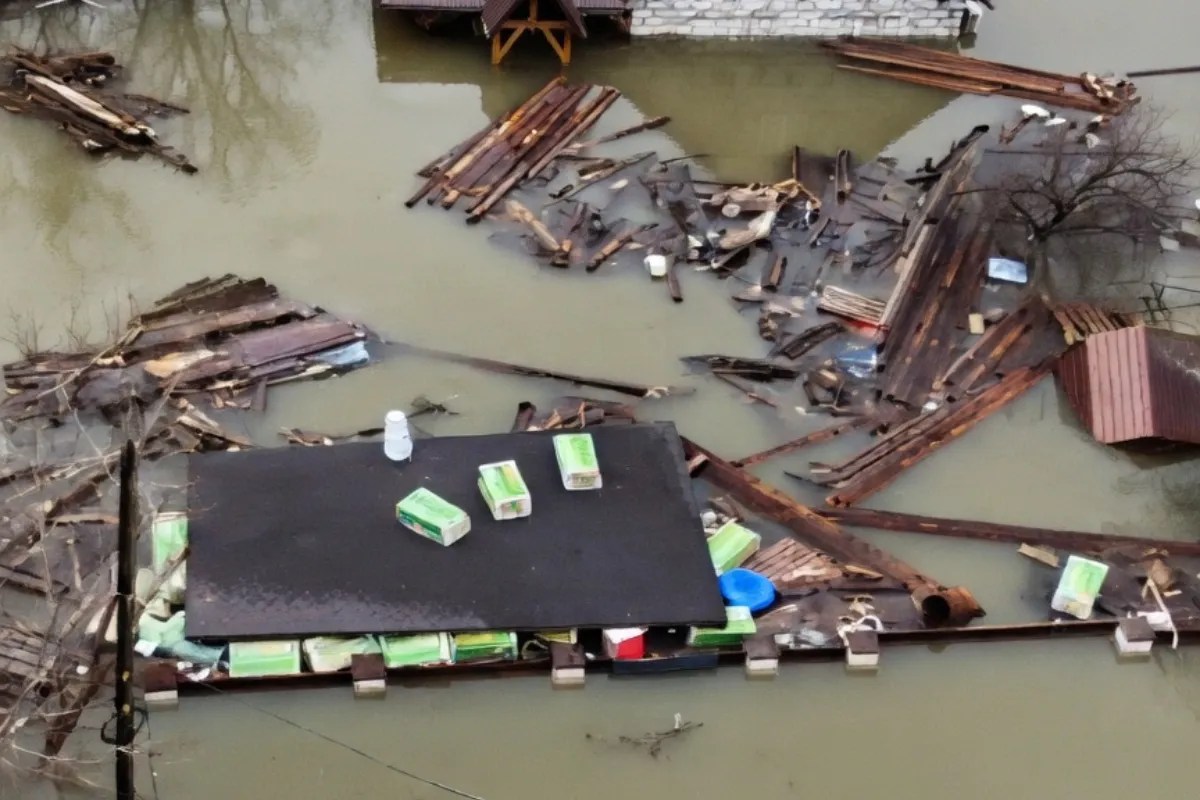
The flash flooding in Dagestan, specifically targeting the capital of Makhachkala, represents a systemic failure of aging Soviet-era infrastructure when confronted with rapid-onset hydrometeorological anomalies. While initial reports focus on the human drama of submerged streets, the deeper structural reality is an cascading failure across three critical vectors: hydraulic capacity, electrical grid resilience, and emergency governance protocols. When a regional capital declares a state of emergency while 300,000 citizens lose power, the event ceases to be a "natural disaster" and becomes a case study in urban vulnerability and the limitations of reactive engineering.
The Hydraulic Bottleneck and Surface Runoff Velocity
The primary driver of the destruction in Makhachkala is not merely the volume of rainfall, but the rate of precipitation relative to the drainage coefficient of the urban landscape. Urban centers built on the Caspian littoral face a unique topographical challenge: a narrow coastal plain backed by steep mountain ranges. This geography creates a high-velocity runoff environment.
The drainage systems in Dagestan’s capital were designed for historical precipitation averages that no longer reflect current climate volatility. This creates a "hydraulic bottleneck." As water descends from the Caucasus foothills, it gains kinetic energy. In a functional urban environment, bioswales and high-capacity storm sewers would mitigate this energy. In Makhachkala, the proliferation of unregulated construction and the paving over of natural absorption zones have increased the surface runoff coefficient to near-unity. Water that should have been absorbed by the soil instead stays on the surface, pooling in low-lying residential sectors and transforming arterial roads into high-volume canals.
The Physics of Grid Failure and 300,000 Outages
The loss of electricity for over 300,000 residents is the most significant operational failure of this crisis. Electrical grids in the North Caucasus operate on a "hub-and-spoke" architecture that is inherently sensitive to localized flooding at the substation level.
- Substation Inundation: Most distribution transformers are sited at ground level or in basements. Once water levels exceed the insulation thresholds of high-voltage equipment, short-circuiting occurs. To prevent a permanent meltdown of the regional grid, central operators are forced into "load shedding" or manual shutdowns.
- Insulation Breakdown: Increased humidity and direct water contact degrade the dielectric strength of insulators on power lines. In Dagestan’s coastal environment, the mixture of salt spray from the Caspian Sea and fresh floodwater creates a highly conductive slurry that triggers flashovers and transformer explosions.
- The Secondary Loss Loop: The loss of electricity immediately disables the pumps required to clear the floodwater. This creates a negative feedback loop where the lack of power prevents the mitigation of the very flooding that caused the power loss in the first place.
The Logistics of an Urban Emergency Declaration
Declaring a state of emergency in a regional capital is a formal legal mechanism that shifts the chain of command from civil administration to a unified crisis management center. This transition is necessary because the complexity of a simultaneous flood and blackout exceeds the bandwidth of standard municipal services.
The immediate priority in such a transition is the "Life-Line Strategy." This involves the prioritization of energy restoration to critical nodes—hospitals, water filtration plants, and telecommunications hubs—over residential sectors. For the 300,000 people in the dark, the delay in restoration is a calculated trade-off to ensure the city’s core life-support systems do not experience a total collapse. The friction in this process usually stems from a lack of "digital twins" or accurate maps of the underground utility networks, which forces repair crews to operate blindly in submerged environments.
Economic and Structural Depreciation Costs
The financial impact of the Dagestan floods can be categorized through the lens of direct asset destruction versus indirect economic friction.
- Direct Asset Destruction: This includes the replacement cost of blown transformers, the resurfacing of eroded asphalt, and the structural repair of residential foundations weakened by hydrostatic pressure.
- Economic Friction: The shutdown of businesses in the capital and the interruption of logistics along the coastal corridors result in a loss of regional GDP that often exceeds the physical repair costs. When a city of this size loses power, the "Just-in-Time" supply chains for food and medicine are severed, leading to immediate inflationary spikes in essential goods.
The recurring nature of these floods suggests that the current investment model is focused on "Recovery Spend" rather than "Resilience Spend." Recovery spend is inherently inefficient as it merely restores the status quo—an infrastructure that has already proven to be inadequate.
The Topographical Trap of the Caspian Basin
Makhachkala's location at the foot of the mountains makes it a natural catchment area. This is a fundamental geological reality that cannot be engineered away; it can only be managed. The failure to maintain the "canal" systems that traditionally diverted mountain runoff into the Caspian Sea is a primary culprit. Over the last decade, urban sprawl has encroached on these vital bypass channels. Sedimentation and illegal waste dumping have further reduced their volumetric capacity. During this current event, these canals likely reached "bankfull discharge" within the first hour of heavy rain, leaving the excess volume with nowhere to go but the streets.
Strategic Recommendations for Urban Hardening
To move beyond the cycle of emergency declarations and mass outages, the regional strategy must pivot toward decentralized infrastructure.
Implementing a "Sponge City" model is the only viable long-term solution. This involves replacing non-porous surfaces with permeable materials and constructing massive underground detention vaults to hold peak-flow runoff before it reaches the electrical substations. Furthermore, the electrical grid requires "Micro-Gridding." By segmenting the city into independent power zones with their own localized generation or storage, a flood in one district would not trigger a cascading blackout for 300,000 people.
The immediate tactical move for the Dagestan administration is a comprehensive audit of the Caspian drainage outlets. If the outlets are blocked by debris or coastal siltation, no amount of inland pumping will clear the city. Clearing the "exit points" of the hydraulic system is the prerequisite for any meaningful reduction in water levels.