The wind in New York City usually has a voice you can ignore. It’s the sound of a plastic bag skittering across asphalt or the low whistle through a chain-link fence in Queens. But when the barometer begins its frantic slide and the Atlantic air collides with the frigid Canadian interior, that voice changes. It becomes a low-frequency hum that vibrates in the marrow of your bones.
For nine years, that specific hum has been missing.
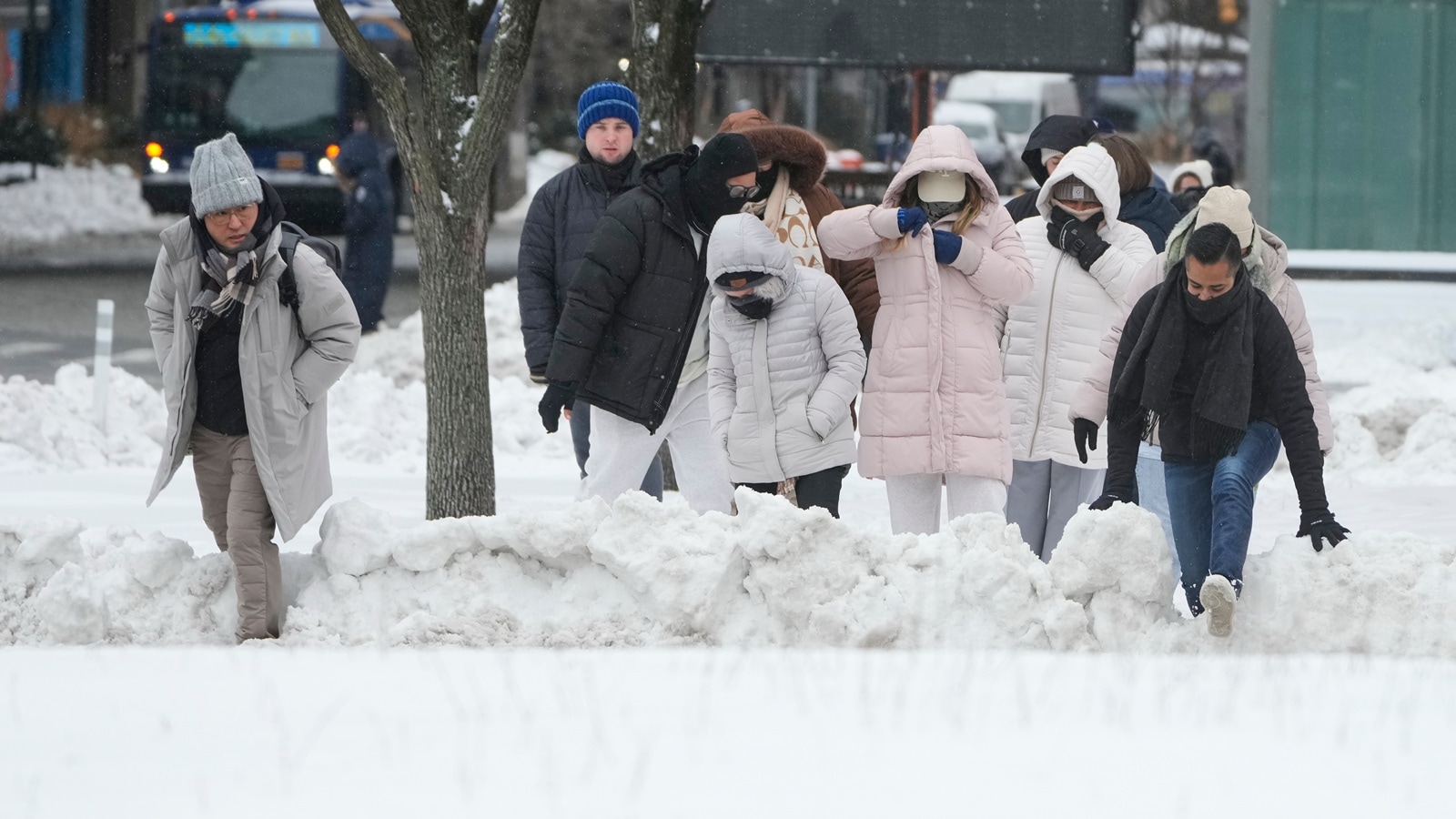
A generation of children in this city has grown up knowing "snow days" as little more than a light dusting that turns to gray slush by noon. They have never seen the sky turn the color of a bruised plum at 3:00 PM. They haven't felt the eerie, pressurized stillness that precedes a true blizzard. Now, the National Weather Service has issued the first blizzard warning for the city since 2016, and the shift in the atmosphere is more than just meteorological. It is a psychological reckoning with a force we had almost forgotten how to fear.
The numbers are clinical. Meteorologists point to a "bomb cyclone"—a term that sounds like sensationalism until you understand the physics. It occurs when a mid-latitude cyclone rapidly intensifies, its central pressure dropping at least 24 millibars in 24 hours. It is a vacuum in the sky, sucking in everything surrounding it. For the East Coast, this means sustained winds of 35 miles per hour and visibility dropped to less than a quarter-mile for a grueling three-hour stretch. That is the technical definition of a blizzard. But the technical definition doesn't account for the guy named Elias running a bodega on 4th Avenue, wondering if his delivery driver will make it home before the bridges close.
Elias represents the invisible stakes. He is currently taping his windows, not because he thinks the glass will shatter, but because the wind has a way of finding the smallest crack and turning a warm room into an icebox in minutes. He is stocking extra loaves of bread and gallons of milk, participating in the ritualistic "bread and milk" run that New Yorkers mock right up until the moment the snowflakes start to stick.
Consider the physics of a city built on movement. New York is a circulatory system. The subways are the veins, the taxis are the blood cells, and the people are the oxygen. A blizzard is a massive, frozen clot. When the wind-chill factor hits double digits below zero, the steel of the subway tracks can contract and snap. The third rail, usually a source of life-sustaining power, becomes a liability when packed with wind-driven drifts.
The warning isn't just a suggestion to wear a heavier coat. It is a signal that the infrastructure we take for granted—the seamless transition from home to work to dinner—is about to be revoked.
History has a way of repeating itself, but we rarely have the memory to match it. In 2016, the "Jonas" storm dumped nearly 28 inches on Central Park. It was beautiful for an hour. Then the power went out in the coastal stretches of the Rockaways. Then the flooding started. People often forget that the greatest threat of a winter storm isn't always the cold; it’s the weight. Snow is heavy. A single cubic foot of drifted, packed snow can weigh 20 pounds. Multiply that by the square footage of an old Brooklyn brownstone roof, and you aren't looking at a winter wonderland. You are looking at several tons of pressure pushing down on a structure built in 1890.
The city prepares in a way that feels like a mobilization for war. The Department of Sanitation isn't just picking up trash; they are mounting plows on nearly 2,000 trucks. They are loading 700,000 tons of salt. But salt has a breaking point. Once the temperature drops below 15 degrees Fahrenheit, the chemical reaction slows. The salt sits on top of the ice, useless, a gritty reminder that nature doesn't always care about our chemistry sets.
There is a specific kind of person who thrives in this. You see them in the hardware stores right now. They aren't the ones panicking. They are the ones buying extra batteries for a transistor radio and checking the expiration date on their camping stove. They know that a blizzard is a lesson in self-reliance. When the whiteout hits, the emergency services can't find you as easily. The ambulance that usually takes six minutes to arrive might take forty. Or it might not come at all.
This isn't about being cynical. It’s about understanding the fragility of our urban ego. We live in a world of high-speed fiber optics and instant delivery, but we are still at the mercy of a low-pressure system spinning off the coast of Cape Hatteras.
The real danger lies in the "dry" period—the hours before the first flake falls. This is when the overconfidence sets in. The sky is gray, sure, but the roads are clear. You think you can make that one last trip to the office. You think the warning is an exaggeration. But a blizzard isn't a slow progression; it is a curtain falling. One minute you can see the Empire State Building’s needle; the next, you can’t see the taillights of the car ten feet in front of you.
Visibility is the first thing to go, but silence is the first thing to arrive.
If you have never stood in the middle of Times Square during a true blizzard, it is impossible to describe. The neon lights of the billboards reflect off the falling ice, creating a hallucinatory, shimmering fog. The roar of the city—the honks, the shouts, the subterranean rumble—is smothered. The snow acts as an acoustic foam, absorbing every vibration. For a few hours, the loudest city on earth becomes as quiet as a cathedral. It is a terrifying, majestic peace.
But that peace is a mask for the struggle happening behind closed doors. For the elderly resident in a walk-up apartment whose radiator has decided this is the night to quit. For the delivery worker on an electric bike, squinting through the stinging sleet because their day’s wages depend on someone wanting a hot pizza in a cold storm. These are the human elements the weather maps ignore. The maps show blue and purple swaths of "accumulation zones," but they don't show the anxiety of a parent watching the flickering lights while the thermometer in the hallway drops.
We are told to "stay home," a phrase that has taken on a heavy, almost traumatic weight in recent years. But this time, the walls aren't a cage; they are a fortress. Staying home is an act of civic duty. Every car that stays off the Brooklyn-Queens Expressway is one less vehicle the plows have to maneuver around. Every person who stays inside is one less potential slip-and-fall victim taking up space in an overburdened ER.
The storm will pass, as they always do. The sun will come out, the "snow shadows" will stretch long and blue across the avenues, and the grueling work of digging out will begin. We will complain about the slush puddles at the corners of the streets—those deep, deceptive lakes of icy filth that soak through even the best boots. We will argue over shoveled parking spots and the ethics of using a lawn chair to "save" a space on a public street.
But for now, there is only the waiting.
The Nine Year Ghost is at the door. It is cold, it is relentless, and it is a reminder that we are not the masters of this island. We are merely its inhabitants, permitted to stay as long as we remember how to respect the turn of the seasons.
As the first gusts begin to rattle the fire escapes and the streetlights take on that hazy, golden glow, the only thing left to do is turn off the television, listen to the rising hum of the wind, and realize how small we are against the white.
The city is about to disappear, and in that disappearance, we might finally see it for what it really is: a collection of millions of people, huddled together, waiting for the light to come back.