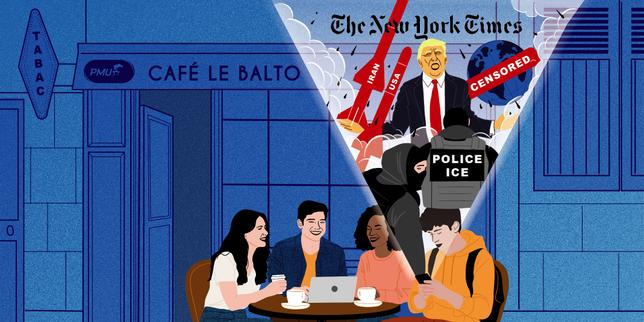
The intersection of domestic American political volatility and international academic mobility has created a distinct demographic phenomenon: the reactionary expatriate student. While traditional study abroad programs are historically marketed as "cultural enrichment," the current migration of American students to France functions as a strategic avoidance of domestic social friction and a search for institutional stability. To understand this shift, one must move beyond the anecdotal "shame" reported in legacy media and analyze the structural drivers—economic, psychological, and reputational—that transform a four-year degree in Paris into a hedge against American political polarization.
The Triad of Educational Displacement
The decision for an American citizen to pursue higher education in France during a Trump administration is rarely a singular emotional response. It is governed by three specific pillars of displacement that redefine the value proposition of a European degree.
1. The Reputational Liability Coefficient
In a globalized labor market, the "brand" of a student’s home country acts as a silent variable in their professional networking. For many students, the 2016-2020 period introduced a high Reputational Liability Coefficient. They perceive their American identity not as an asset of soft power, but as a data point that requires constant apology or explanation in international circles. This creates a psychological tax on the student, leading to "identity masking" where the individual prioritizes their integration into French academic rigor to distance themselves from the perceived chaos of Washington.
2. The Arbitrage of Social Safety
American higher education is increasingly viewed through the lens of risk management. The "Cost Function of Domestic Attendance" now includes variables such as the threat of campus gun violence, the erosion of reproductive healthcare access, and the rising cost of private insurance. France, conversely, offers a different risk profile. The state-subsidized healthcare system (l’Assurance Maladie) and the significantly lower tuition rates at public universities create an economic arbitrage. Students aren't just buying an education; they are purchasing a temporary reprieve from the American social safety net's volatility.
3. Institutional Stability vs. Executive Volatility
The French "Grande École" system and its traditional universities represent a centuries-old commitment to Cartesian logic and secularism (laïcité). To an American student experiencing the "whiplash effect" of executive orders and judicial shifts in the U.S., the perceived rigidity of French bureaucracy is paradoxically comforting. It offers a predictable, if sometimes cumbersome, framework that feels insulated from the daily news cycle of the White House.
Mapping the Cause and Effect of Academic Exile
The narrative that these students are simply "unhappy" misses the mechanical reality of how political change alters migration patterns. The causal chain begins with Policy-Induced Alienation. When executive rhetoric targets specific demographics—internationalists, climate scientists, or liberal arts proponents—it effectively de-values the domestic environment for those groups.
This leads to a Selection Bias in Migration. The students moving to France are not a representative cross-section of America; they are often high-attainment individuals with the cultural capital to navigate foreign bureaucracies. This results in a localized "brain drain" where the very individuals most likely to foster international cooperation are the ones most eager to leave the domestic sphere.
The second-order effect is the Solidification of the Echo Chamber. By physically removing themselves from the American geographic landscape, these students lose the ability to engage in the very domestic discourse they find distressing. Their perspective becomes "Euro-centric," further widening the ideological gap between the expatriate class and the mainland population. This creates a feedback loop: the more polarized the U.S. becomes, the more these students feel justified in their exile, which in turn reduces the number of moderate or dissenting voices within the domestic borders.
The Economic Reality of the "Expatriate Shame"
The sentiment of being "ashamed of one's country" is often dismissed as a luxury belief. However, when quantified, it reflects a shift in Human Capital Allocation.
- Tuition Variance: A private U.S. university can cost $60,000–$80,000 annually. A French public university costs approximately €3,000 for non-EU citizens (and significantly less for those with dual residency).
- Opportunity Cost: The time spent navigating a foreign language and culture is a high-yield investment in "Cultural Intelligence" (CQ), a metric increasingly valued in multinational corporations.
- Long-term Residency Path: Many students view the "Student Visa to Talent Passport" pipeline as a legitimate escape hatch. Under French law, obtaining a Master’s degree in-country can reduce the residency requirement for naturalization from five years to two.
This is not a vacation; it is a calculated diversification of citizenship options. The "shame" mentioned in the original reference is the emotional catalyst, but the structural incentive is the acquisition of a European Union foothold.
The Bottleneck of Integration
While the logic of leaving is sound, the reality of the French academic landscape introduces a new set of frictions. The "Three Pillars" mentioned earlier are often challenged by the French Integration Barrier.
- The Language Parity Gap: Even students with high-level French struggle with the specific "discourse of the dissertation" (la dissertation) required in French universities, which follows a strict dialectical structure (Thesis-Antithesis-Synthesis).
- The Social Atomization: Unlike the "campus life" model of U.S. universities, French education is decentralized. Students live in independent apartments and navigate the city as adults. This lack of a "buffer" can exacerbate the very feelings of isolation the student was trying to escape.
- The Administrative Labyrinth: The "Préfecture" becomes the new "White House"—a source of stress and unpredictability regarding visa renewals and work permits.
The student essentially swaps one form of systemic anxiety for another. The American anxiety is ideological and existential; the French anxiety is procedural and bureaucratic.
Defining the New American Diaspora
We must distinguish between the "Year Abroad" student of the 1990s and the "Political Refugee" student of the 2020s. The former was seeking adventure; the latter is seeking a different social contract.
This cohort represents a Strategic Disengagement. They are not looking to change the U.S. from afar; they are looking to see if they can survive without it. This transition from "citizen" to "observer" is a critical shift in the American psyche. When the brightest young minds of a nation begin to view their passport as a burden to be managed rather than a privilege to be exercised, the long-term health of that nation's soft power is in terminal decline.
The "Trump Effect" on education is therefore not just about who is in the Oval Office. It is about the destruction of the Domestic Affinity Metric. If a country cannot provide a psychological sense of belonging to its most educated youth, those youth will naturally gravitate toward systems that offer a higher "Return on Identity."
Strategic Recommendation for the Transatlantic Observer
For those analyzing this trend, the focus must remain on the Retention of Talent. Any strategy to "re-engage" this diaspora requires more than patriotic rhetoric. It requires a stabilization of the Domestic Affinity Metric.
- Lower the Cost Function: Address the economic drivers (student debt, healthcare) that make the French "Arbitrage of Social Safety" so attractive.
- De-politicize Academic Spaces: Ensure that the "brand" of American education is associated with rigorous inquiry rather than a battlefield for culture wars.
- Validate the Expatriate Experience: Instead of viewing these students as "shame-filled deserters," policy-makers should view them as a strategic reserve of bilingual, culturally fluent assets who can bridge the gap between a populist America and a skeptical Europe.
The trend of Americans fleeing to France is a leading indicator of a deeper systemic failure. The movement of people is the most honest data point in geopolitics. If the flow of high-value students continues to move one way across the Atlantic, it signals that the American "Value Proposition" is currently being outcompeted by the European "Stability Model."
The final play for any administration—Trump or otherwise—is to recognize that a country’s greatest export is its vision of the future. If that vision is currently being rejected by its own students in favor of a French classroom, the solution is not to criticize the student, but to fix the vision.