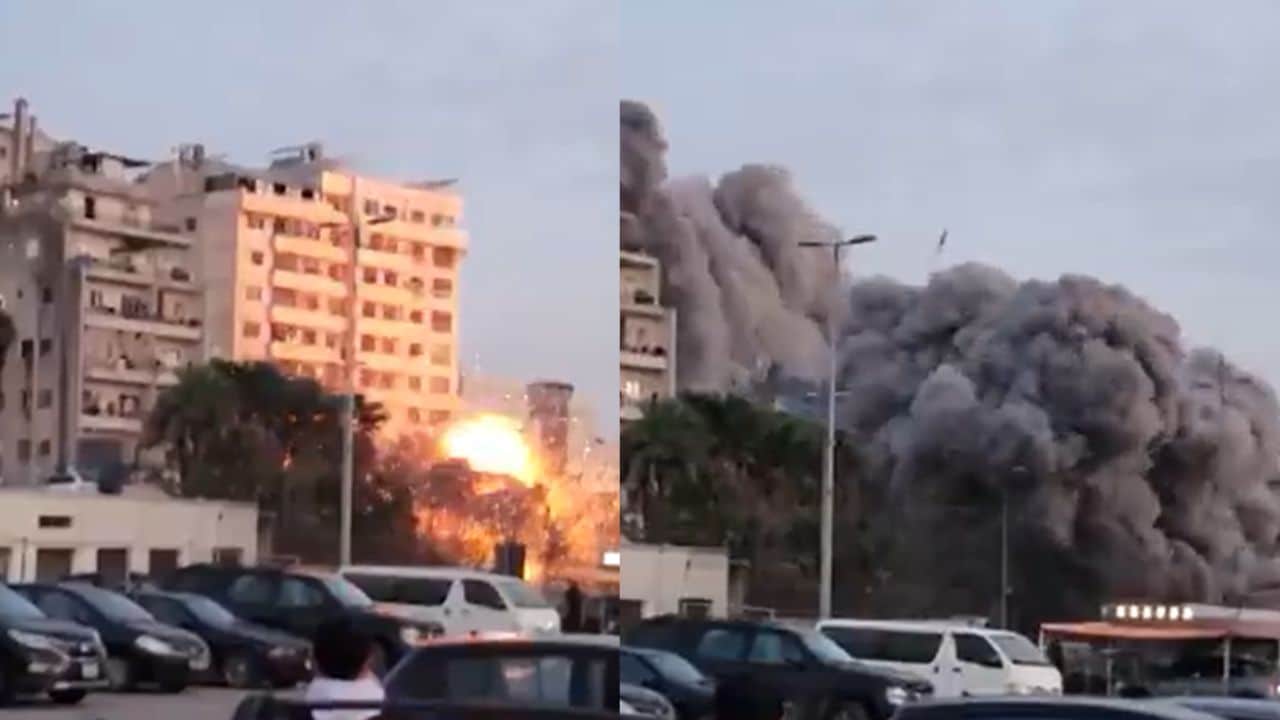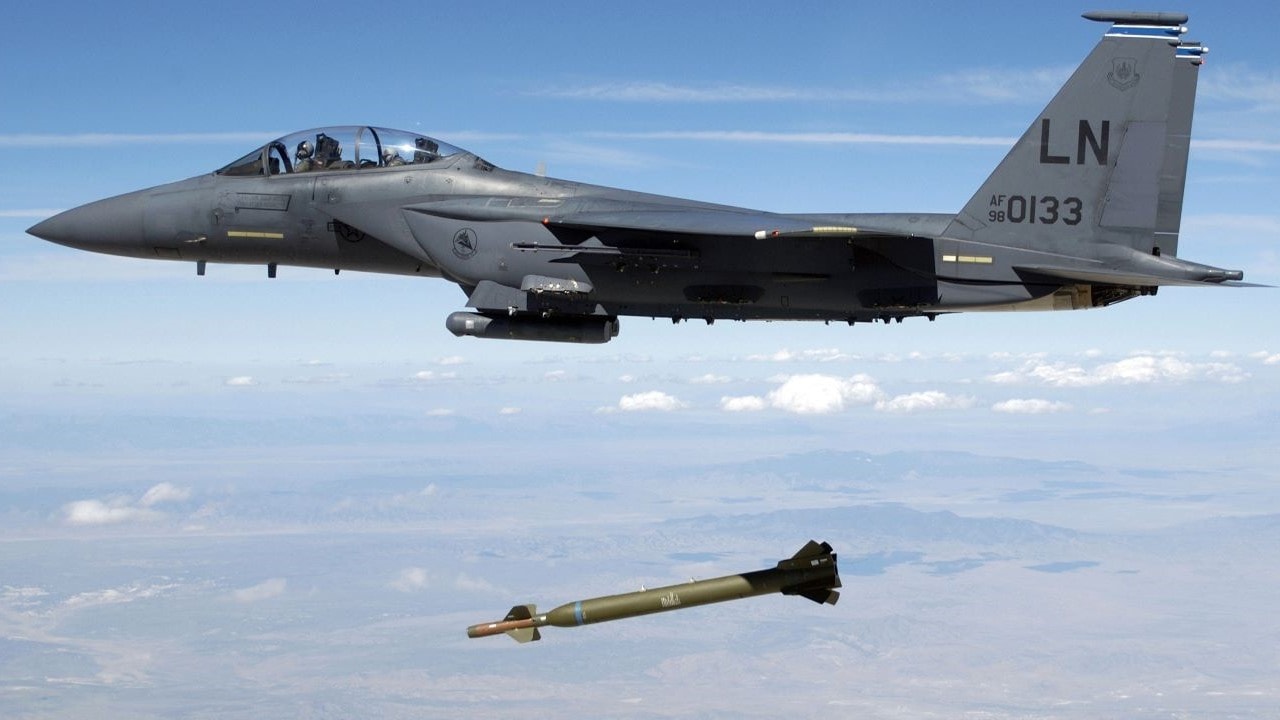
The recent deployment of 5,000-pound GBU-72 Advanced 5K Penetrators against Iranian missile infrastructure near the Strait of Hormuz marks a definitive shift in American kinetic strategy. For years, the tactical conversation centered on the GBU-31 or the massive, 30,000-pound GBU-57. This middle-weight arrival changes the math. It is a weapon designed specifically to bridge the gap between "standard" bunker busters and nuclear-adjacent payloads, providing a precision-guided solution for hardened targets that previously required a much larger, more cumbersome sortie. By targeting the coastal missile batteries and underground storage facilities lining the world's most sensitive maritime chokepoint, the Pentagon has sent a clear message. The era of sanctuary in the bedrock is over.
The Engineering of the GBU-72
To understand why this specific ordnance matters, one must look at the physics of the "Advanced 5K." Conventional bunker busters rely on raw mass and velocity to punch through concrete. The GBU-72, however, utilizes a specialized warhead casing designed to withstand the immense shock of impact without fracturing before the fuse triggers the main explosive charge. Expanding on this topic, you can also read: Why the Green Party Victory in Manchester is a Disaster for Keir Starmer.
The weapon is significantly more lethal than its predecessor, the G-28. It is not just about the size of the hole. It is about the lethality of the overpressure generated within an enclosed space. When a GBU-72 enters an underground bunker, the blast wave is channeled through the tunnels, turning the facility's own architecture against it. This is a surgical strike on a subterranean scale.
The weapon's integration with the F-15E Strike Eagle and the B-21 Raider program suggests a long-term commitment to this weight class. It allows for a higher volume of fire. A single bomber can carry multiple GBU-72s, whereas the massive "MOP" (Massive Ordnance Penetrator) requires a dedicated, heavy-lift platform for just one or two units. This increases the "tempo" of an air campaign, allowing a commander to dismantle a network of bunkers in a single night rather than over a week of staggered missions. Analysts at NBC News have also weighed in on this trend.
Chokepoint Geopolitics and the Hormuz Factor
The Strait of Hormuz is a narrow stretch of water where roughly a fifth of the world’s oil passes daily. Iran has spent decades turning the jagged cliffs and coastal mountains of this region into a "fortress of anti-access." They use a strategy known as A2/AD (Anti-Access/Area Denial).
The Iranian approach relies on mobile anti-ship cruise missile (ASCM) launchers that can be rolled out of deep limestone tunnels, fired, and then retracted before a counter-strike can be organized. Historically, these "missile cities" were considered largely immune to everything but a sustained, multi-day bombardment or a direct ground invasion.
The introduction of the GBU-72 into this theater changes the risk-benefit analysis for Tehran. If a 5,000-pound bomb can collapse the entrance of a tunnel or penetrate the ceiling of a storage hall with GPS-guided accuracy, the "shoot and scoot" tactic becomes a "shoot and be buried" scenario. This strike was not just a tactical success; it was a demonstration of a narrowed window of impunity.
The Intelligence Gap and the Target Profile
No bomb is effective without the coordinates to guide it. The strikes near the Strait suggest a high level of "target development" by Western intelligence services. To hit a bunker, you have to know where the air vents are. You have to know the thickness of the overhead cover and the specific composition of the soil or rock.
The targets in this operation were reportedly hardened silos containing the Khalij Fars and Fattah missile systems. These are weapons designed to sink aircraft carriers and disrupt commercial shipping. By neutralizing these sites, the U.S. is attempting to decapitate Iran’s ability to hold the global economy hostage via the oil markets.
However, there is a risk. Hardened targets are often located near civilian infrastructure or sensitive environmental zones. The use of a 5,000-pound warhead carries a massive "footprint." Even with precision guidance, the seismic shock of a deep-earth detonation can cause collateral damage to nearby structures. This is the gray area of modern siege warfare: the line between a clean military strike and a regional catastrophe is thinner than a GPS coordinate.
Countermeasures and the Evolution of Hardening
Military history is a constant race between the shield and the sword. As the U.S. perfects the GBU-72, adversaries are already looking at "active" hardening. This includes:
- Burying deeper: Moving facilities 100 meters or more below the surface, beyond the reach of 5,000-pound class weapons.
- Decoy tunnels: Constructing hundreds of false entrances to exhaust the attacker's magazine.
- Advanced materials: Using ultra-high-performance concrete (UHPC) mixed with steel fibers to deflect the energy of a penetrator.
If Iran responds by moving its assets even deeper, the U.S. may be forced to rely on larger, more escalatory weapons. This creates an "escalation ladder" where each step toward more powerful conventional bombs brings the conflict closer to the threshold of "strategic" or non-conventional warfare.
The Logistical Reality of Deep Strikes
Operating in the Persian Gulf environment presents unique challenges for precision munitions. High humidity, dust, and heat can affect the sensors of smart bombs. Furthermore, the electronic warfare (EW) environment in the Strait is among the most congested in the world.
Iran has invested heavily in GPS jamming and "spoofing" technologies. If a GBU-72 loses its satellite link, it reverts to an inertial navigation system (INS). While accurate, INS is less precise over long distances. A miss of even ten meters could mean the difference between hitting the "sweet spot" of a bunker's roof and hitting a solid rock face that absorbs the energy without collapsing the structure.
The recent strikes utilized a combination of laser-guidance and satellite-aided navigation, a "dual-mode" approach designed to overcome electronic interference. This suggests that the U.S. is not just testing a new bomb, but a new way of ensuring that bomb hits its mark in a "denied" environment.
The Global Ripple Effect
The use of the GBU-72 is being watched closely by other nations with significant underground interests. From the tunnels of North Korea to the mountain complexes of central Asia, the "bunker" has been the ultimate insurance policy for secondary powers.
When the U.S. demonstrates that it can reliably destroy these sites with mid-sized munitions, the insurance policy is canceled. This forces a shift in global military spending. Instead of building down, nations may start building "out"—dispersing their assets across wider areas rather than concentrating them in a few deep holes.
The financial cost of these operations is also a factor. A single GBU-72 mission, including the aircraft's fuel, maintenance, and the cost of the munition itself, runs into the millions of dollars. In a prolonged conflict, the "cost-per-kill" of destroying a missile silo must be weighed against the value of the missile it contains. If the adversary can build tunnels cheaper than the U.S. can build 5,000-pound bombs, the math favors the defender.
The Doctrine of Preemption
Perhaps the most significant aspect of this strike is the move toward "active preemption." In the past, bunker busters were seen as tools of total war—something used in the opening hours of a full-scale invasion. Using them in a "limited" strike near the Strait of Hormuz suggests a new policy.
The U.S. is now signaling that it will use its most advanced conventional weapons to prevent a threat from maturing, rather than waiting for hostilities to commence. This is a high-stakes gamble. It assumes that the adversary will be intimidated by the display of force rather than provoked into an immediate retaliation.
If the goal was to secure the Strait of Hormuz, the GBU-72 has provided a temporary tactical advantage. But in the long run, the "bunker buster" is only as effective as the diplomacy that follows it. For now, the missiles in the mountains are under a new kind of pressure.
The move to target the missile sites near the Strait of Hormuz is not a one-off event. It is the beginning of a new chapter in how the U.S. projects power in the 21st century. The focus has shifted from the surface to the subsurface.
As long as regional powers continue to hide their most dangerous assets in the earth, the U.S. will continue to refine the tools used to dig them out. The GBU-72 is the current peak of that refinement, a weapon that turns the very earth that was supposed to protect an army into its tomb. The Strait remains open, but the price of closing it has just risen exponentially.