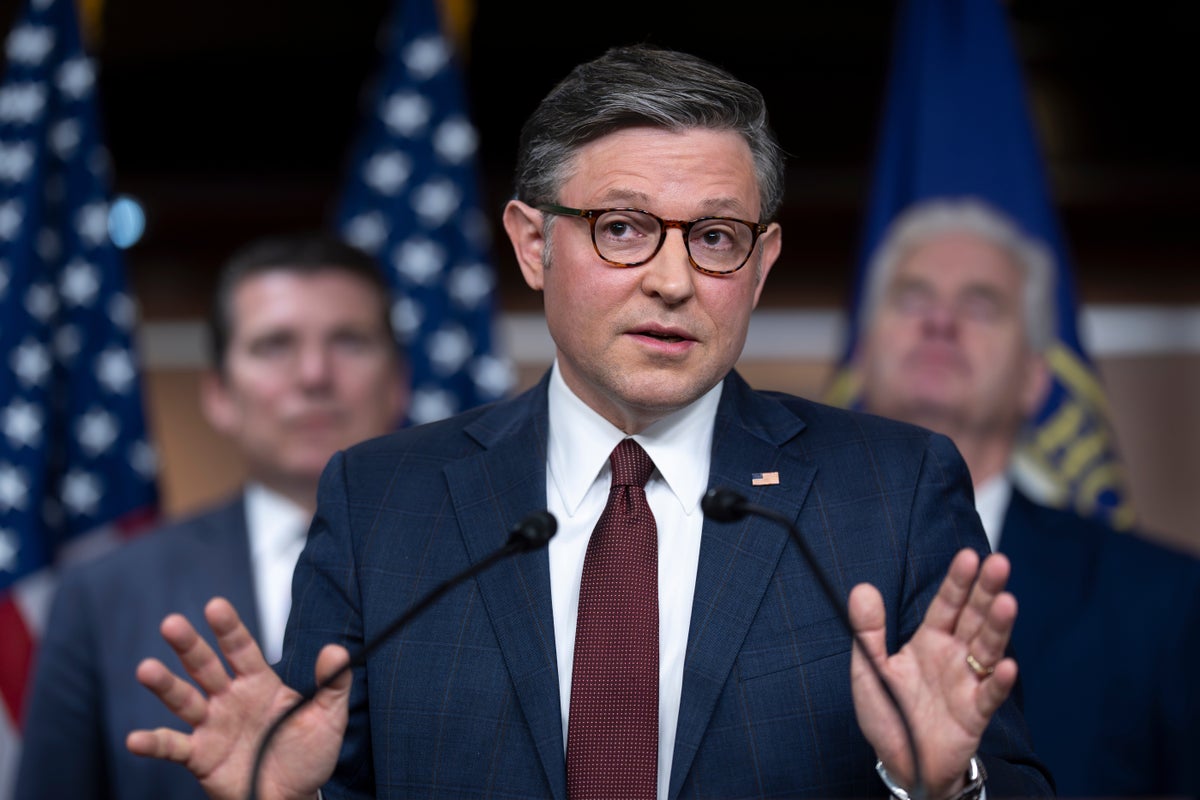
The air in the Speaker’s lobby usually smells of old wood and expensive wool. It is a place where history is supposed to feel heavy, where the marble floors echo with the weight of decisions that steer the course of a superpower. But on a Tuesday afternoon that felt more like a pressure cooker than a legislative session, Mike Johnson wasn’t thinking about history. He was thinking about the phone in your pocket. He was thinking about the invisible digital threads that connect a grain elevator in Nebraska to a server farm in a country that doesn’t wish us well.
He was also thinking about his own ranks.
The Republican party has always prided itself on being the party of national security, the "peace through strength" crowd. Yet, as the debate over Section 702 of the Foreign Intelligence Surveillance Act (FISA) reached a fever pitch, the Speaker found himself staring into a mirror that had been shattered into a dozen jagged pieces. On one side stood the intelligence hawks, men and women who receive the classified briefings that keep them up at night. On the other stood the firebrands, led by figures like Marjorie Taylor Greene and Lauren Boebert, who see the "Deep State" not as a shield, but as a weapon pointed directly at the American heartland.
The Midnight Knock and the Digital Shadow
To understand why a soft-spoken Louisianan would suddenly "unload" on his colleagues, you have to look past the dry text of the Reauthorizing Section 702 bill. You have to look at the hypothetical—but very real—consequences of a world where the lights go out.
Imagine a mid-level analyst at the NSA. Let’s call her Sarah. Sarah isn’t a shadowy villain in a trench coat; she’s a person who drinks too much lukewarm coffee and worries about her mortgage. Her job is to monitor the communications of foreign adversaries. One morning, she flags a conversation between a known operative in a hostile capital and an unidentified "node" in the United States.
Under Section 702, Sarah can see what that foreign operative is saying. This is the "Spy Act" in its rawest form. It allows the government to collect communications from non-citizens located outside the U.S. without a specific warrant for every single interaction. The logic is simple: if we had to go to a judge every time a foreign terrorist sent a WhatsApp message, the bomb would go off before the ink on the warrant was dry.
But here is where the friction creates fire. Sometimes, that foreign operative is talking to an American. Maybe it’s a spy. Maybe it’s a victim. Or maybe it’s a congressional staffer.
When those American communications are "incidentally" collected, they sit in a database. For years, the FBI has been able to query that database using American names or emails without a warrant. To Lauren Boebert and the MAGA wing, this isn’t "intelligence." It’s a backdoor to the Fourth Amendment. It’s a digital skeleton key that lets the government rummage through your private life because you happened to be in the same digital room as a bad guy.
The Speaker’s Transformation
Mike Johnson didn’t start as a defender of the surveillance state. Before he held the gavel, he was one of the loudest skeptics. He knew the stories of abuse. He knew about the times the FBI used FISA data to check on political donors or local activists.
Then he got the "The Room."
There is a specific kind of silence that happens in a SCIF (Sensitive Compartmented Information Facility). It’s a room where electronic signals go to die, a lead-lined bunker where the most terrifying truths of the world are laid bare. When Johnson became Speaker, the briefings changed. He was no longer looking at the law through the lens of a constitutional lawyer; he was looking at it through the lens of a man responsible for making sure Chicago doesn’t lose its power grid or that a passenger jet doesn't vanish over the Atlantic.
This is the central tragedy of modern governance. Knowledge changes you. It isolates you.
When Johnson turned on the "MAGA faithful," it wasn’t because he had suddenly fallen in love with bureaucracy. It was a collision of two different kinds of fear. Boebert and her allies fear the government. Johnson, now briefed on the specific, looming threats that most of us only see in Tom Clancy novels, fears the vacuum that would be left if Section 702 expired.
The Brawl Behind Closed Doors
The reports of Johnson "unloading" describe a man who has reached his limit. Behind the scenes, the tension wasn't just about policy; it was about the basic math of keeping the country functional. The Speaker reportedly lambasted his colleagues for "paralysis."
It is easy to tweet about liberty from the sidelines. It is much harder to be the person who has to explain to the public why a preventable tragedy occurred because the intelligence community was "blind."
The critics, however, aren't just shouting into the wind. They point to the fact that the FBI has mismanaged this power hundreds of thousands of times. They argue that if the "Spy Act" is so vital, it should be able to survive the basic scrutiny of a warrant requirement for American citizens.
"If you trust the government with this much power," one might hear in the halls of the Cannon House Office Building, "you haven't been paying attention to the last twenty years."
This is the "invisible stake." It’s not about Mike Johnson’s temper or Lauren Boebert’s social media engagement. It’s about the fundamental tension of the 21st century: How much of our soul are we willing to trade for a sense of safety?
The Ghost of 1791 vs. The Reality of 2026
We are living in a time where the technology has outpaced our philosophy. The Founding Fathers understood the "search and seizure" of a physical desk. They understood a locked chest. They did not understand a world where your entire identity—your location, your heartbeat, your private fears shared in an encrypted chat—is floating in a "cloud" owned by a corporation and monitored by an agency with a three-letter name.
The MAGA wing’s rebellion against Johnson is a desperate, messy attempt to pull the emergency brake on a train that left the station decades ago. They see themselves as the last line of defense against a technocracy that views the Constitution as an obstacle to be bypassed.
Johnson sees them as children playing with matches in a room full of gasoline.
He looked at them—the people who helped put him in power—and saw a group of lawmakers willing to let the nation’s primary counter-terrorism tool die on the vine because they couldn't get a "perfect" bill. He saw the "faithful" becoming the "obstructionists."
The anger was palpable. It wasn't the measured tone of a former constitutional lawyer. It was the roar of a man who realizes that his party is no longer a monolith, but a collection of warring tribes who can’t agree on who the real enemy is. Is the enemy the terrorist in the mountains of the Hindu Kush, or is the enemy the analyst in the cubicle in Maryland?
The Cost of the Deadlock
While the politicians brawled, the deadline for 702’s expiration loomed like a guillotine. The "Spy Act" isn't a theoretical exercise. It accounts for a massive percentage of the President’s Daily Briefing. It has stopped cyberattacks on hospitals. It has tracked the precursors for fentanyl before they reached our borders.
But it has also looked at us.
The human element of this story isn't just in the anger of a Speaker or the defiance of a congresswoman. It’s in the quiet anxiety of an American public that has learned to expect its privacy to be violated. We have become a nation of people who assume we are being watched, and in that assumption, something vital about our character has withered. We self-censor. We hesitate.
Johnson’s "unload" was a moment of peak political friction, a spark thrown off by the grinding of two tectonic plates. One plate is the old-world order of national security and institutional trust. The other is a new, populist rage that trusts nothing and no one, especially not the people with the badges and the secrets.
There was no handshake at the end of the meeting. No "synergy" was found. Instead, there was only the cold realization that the Republican party is currently a house divided against itself, not just on tactics, but on the very definition of what it means to keep America safe.
The gavel came down, but the echoes didn't stop. They moved through the halls, out into the humid D.C. air, and eventually, they found their way back to the digital signals crossing the ocean. The spies are still listening. The politicians are still fighting. And the line between protection and intrusion remains as thin and fragile as a single strand of fiber-optic cable.
Would you like me to analyze the specific legal amendments proposed by the House Judiciary Committee to see how they would have altered these "backdoor" searches?