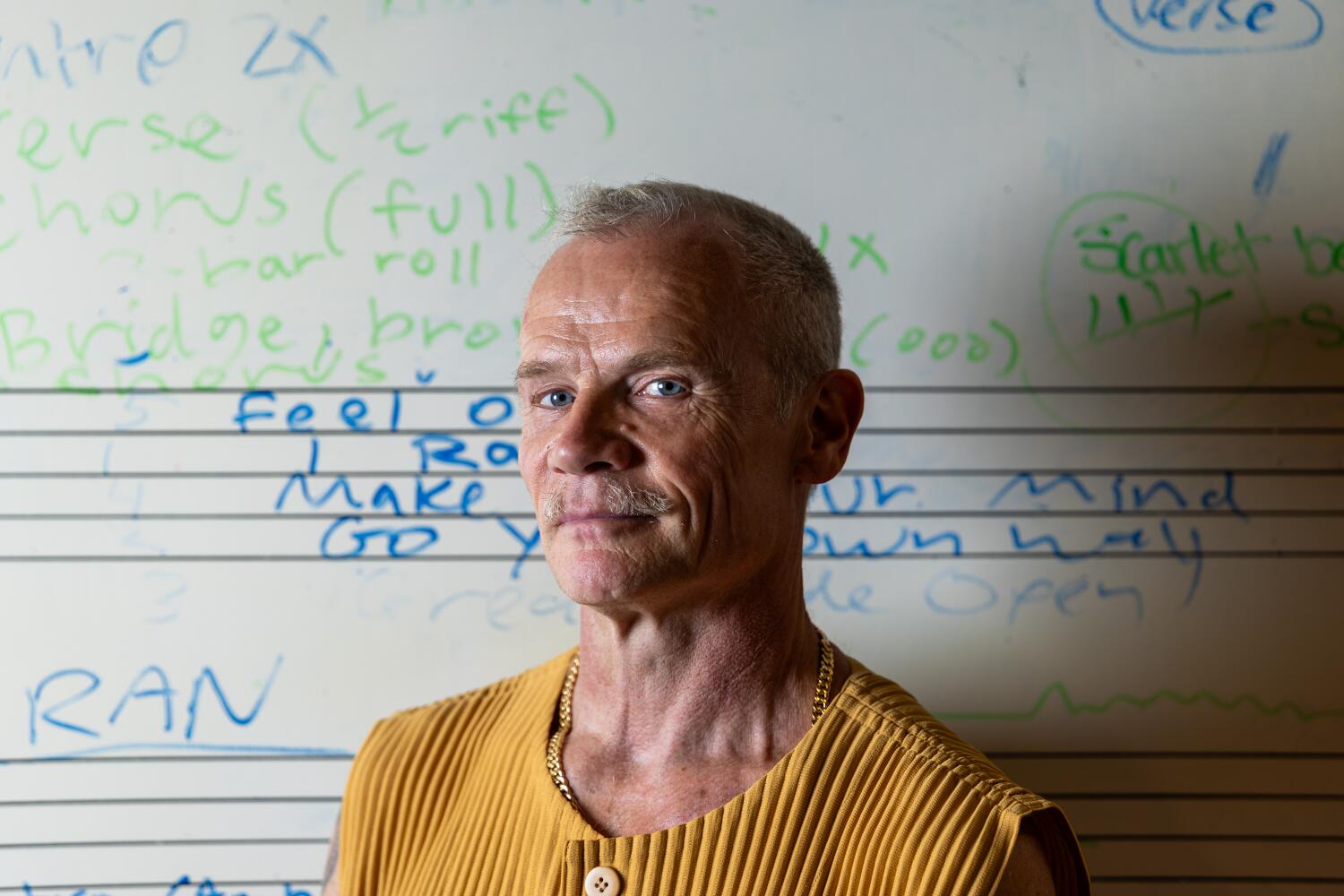
Michael Balzary, known globally as Flea, has spent four decades as the kinetic, shirtless engine of the Red Hot Chili Peppers. At 63, a time when most rock icons are content to coast on royalty checks and "greatest hits" tours, Flea is systematically dismantling his musical identity. He isn't just picking up a new instrument; he is attempting to bridge a gap between the punk-funk aggression that made him famous and the bebop discipline that haunted his childhood. This isn't a hobby. It is a calculated, grueling pivot into the world of trumpet and avant-garde jazz that challenges the very definition of a "rock star."
The transition from the electric bass to the trumpet is not a simple shift in gear. It is a fundamental rewiring of the brain and the body. On the bass, Flea relies on percussive strength and rhythmic intuition. The trumpet, however, is a cruel master of physics and breath. To understand why a multimillionaire would subject himself to the humiliation of being a "student" again, we have to look past the stage persona and into the history of a kid who grew up in a house filled with the sounds of his stepfather’s jazz quintet. Meanwhile, you can read similar events here: The MrBeast insider trading scandal is a wake-up call for the creator economy.
The Ghost of Walter Urban Jr.
Flea’s childhood was not defined by the Rolling Stones or Led Zeppelin. It was defined by the upright bass and the trumpet. His stepfather, Walter Urban Jr., was a talented jazz musician whose influence was both a gift and a shadow. Young Michael Balzary spent his formative years sitting on the floor of his Los Angeles home, watching jazz cats blow through complex changes. He wanted to be them. He didn't want to jump around in tube socks; he wanted to play like Dizzy Gillespie.
When he eventually picked up the bass to join what would become the Red Hot Chili Peppers, it was a detour. It was a wildly successful detour that changed the face of alternative rock, but it was a departure from his first love. The current shift toward jazz is not a new direction. It is a return to a path he abandoned in the early 1980s. To see the complete picture, we recommend the detailed report by Variety.
Critics often dismiss celebrity side projects as vanity exercises. In this case, the math suggests otherwise. Jazz requires an intimacy with music theory that rock and roll often ignores. You cannot fake your way through a 12-bar blues progression in a jazz context the way you can with a pentatonic rock riff. Flea has spent the last several years immersed in the Silverlake Conservatory of Music, the school he founded, not just as a benefactor, but as a pupil.
The Physics of the Pivot
The mechanical difference between these two worlds is staggering. A bass player operates through tactile feedback—fingers on strings, the vibration of wood against the chest. The trumpet is an internal instrument.
The sound starts in the diaphragm, moves through the vocal tract, and is shaped by the "embouchure"—the specific tension of the facial muscles around the lips. At 63, those muscles do not learn as quickly as they do at 16. Flea is fighting a battle against his own anatomy to achieve the tone and precision required for legitimate jazz performance.
He is moving from the "big" movements of stadium rock—the windmills, the high jumps, the heavy plucking—to the "micro" movements of valve control and breath support. In jazz, the spaces between the notes are as important as the notes themselves. For a musician who built a career on filling every available millisecond with a slap or a pop, learning to embrace silence and subtlety is a psychological hurdle.
The Silverlake Experiment
The Silverlake Conservatory of Music serves as the laboratory for this transformation. While the media focuses on the celebrity status of its founder, the facility is a rigorous academic environment. Flea has been seen there at odd hours, practicing scales that most beginners master in middle school.
There is a specific kind of bravery in being bad at something when you are already a master of something else. Most performers of Flea’s stature protect their legacy with a fortress of nostalgia. They play the hits. They stay in their lane. By stepping onto a jazz stage with a trumpet, Flea is stripping away the "Flea" persona and presenting Michael Balzary: a man who is currently a mediocre jazz player striving to be a good one.
The industry analyst sees this as a branding risk. If he fails to achieve a certain level of proficiency, it could be seen as a late-career eccentricity. However, the investigative lens reveals a deeper motivation. The Red Hot Chili Peppers have reached a plateau of commercial success where there is nowhere left to go but "more." Jazz offers something rock cannot: an infinite ceiling of complexity.
Why Jazz and Why Now
The timing of this pivot coincides with a broader shift in the music industry. As rock continues to move toward a heritage genre, jazz is experiencing a quiet, intellectual resurgence among veteran players who are tired of the four-chord loop.
Jazz is a conversation. Rock is a monologue. In the Peppers, Flea dictates the energy. In a jazz ensemble, he must listen and react. This requires a level of humility that is rarely found in the Rock and Roll Hall of Fame. He is reportedly studying the works of Louis Armstrong and Chet Baker not just for their melodies, but for their economy of expression.
This isn't about virtuosity for the sake of showing off. It’s about the "dream" mentioned in the original premise—the dream of being a part of a lineage that predates the electric guitar. It’s about being "one of the guys" in a smoke-filled room rather than the focal point of a 50,000-seat arena.
The Resistance to the Rock Star Label
Flea has often spoken about his disdain for the "rock star" label, seeing it as a cage. The trumpet is his bolt cutter. By committing to an instrument that demands daily, disciplined practice, he is forcing a separation between his public image and his private craft.
The technical requirements of the trumpet are so high that they demand a lifestyle change. You cannot play the trumpet well if you aren't healthy. You cannot play it if you aren't focused. It is a "clean" instrument. For a man who survived the excesses of the 80s and 90s L.A. scene, the discipline of jazz acts as a secondary form of sobriety. It is a grounding wire.
The Economic Reality of the Pursuit
From a business perspective, Flea’s jazz journey is an anomaly. There is no money in jazz, at least not compared to the touring revenue of a global rock band. Every hour he spends practicing the trumpet is an hour he isn't writing a chart-topping bass line.
This suggests the motivation is entirely intrinsic. He is "buying" his way into jazz not with money, but with time—the one currency a 63-year-old icon has in limited supply. He is trading the certainty of his bass legacy for the uncertainty of a new, fragile competence.
The skeptics will point to his recent performances. Is he Miles Davis? No. Is he even a top-tier session player? Not yet. But the trajectory is what matters. Most people stop learning at 30. They stop being "bad" at things. They settle into their expertise and defend it until they die. Flea is doing the opposite. He is intentionally entering a field where he is at the bottom of the hierarchy.
The Impact on the Red Hot Chili Peppers
One must wonder how this obsession affects his primary gig. Jazz training improves "ear training" and improvisational skills. We are already seeing a shift in the Peppers' live jams. They are becoming more harmonically adventurous. Flea is bringing the vocabulary of jazz—the flat fifths, the unexpected intervals—back to the bass.
The band has always been a funk-rock outfit with a punk heart. Now, it is becoming something more cerebral. The interplay between Flea and John Frusciante has always been the band's core strength, and Frusciante’s own experimental tendencies match Flea’s jazz exploration. They are no longer just a "party band." They are a veteran unit exploring the outer edges of their instruments.
Decoding the Obsession
To get to the bottom of this, one must look at Flea's social circles. He isn't hanging out with rock stars; he’s hanging out with Kamasi Washington and the new guard of L.A. jazz. These are musicians who value technical prowess and soul over image. By immersing himself in this community, Flea is seeking validation from a group that doesn't care how many records he sold in 1991.
They care about his "time." They care about his "tone."
This is the ultimate test of an artist’s ego. Can you handle being the least talented person in the room? For Flea, the answer seems to be a resounding yes. He is leaning into the discomfort. He is posting videos of his practice sessions, mistakes and all, which is a radical act of transparency in an age of filtered perfection.
The Legacy of the 63-Year-Old Student
We are witnessing a rare phenomenon in popular culture: the evolution of a legend in real-time. This isn't a "jazz-influenced" rock album. This is a man trying to change his DNA.
The "dream" Flea is chasing isn't about fame or accolades. He already has those in excess. The dream is the feeling of a perfect C-sharp. It's the feeling of finally understanding a Coltrane solo that baffled him as a teenager. It's the pursuit of a language that he has heard his whole life but couldn't quite speak until now.
If you want to see the future of Flea, don't look at the bass he's holding on a billboard. Look at the trumpet case in the back of his car. That is where the real work is happening. That is where the rock star dies and the musician is born.
Watch the hands. The callouses on his fingers from the bass are thick and old, but the muscles in his face are new, aching from the effort of a new language. He is an apprentice again, and in that apprenticeship, he has found a way to stay young that no plastic surgeon or fitness coach could ever provide.
Ask him about the next tour, and he’ll talk about the music. Ask him about the trumpet, and he’ll talk about the soul.
Would you like me to analyze the specific jazz theory concepts Flea is incorporating into his recent bass solos to see how his trumpet studies are practically changing his rock performances?