The air in Damascus doesn't just sit; it lingers with the scent of jasmine and exhaust, a thick, ancient humidity that masks the smell of impending fire. On a Tuesday that felt like any other, the silence was not a lack of sound, but a holding of breath. Then came the whistle. A sharp, mechanical shriek that tore through the afternoon haze, followed by the kind of bone-shaking roar that changes the geography of a neighborhood in a heartbeat.
When the dust settled over the Mezzeh district, the geopolitical chessboard of the Middle East hadn't just lost a piece. It had lost a master of the game.
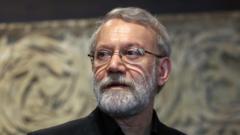
Israel’s announcement was clinical. A targeted strike. A successful elimination. Ali Larijani, a man whose name moved through the corridors of Tehran like a draft under a locked door, was dead. To the world reading the headlines, it was a data point in a long-running shadow war. But for those who understand the intricate, bloody machinery of regional influence, this wasn't just another body. It was the severing of a vital nerve.
The Architect of the Unseen
Larijani was never a man of the spotlight. He didn't crave the roaring crowds or the televised bluster of the front-line commanders. He was a creature of the twilight, an elite security chief who operated in the spaces between diplomacy and destruction. If you want to understand who he was, don't look at his official titles. Look at the maps.
Consider the "Land Bridge"—that invisible vein of influence stretching from the Iranian border, through the jagged mountains of Iraq, across the Syrian plains, and down to the Mediterranean coast. Larijani was one of its primary mechanics. He ensured the oil flowed where it needed to, that the munitions reached the right hands in the dead of night, and that the various militias acting as Tehran’s proxies remained a cohesive, if chaotic, force.
He was the person who turned abstract foreign policy into concrete reality on the ground.
Imagine a middle-aged shopkeeper in Damascus, perhaps someone we will call Omar. For Omar, the "security situation" isn't a headline. It’s the way the checkpoints get tighter when a high-ranking official is in town. It’s the low hum of a drone that stays just out of sight but never out of mind. When Larijani moved, the very atmosphere changed. His presence was a signal that the stakes were rising, that the shadow war was about to step into the light.
The Precision of the Blade
The strike in Mezzeh was not a random act of violence. It was a surgical statement. In the world of intelligence, killing a man like Larijani is less about the explosion and more about the message. It tells the survivors: We see you. We know where you sleep. We know who you are meeting with before you even sit down at the table.
Israel’s intelligence apparatus, often personified by the Mossad and the IDF’s Unit 8200, operates on a level of granular detail that feels almost supernatural. To hit a specific vehicle or a specific room in a bustling capital city requires a chain of information that begins months, sometimes years, in advance. It involves tracking bank accounts, intercepting encrypted whispers, and perhaps most crucially, the betrayal of those within the inner circle.
The vacuum left by such a strike is immediate and cold.
When a commander dies in battle, he is a martyr. When a security chief is vaporized in an airstrike while moving between "safe" houses, he becomes a liability. The trust that holds these clandestine networks together begins to fray. Every subordinate looks at his peer and wonders who talked. Every phone call becomes a potential death sentence.
The Invisible Stakes
Why does this matter to someone sitting thousands of miles away? Because the Middle East is not a vacuum. It is a pressure cooker with a faulty valve.
Larijani represented a specific brand of Iranian strategy: the long game. By building a perimeter of influence far from its own borders, Iran seeks to ensure that any conflict happens on someone else's soil. Lebanon. Syria. Yemen. Larijani was the man who kept the lights on in those outposts.
When you remove the architect, the building doesn't always fall, but the blueprints become harder to read. The immediate fear following his death isn't just about retaliation; it's about miscalculation. Without a seasoned hand at the wheel, the local militias he managed might become more erratic. They might strike out without orders, or they might crumble, creating a power void that even darker forces are eager to fill.
The Human Cost of High Strategy
We often talk about these events in terms of "strategic assets" and "kinetic solutions." It’s a clean way to describe a messy reality. But beneath the geopolitical jargon, there is the raw, terrifying reality of modern warfare.
Mezzeh is an upscale neighborhood. It is home to embassies, schools, and families. When the missiles struck, they didn't just hit a "target." They shattered the windows of ordinary homes. They sent children screaming under beds. They reminded everyone within a five-mile radius that safety is an illusion maintained by the grace of those who hold the triggers.
The irony of Larijani’s life is that he spent it building walls of influence to protect his ideology, only to find that those walls offered no protection from a sky that had turned against him. He was a man of immense power who, in his final seconds, was as vulnerable as the civilians living in the shadow of his safe houses.
The Echoes in Tehran
In the halls of power in Tehran, the mood is likely one of grim recalculation. Larijani was part of a vanishing breed of old-guard security officials who bridged the gap between the revolutionary fervor of the past and the cold pragmatism of the present. Replacing him isn't as simple as promoted the next man in line. It requires finding someone with the same web of personal loyalties and the same intuitive grasp of a fractured region.
The "Eye for an Eye" doctrine is a powerful motivator in this part of the world. History suggests that a strike of this magnitude will not go unanswered. But the response is rarely a mirror image. It might be a cyber-attack on a power grid, a drone swarm launched from a distant desert, or a quiet assassination in a European capital. The cycle of violence is not a circle; it is a spiral.
The Weight of the Silence
As the sun sets over Damascus tonight, the smoke has cleared, but the tension is heavier than ever. The rubble in Mezzeh will be cleared. The official statements will be archived. New names will appear on the organizational charts of the Iranian security forces.
But something fundamental has shifted.
The killing of Ali Larijani is a reminder that in the modern age, there are no shadows deep enough to hide in. The world is watched by unblinking eyes in the stratosphere and felt by sensors buried in the earth. We live in an era where the distance between a decision in an underground bunker and a fireball on a city street is measured in seconds.
Larijani lived by the secret and died by the silent. He was a man who understood better than most that in the game of nations, the most important players are the ones you never see—until the moment they decide you have stayed on the board for far too long.
The jasmine still smells sweet in Damascus, but tonight, it is competing with the metallic tang of cooling iron and the heavy, expectant silence of a region waiting for the next whistle in the dark.