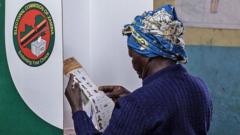
The room in Lusaka is usually hot. Not just the dry, searing heat of the Zambian sun, but the heavy, pressurized air of a windowless office where history is supposed to be made. In these rooms, women sit across from men who hold the keys to the kingdom—party nomination forms, endorsements, and the structural power to turn a community leader into a Member of Parliament.
They come with resumes. They come with a lifetime of service in their wards. They come with the hope that their merit will finally outweigh the traditional hurdles of gatekeeping. But then, the conversation shifts. The air becomes thicker. The official doesn’t ask about her policy on clean water or her plan for local schools. He leans back, eyes scanning her in a way that has nothing to do with governance.
"What are you willing to do for this seat?"
It isn’t a question about hard work. It is a demand for her body.
Recently, Brenda Tambatamba, the Permanent Secretary in the Ministry of Labour and Social Security, voiced a truth that has been whispered in the shadows of Zambian political corridors for decades. She revealed that aspiring female politicians are being systematically targeted for sexual favors in exchange for adoptions—the official process of being selected as a party candidate.
This isn't just a "women's issue." It is a structural rot that threatens the very foundation of representation.
The Invisible Toll
Imagine a woman named Chanda. This is a hypothetical composite of the stories shared in confidence across the region. Chanda has spent ten years running a successful cooperative for farmers. She is articulate, beloved by her neighbors, and knows every pothole in her district by name. She decides to run for office because she is tired of waiting for change.
She enters the party headquarters. She has the grassroots support. She has the vision. But she encounters the "gatekeeper."
In the quiet of an evening meeting, the gatekeeper makes it clear: her political future is contingent on a hotel room key. If she refuses, her nomination papers might "go missing." Her reputation might be shredded by a coordinated whisper campaign. If she stays, she is violated. If she leaves, the community loses a leader who actually cared.
The tragedy isn't just the individual trauma, though that is profound. The tragedy is the silence that follows. When sexual harassment is the entry fee for public service, the "table" where decisions are made remains a boys' club, not by lack of interest from women, but by a calculated policy of exclusion via exploitation.
The Statistics of Silence
The numbers tell a story of stagnation. Despite various international protocols and national gender policies, the percentage of women in the Zambian National Assembly remains stubbornly low. We often blame "culture" or "lack of education." We point to the high cost of campaigning. While those are real barriers, they are often used as convenient distractions from the predatory behavior happening behind closed doors.
When a woman is asked for sex in exchange for a nomination, the system is telling her that her intellect is worthless. It tells her that her decades of experience are secondary to her utility as an object.
According to reports from gender activists and officials like Tambatamba, this behavior isn't isolated to one party or one region. It is a cross-cutting plague. It thrives because there is no independent, safe mechanism for reporting these advances without committing political suicide. To speak out is to be labeled "difficult" or "promiscuous"—the ultimate irony.
The Myth of the Level Playing Field
We like to talk about democracy as a meritocracy. We tell young girls they can be anything they want to be. But we rarely mention the "pink tax" of political entry.
For a man, the cost of a nomination is usually financial or social. He might need to buy a certain number of posters or have the right connections. For a woman, the cost is often her dignity. This creates a filtered leadership. The women who make it through are either those who had the extraordinary luck to find a mentor with integrity, or those who have had to endure unimaginable pressures just to keep their names on the ballot.
Consider the psychological warfare involved. A woman who refuses these advances is often told she "doesn't want it bad enough." She is told she isn't "loyal to the party." The language of commitment is twisted to justify abuse.
Breaking the Iron Grip
How do we fix a system where the judges are often the perpetrators?
Tambatamba’s public acknowledgement is a start, but it isn't the finish line. Awareness is a flickering candle in a dark cavern; it reveals the monsters, but it doesn't chase them out. The solution requires a radical shift in how political parties are governed.
Internal party democracy cannot remain an opaque process. When the selection of candidates happens in the shadows, predators thrive. We need digitized, transparent nomination processes where the criteria are public and the results are audited by independent bodies.
More importantly, there must be a zero-tolerance policy that actually carries weight. In many cases, these officials are well-known. Their behavior is an "open secret." Everyone knows, yet everyone looks away because the perpetrator "delivers votes."
We have to decide what we value more: a few extra votes in a swing district, or the integrity of our daughters' futures.
The Ripple Effect
When women are barred from leadership through sexual blackmail, the entire nation pays the price.
Studies consistently show that female legislators are more likely to prioritize health, education, and social welfare. They bring perspectives on the economy that are grounded in the reality of the household and the marketplace. When you sexually harass a woman out of a race, you aren't just hurting her. You are denying a village a clinic. You are denying a school new desks. You are stalling the progress of an entire nation.
This is the invisible cost of the "quiet" corruption. It doesn't look like a bribe in a briefcase. It looks like a woman walking out of an office, shaking, deciding that her dream of serving her country isn't worth the soul-crushing price being demanded of her.
She goes back to her farm. She goes back to her shop. And the seat at the table remains occupied by someone whose primary qualification was his ability to gatekeep.
The sun sets over Lusaka, and another election cycle begins to churn. The posters will go up. The rallies will be loud. There will be music and dancing and promises of a new dawn. But in the quiet offices, the question is still being asked.
The real test of our democracy isn't whether we can hold an election. It’s whether a woman can seek to lead her people without being hunted by those who claim to represent them. Until the price of the seat is merit and merit alone, the table is broken.
The door is open, but the hallway is full of shadows. It is time we turned on the lights.