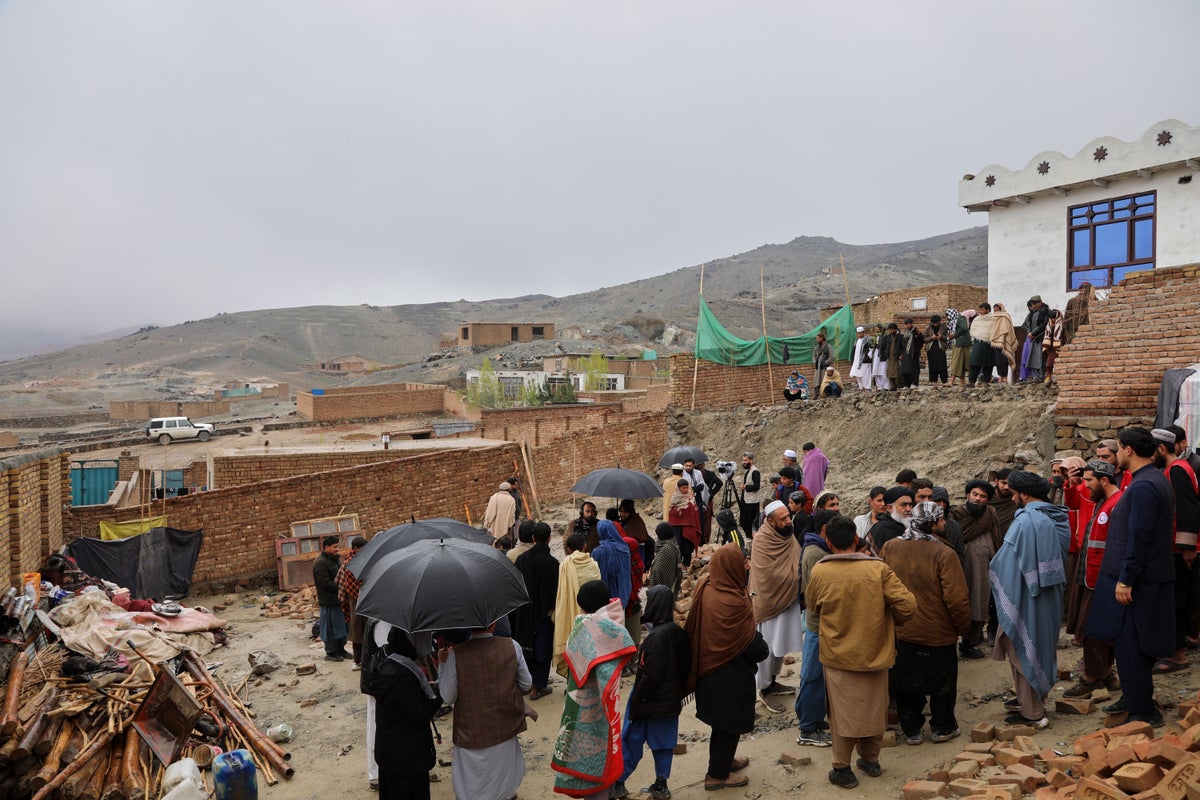
The headlines are always the same. They are predictable, tear-jerking, and fundamentally useless. A family of eight, recently returned from Iran, perishes in an Afghan earthquake. The media frames this as a singular, tragic irony—a cruel twist of fate for those seeking safety. This narrative is a comfortable lie. It suggests that the tragedy lies in the timing or the specific bad luck of the victims.
The truth is much colder. These deaths aren't a "twist of fate." They are the mathematical certainty of a failed global repatriation strategy that prioritizes political optics over structural engineering. We keep weeping over the rubble while ignoring the fact that we essentially invited these families back into a geographic deathtrap.
The Repatriation Industrial Complex
Western news cycles love a homecoming story. There is a "lazy consensus" among NGOs and international bodies that returning refugees to their "homeland" is the gold standard of success. It looks good on a spreadsheet. It signals stability. But in the context of Afghanistan, "home" is a high-magnitude seismic zone with zero building code enforcement.
When we celebrate or pressure the return of displaced populations to regions like Herat or the Hindu Kush, we are performing a logistical miracle and a moral failure. We are moving people from the relative structural safety of Iranian urban centers back into mud-brick kilns.
I’ve sat in rooms where "returnee integration" is discussed as a victory. Nobody mentions the Peak Ground Acceleration (PGA). Nobody looks at the soil liquefaction maps. We treat human beings like chess pieces, moving them back onto a board that is literally cracking in half. If you send a family back to a village where the homes are made of unreinforced masonry, you haven't "repatriated" them. You've just changed the cause of death on their future certificate from "malnutrition" to "blunt force trauma."
The Myth of Natural Disasters
There is no such thing as a natural disaster. There are only natural phenomena—tectonic shifts, atmospheric pressure changes, hydrologic cycles—and human-made disasters. An earthquake of magnitude 6.3 in California results in broken glass and an insurance claim. In Afghanistan, it results in mass graves.
The "disaster" isn't the movement of the Earth. It’s the persistence of unreinforced earth architecture in a modern age. We continue to fund "emergency aid" which is, by definition, reactive. We wait for the bodies to be buried before we ship the tents. This is the definition of insanity.
- The Resource Paradox: We spend billions on temporary food aid but pennies on seismic retrofitting for rural housing.
- The Knowledge Gap: We assume local "traditional" building methods are time-tested. They aren't. They are poverty-tested. They exist because there is no other choice, not because they are safe.
- The Accountability Vacuum: When eight people die in a collapsed house, we blame the earthquake. We should be blaming the agencies that incentivized their return without verifying the structural integrity of their destination.
Imagine a scenario where a tech company releases a car that explodes if it hits a pothole. We wouldn't blame the pothole. We would sue the company into oblivion. Yet, in the humanitarian sector, we continue to funnel people into "exploding" infrastructure and call the result an act of God.
Why Your Donations Are Part of the Problem
The public loves "instant impact." They want to see blankets, bottled water, and blue-vested workers digging through ruins. This is "disaster porn." It satisfies the ego of the donor while doing absolutely nothing to change the underlying physics of the next catastrophe.
If we actually cared about saving lives, we would stop funding the "recovery" and start funding the "prevention." But prevention is boring. You can't take a heart-wrenching photo of a reinforced concrete pillar or a properly tied roof beam.
We need to stop asking "How can we help the survivors?" and start asking "Why did the house fall down in the first place?"
The answer is always the same: we have accepted a lower standard of existence for certain geographies. We have decided that for an Afghan refugee, a mud hut is "good enough." Until we stop treating seismic safety as a luxury for the West, these "tragedies" will continue to be scheduled events.
The Brutal Reality of Iranian Expulsion
Let’s talk about the "returning" part of the narrative. The media portrays these families as "returning home," as if they decided to pack up a U-Haul and head back for the scenery. Most of the time, they are being squeezed out by Iranian policy or fleeing a lack of legal status.
When Iran tightens the screws on its refugee population, it is effectively a death sentence. They aren't just crossing a border; they are crossing from a country with (admittedly flawed) building codes into a country where the buildings are essentially sandcastles.
The international community stays silent because it's politically convenient. If refugees stay in Iran, they are a "problem" for the West to solve. If they go back to Afghanistan and die in an earthquake, they are a "statistic" that can be blamed on nature.
The Physics of Poverty
Let’s look at the math. In a typical Afghan village, the walls are made of sun-dried mud bricks (cob or adobe). These structures have immense thermal mass—great for the heat—but zero tensile strength. During a tremor, the heavy roof (often weighted down with more mud for insulation) becomes a hammer. The walls crumble, and the roof drops.
$F = ma$
The force ($F$) of a collapsing roof is the product of its mass ($m$) and the acceleration ($a$) of gravity. When you have a roof weighing several tons held up by nothing but dried dirt, the result is instantaneous. There is no "void space" for survivors. There is only burial.
To ignore this physics while facilitating the return of thousands of people to these exact structures is negligence. It’s not "humanitarian aid." It’s a logistics exercise in fatality management.
Dismantling the Victim Narrative
The family of eight that died wasn't "unlucky." They were the victims of a global system that values the movement of people over the safety of people. We focus on the border crossing because it’s a political metric. We ignore the bedroom because it’s a structural one.
If you want to disrupt this cycle, stop looking at the "human interest" angle and start looking at the civil engineering angle.
- Demand Seismic Standards in Aid: No NGO should receive funding for "reintegration" unless they can prove the housing they are placing people in can survive a 6.0 tremor.
- Pivot to Materials, Not Just Food: The cost of a few bags of cement and some rebar is negligible compared to the cost of a multi-year food program.
- End the Sentimentality: Stop calling it "returning home." Call it what it is: moving people from a zone of relative safety into a high-risk debris field.
We don't need more "thoughts and prayers." We need more shear walls. We don't need more "solidarity." We need more lateral load-bearing capacity.
The earthquake is a constant. Our willingness to settle for "good enough" architecture for the world’s most vulnerable is the variable. Until that changes, the news will keep printing the same story, the same numbers, and the same fake shocks.
Stop mourning the "unfortunate" timing and start indicting the deliberate indifference of the system that put them there. The earth didn't kill that family. The blueprints did.