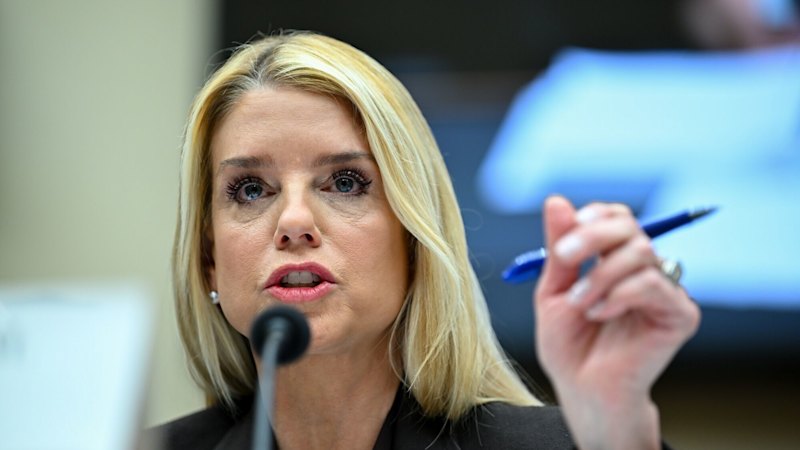
The standoff over the most toxic archive in American history reached a breaking point on Wednesday. In a move that fractured party lines and stunned the Department of Justice, the House Oversight Committee voted 24-19 to subpoena Attorney General Pam Bondi. This is not a request for a friendly chat. It is a formal demand for a recorded, under-oath deposition regarding what lawmakers are now calling a systematic "cover-up" of the Jeffrey Epstein investigative files.
For years, the promise of full transparency regarding Epstein’s global sex-trafficking network has been used as a political cudgel. Now, that cudgel is being swung by Bondi’s own allies. Five Republicans joined every Democrat on the committee to compel her testimony, signaling a collapse in the unified front the administration had attempted to maintain around the disgraced financier’s secrets.
The Breach of Trust
The primary friction point is the Epstein Transparency Act, a piece of legislation passed in November with near-unanimous support. It was supposed to be the end of the mystery. The law mandated the release of all DOJ files related to Epstein, yet the reality has been a chaotic, drip-fed rollout that satisfied no one.
When the DOJ finally released a tranche of documents in late January, it wasn't the "bombshell" the public expected. Instead, the department dumped three million pages of largely recycled material while simultaneously announcing it would withhold another 2.5 million documents. The justification? That the remaining files were either duplicative or protected under "ongoing investigations."
Representative Nancy Mace, the South Carolina Republican who introduced the subpoena motion, isn't buying the bureaucracy. "The record is clear: they have not released the files," Mace stated. She and her colleagues are pointing to a massive gap in the record: missing flight logs, absent audio recordings, and vanished video evidence that was supposed to be part of the FBI's original haul from Epstein’s properties.
Surveillance and Strategy
The tension between the DOJ and Congress turned personal in February. During a separate hearing before the House Judiciary Committee, a photographer captured an image of a document Bondi was holding. It was titled "Jayapal Pramila Search History."
The revelation was explosive. It suggested that the DOJ was covertly monitoring the search histories of Members of Congress who were using secure terminals to review the unredacted Epstein files. Lawmakers found themselves in a surveillance loop: as they looked for the truth about Epstein, the Department of Justice was looking at them.
This environment of mutual suspicion has paralyzed the oversight process. Bondi has defended the department’s actions, claiming that the sheer volume of material—millions of pages requiring meticulous redaction to protect victims—makes a faster release impossible. However, the discovery that victim names were left unredacted in some public files while the names of powerful associates remained scrubbed has decimated her credibility with the committee.
The Myth of the Client List
A central component of this drama is the "client list"—a document that has taken on almost mythical status in the American zeitgeist. In February 2025, Bondi herself fueled this fire, telling Fox News that an Epstein client list was "sitting on my desk right now."
By July, the DOJ issued an unsigned memorandum walking that back, claiming no such incriminating list exists. This reversal created a vacuum of trust. If the Attorney General of the United States publicly claims to possess the "Holy Grail" of the investigation and then months later denies its existence, only two conclusions remain: she was grandstanding for the cameras, or the document has been suppressed.
The subpoena aims to resolve this discrepancy. Unlike previous hearings where Bondi could pivot to talking points about the stock market or the administration’s successes, a deposition is a different animal. It is a granular, forensic interrogation. Lawmakers want to know exactly what was on her desk in February 2025 and why it hasn't seen the light of day.
A Bipartisan Mutiny
The political geography of this vote is perhaps the most telling aspect of the crisis. The inclusion of GOP Reps. Lauren Boebert, Tim Burchett, Michael Cloud, and Scott Perry in the "yes" column proves that the Epstein issue has transcended traditional partisanship.
These are not "Never Trump" Republicans; these are stalwarts of the party's right wing who feel the DOJ has prioritized protecting the "Deep State" over delivering justice to survivors. They are joined by Democrats like Robert Garcia, who has accused Bondi of "orchestrating a cover-up."
The DOJ’s strategy of offering private, one-on-one briefings to lawmakers—a tactic used to avoid public testimony—was flatly rejected by Mace. "That's nice," she remarked with visible sarcasm, noting that private meetings aren't under oath and don't produce a public record.
The Logistics of Silence
The Department of Justice currently controls the narrative through physical bottlenecks. Members of Congress must travel to a specific DOJ annex, use one of only four secure computers, and work without the assistance of their staff. At the current pace of review, it would take a single lawmaker over seven years to read through the three million pages already released.
By demanding a deposition, the Oversight Committee is attempting to bypass this digital fortress. They aren't looking to read every page; they are looking to question the person who decided which pages to hide.
The immediate future of the Bondi subpoena likely involves a protracted legal battle over executive privilege. But the optics are already settled. For the first time in this administration, the house is divided against itself, and the cracks are forming over a decade-old ghost that refuses to stay buried.
The survivors of Jeffrey Epstein, many of whom sat directly behind Bondi during her last appearance on the Hill, are no longer content with "Phase 1" binders and redactions. They are waiting for the deposition. If Bondi fails to produce the "truckload" of evidence she once promised, the political cost may be higher than any administration is willing to pay.
The deposition will be videotaped. It will be transcribed. And for Pam Bondi, it will be the most dangerous room in Washington.