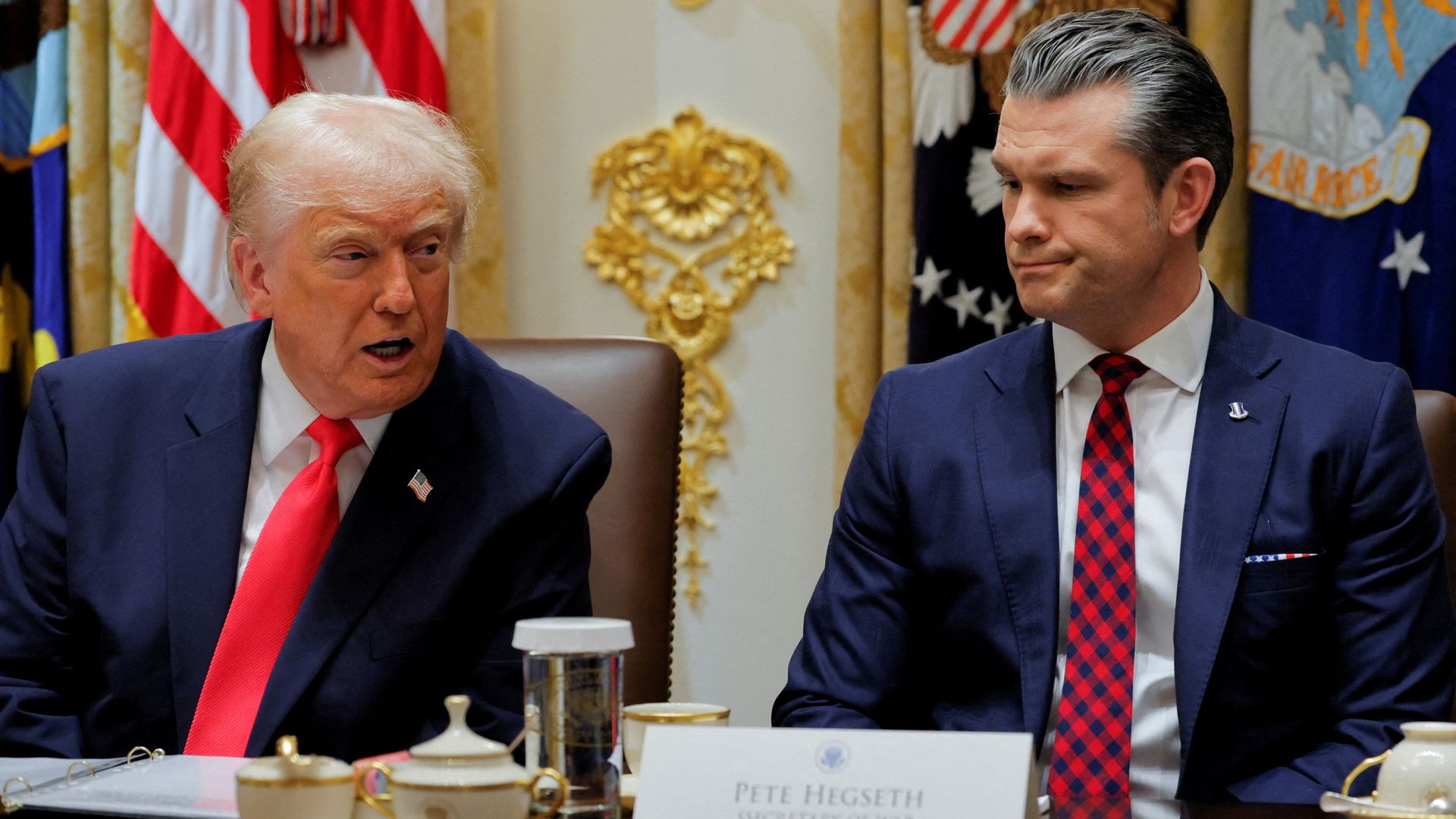
"As long as we need to."
It is the most expensive sentence in the English language. When the US Defence Secretary utters those words, he isn’t describing a strategy. He is describing a blank check written in the blood of taxpayers and the credibility of a superpower. It sounds like resolve. It feels like moral clarity. In reality, it is the white flag of intellectual surrender.
The competitor narrative suggests that "staying the course" is the ultimate display of strength. They frame the conflict as a test of stamina. They are wrong. Stamina without a defined exit is just a slow-motion suicide pact. If you cannot define "need," you cannot define victory. And if you cannot define victory, you are not fighting a war; you are managing a catastrophe.
The Sunk Cost Trap as National Policy
Military leadership often falls into the same psychological pit as a failing CEO. They’ve already spent billions. They’ve already lost lives. To stop now would be to admit those losses were in vain. So, they double down.
In the private sector, we call this the Sunk Cost Fallacy. In the Pentagon, they call it "strategic patience."
I have watched agencies burn through decade-long budgets chasing "stability" in regions that have not seen a stable day since the fall of the Ottoman Empire. The "as long as it takes" mantra assumes that time is a neutral variable. It isn't. Time is a predator. Every day a conflict drags on, the cost-to-benefit ratio doesn't just shift—it evaporates.
The $2 trillion spent in Afghanistan wasn’t an investment in democracy. It was a massive transfer of wealth from the US Treasury to defense contractors, all while the underlying "need" remained as murky on Day 7,000 as it was on Day 1. When the Defence Secretary says we will stay as long as needed, he is signaling to every adversary that we are willing to bleed out slowly rather than make a hard, unpopular decision.
The Myth of the Infinite Arsenal
The "as long as we need to" crowd lives in a fantasy world where American industrial capacity is still at its 1944 peak. It isn't.
We are currently witnessing the cannibalization of our own readiness to support proxy theaters. You cannot fight a high-intensity conflict "forever" when your lead times for critical munitions like 155mm shells or Javelin missiles are measured in years, not weeks.
- The Production Reality: We are firing missiles faster than we can forge them.
- The Fiscal Reality: Interest payments on the national debt now rival the defense budget itself.
- The Human Reality: Recruitment is cratering because "forever" is a terrible sales pitch to a twenty-year-old.
Logic dictates that a "forever" commitment requires a "forever" economy. We don't have one. We have a brittle supply chain and a debt-to-GDP ratio that makes the 1940s look like a period of fiscal restraint. To promise a long-term fight without a radical overhaul of the domestic industrial base is more than dishonest—it is dangerous. It invites a "Suez Moment" where the US discovers, too late, that it can no longer afford its own ambitions.
Why "Stability" is a Grifter's Goal
Ask a hawk what we are fighting for, and they will eventually say "stability."
Stability is the "synergy" of the geopolitical world. It’s a meaningless buzzword used to justify intervention. Real-world dynamics are fluid. Trying to freeze a region into a specific "stable" state is like trying to hold back the tide with a plastic bucket.
The smarter move? Adaptive disengagement.
Instead of promising to stay forever, we should be promising to leave the moment our specific, narrow interests are met. This creates urgency for our allies. When you tell a partner "we are here for as long as you need us," you remove any incentive for them to stand on their own. You become the perpetual crutch. You aren't "fostering" (to use a banned term of the weak-minded) independence; you are subsidizing dependency.
The Brutal Math of Attrition
Let’s look at the actual mechanics of long-term conflict. Modern war is a game of attrition, not just of men, but of technology and economic will.
Imagine a scenario where a superpower commits to a ten-year defense of a secondary theater.
- Year 1-3: Public support is high. Equipment is plentiful.
- Year 4-6: Inflation spikes. Domestic infrastructure crumbles. The "need" becomes a political football.
- Year 7-10: The adversary, who is fighting on their own doorstep, realizes they only have to outlast the American voter’s attention span.
The adversary doesn't have to "win" in a traditional sense. They just have to not lose until the US Secretary of Defence is replaced by someone whose mandate is to cut costs. By promising to stay "as long as we need to," we give the enemy the exact playbook they need to defeat us: just wait.
Stop Asking "How Long?" and Start Asking "How Much?"
The public and the press are asking the wrong question. They ask, "Will we stay?"
The real question is: "At what specific price point does this interest become a liability?"
Every strategic objective has a price tag. If the objective is "preventing a regional hegemon from seizing X territory," what is that worth? $100 billion? $500 billion? 3% of our total air power?
If you don't have a number, you don't have a plan. You have a wish.
The Defence Secretary’s rhetoric avoids the number because the number is terrifying. It’s easier to speak in platitudes about "values" and "resolve" than to admit that we are trading our long-term ability to defend the Pacific for a short-term stalemate in a peripheral zone.
The Counter-Intuitive Truth: Exit is an Asset
The most powerful move a superpower can make is not staying; it is leaving.
Strategic ambiguity regarding our departure dates used to be a tool. Now, we use strategic certainty—"we're staying"—which removes all leverage. When you announce you aren't going anywhere, you lose the ability to pressure your allies and you lose the element of surprise with your enemies.
We need to stop fetishizing "commitment." Commitment is for marriages and gym memberships. Foreign policy is about cold, hard, transactional utility. If the utility of a conflict has peaked, the only logical move is to liquidate the position.
The "lazy consensus" says that leaving is a sign of weakness (the "Saigon moment" fear). I argue that staying in a failing or stagnant enterprise is the ultimate sign of weakness. It shows a lack of institutional courage to admit a mistake. It shows a leadership class that is more afraid of a bad news cycle than a depleted national treasury.
The Actionable Pivot
We must replace "as long as we need to" with "as long as the ROI justifies the risk."
This requires:
- Hard Caps: Setting a literal dollar and equipment ceiling on interventions.
- Trigger-Based Exits: Defining exactly what conditions—regardless of time—will result in an immediate withdrawal of support.
- Industrial Honesty: Admitting that we cannot be the "arsenal of democracy" while our factories are ghost towns.
Stop buying the lie that "resolve" is a substitute for math. It isn't. The history of the 21st century is already littered with the wreckage of "as long as it takes." It’s time to stop acting like time is on our side. It never was.
The Secretary of Defence is not promising a victory. He is promising a funeral for American treasury and influence, draped in the flag of "commitment."
Don't applaud the "resolve." Fear the incompetence.