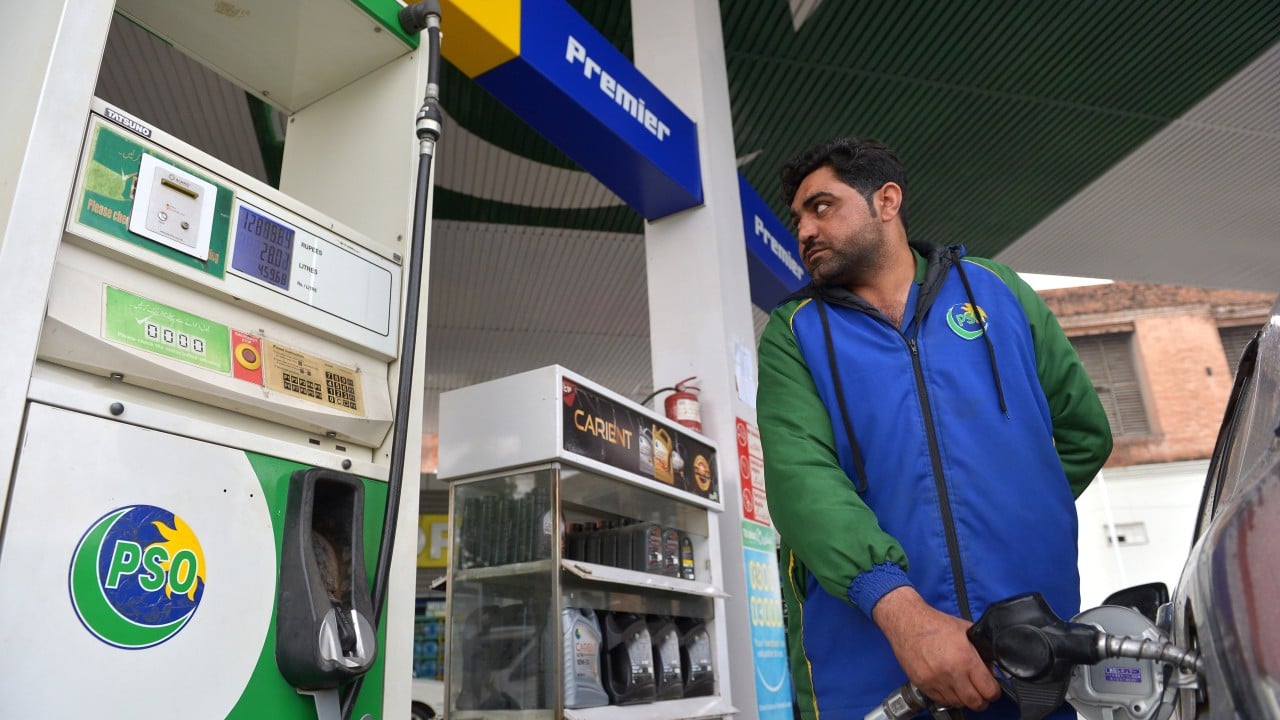
The metallic click of a fuel nozzle is a sound usually associated with progress. It is the sound of a commute starting, a delivery being made, or a family heading to dinner. But in the streets of Karachi and Lahore, that sound has become a trigger for a specific kind of internal dread. When the pump hits the click and the digital display flashes the final price, the math doesn't just represent liters of petrol. It represents the calories missing from a dinner table or the school fees that will now be paid late.
Pakistan is currently navigating a fiscal storm where the price of fuel has surged by as much as 54%. For the global observer, this is a line item in an IMF report. For the person behind the handlebars of a 70cc motorcycle, it is a tectonic shift in the geography of their daily life.
The Ghost in the Engine
Consider a hypothetical courier named Tariq. Tariq doesn’t study macroeconomics, but he feels the weight of the global oil market every time he twists his throttle. A year ago, Tariq’s daily earnings were enough to cover his fuel, a modest lunch, and a small contribution to his daughter’s savings jar. Today, that jar is empty.
The 54% spike isn't just a number. It is a predator.
When the government adjusts prices to meet international obligations and stabilize a teetering economy, the immediate result is a contraction of the soul. The "invisible stakes" here aren't found in the halls of parliament; they are found in the silent calculations made at 11:00 PM in millions of households. People are measuring their lives in kilometers. Can we afford to visit the grandmother on the other side of the city? Is the job interview ten miles away worth the cost of the commute if the salary isn't guaranteed?
This is the psychological tax of inflation. It turns every movement into a financial risk.
The Math of a Breaking Point
To understand how we got here, we have to look at the cold, hard mechanics of the Pakistani economy. The country has long relied on subsidies to keep the public peace, artificially lowering the cost of energy. But subsidies are not magic; they are debt. When the debt becomes a mountain that threatens to bury the national credit rating, the subsidies must go.
The removal of these cushions, combined with a weakening rupee and fluctuating global Brent crude prices, created a perfect, devastating sequence of events.
- The Rupee’s Slide: As the local currency loses value against the US dollar, every barrel of oil imported becomes exponentially more expensive.
- The IMF Mandate: International lenders require "cost recovery," meaning the government can no longer pay for a portion of your petrol. You pay the full, painful market price.
- The Tax Layer: To bridge the budget deficit, the government applies a petroleum development levy, adding another layer of cost to every liter.
When these three factors collide, the result is a 54% increase that hits the poorest the hardest. Richer households might switch to a smaller car or cut back on air conditioning. For the lower-middle class, there is nothing left to cut but the essentials.
The Ripple That Becomes a Tsunami
The most dangerous misconception about fuel prices is that they only affect people with vehicles. This is a fallacy. In a modern economy, fuel is the blood that carries nutrients to every limb of the social body.
When it costs more to put diesel in a truck, it costs more to move tomatoes from a farm in Sindh to a market in Islamabad. When the tractor's fuel price jumps, the cost of tilling the land for wheat rises. Consequently, the price of a loaf of bread is tethered directly to the price at the pump.
The mother who walks to the market finds that the price of milk has risen, even though she doesn't own a car. She is paying for the fuel she never used. This is the "hidden cost" that standard news reports often skip over. They talk about the "energy sector" and "fiscal consolidation," but they rarely talk about the price of an onion.
A Lived Reality of Scarcity
I remember standing at a refueling station during one of these price hikes. The atmosphere was not one of anger, but of a heavy, resigned silence. Men stood by their bikes, watching the numbers spin with a look of profound betrayal. There is a specific kind of exhaustion that comes from working harder every year only to find yourself further behind.
We often think of economic stability as a high-level concept involving central banks and gold reserves. It isn't. Stability is the ability to predict what your life will look like next week. When fuel prices jump by half in a matter of months, that predictability vanishes. You cannot plan a business. You cannot budget for a wedding. You cannot even be sure of the cost of your commute tomorrow morning.
The logic used by the state is that these "bitter pills" are necessary to prevent a total economic collapse—to keep the country from defaulting like Sri Lanka did. It is a choice between a slow, painful squeeze and a sudden, catastrophic fall. But for the person living through the squeeze, the distinction feels academic.
The Geometry of the New Normal
Society is re-arranging itself around this new reality. Carpooling, once a casual suggestion, is now a survival strategy. The "work from home" movement, which began as a health precaution during the pandemic, has returned as a financial necessity.
But there is a limit to how much a population can adapt.
The energy crisis in Pakistan is a window into the future of many developing nations caught between the hammer of climate change and the anvil of global debt. As the world shifts away from fossil fuels, the transition period is proving to be a brutal era for those without a safety net. The infrastructure isn't there for mass electric vehicle adoption, and the public transit systems are often overstretched or nonexistent.
So, people wait. They wait in lines for cheaper fuel before a price hike takes effect at midnight. They wait for a miracle in the exchange rate. They wait for a government that can balance the books without breaking the backs of the citizens.
The tragedy of the 54% rise is not just in the money lost. It is in the dreams deferred. It is the small shopkeeper who decides not to expand his inventory because the transport costs are too high. It is the student who misses a semester because the van fare doubled.
Economic data points are just people with the humanity stripped away. If you add the humanity back in, a fuel price hike looks less like a graph and more like a ghost—a phantom that follows you into every grocery store, every classroom, and every doctor's office, whispering that your money is no longer enough.
The lights in the city stay on, but the glow is dimmer. The engines still hum, but the sound is strained. Every time the price goes up, the distance between the people and the life they were promised grows a little wider, leaving a hollow space where a future used to be.