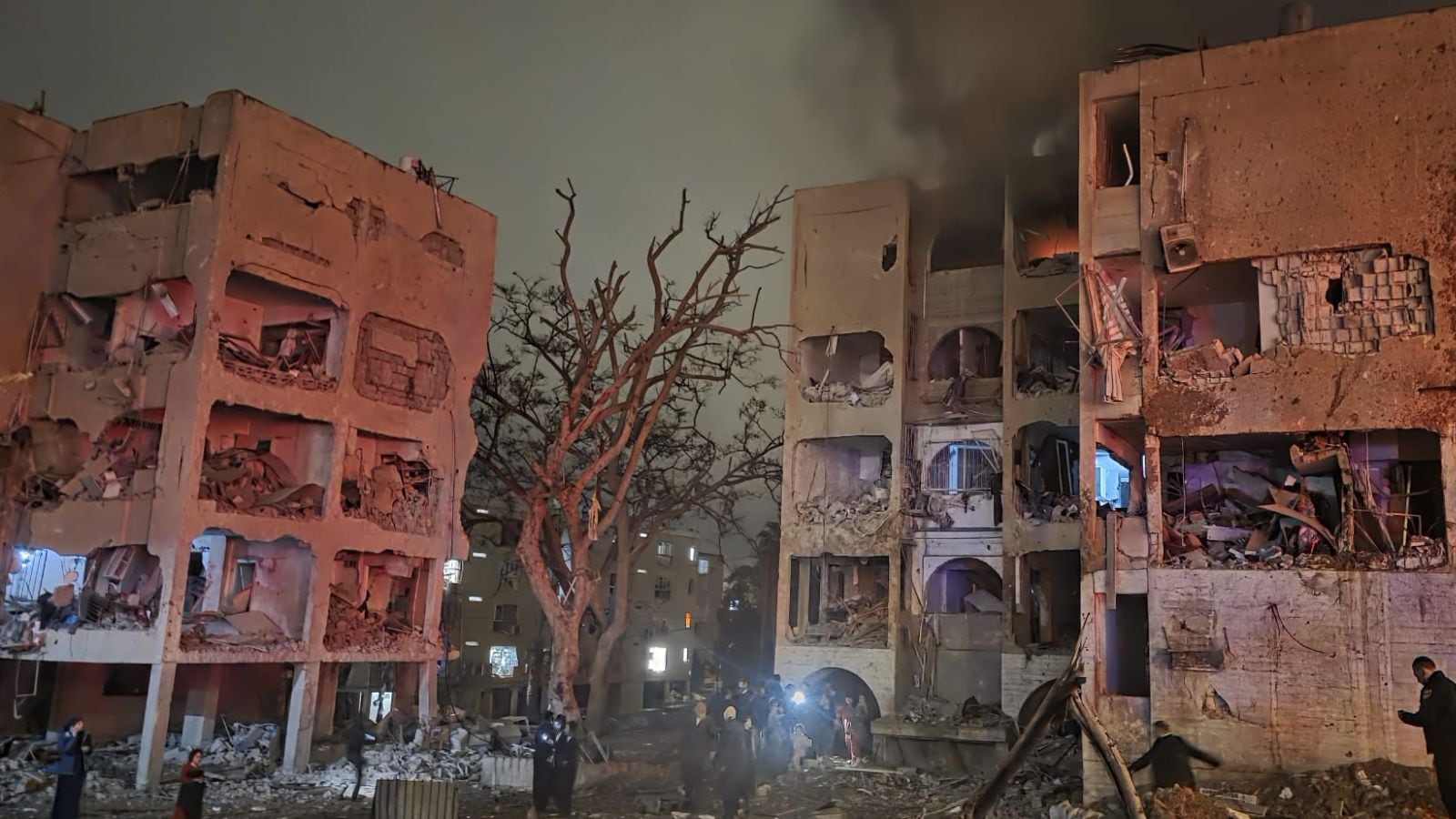
The tactical restraint that governed Middle Eastern warfare for four decades died twenty-three days ago. When Iranian ballistic missiles breached the airspace above the Negev Desert to strike the periphery of Israel’s Shimon Peres Negev Nuclear Research Center, they didn't just target a facility. They targeted the foundational logic of regional deterrence. The projectiles landed in the sand and scrubland near Dimona, far enough away to avoid a catastrophic radiation release but close enough to signal that the red lines of the 20th century have been erased. This is no longer a shadow war of proxies and cyber-attacks. It is a direct, high-stakes gamble for survival where the nuclear "third rail" is now a legitimate target.
As the smoke clears from the latest barrage, the international community finds itself reacting to a new and volatile variable. Donald Trump, currently leading a aggressive campaign with an "America First" posture that paradoxically demands total intervention in the Levant, has pledged to "obliterate" Iran’s power infrastructure if the escalation continues. The threat is not empty rhetoric. It represents a shift in U.S. doctrine from containment to systematic dismantling. We are witnessing the collapse of the "proportional response" model, replaced by a doctrine of total kinetic dominance.
The Geography of Escalation
To understand why the strikes near Dimona matter, one must look at the specific telemetry of the Iranian attack. Tehran did not choose these coordinates by accident. The Negev site is the crown jewel of Israel’s unacknowledged nuclear program. By putting "steel on target" within a few kilometers of the reactor, the Islamic Revolutionary Guard Corps (IRGC) proved they can penetrate the multi-layered defense systems—Arrow, David’s Sling, and Iron Dome—that were previously thought to be an impenetrable shield.
This wasn't a failure of technology. It was a failure of physics. When a saturation strike involves hundreds of drones acting as decoys for dozens of high-velocity ballistic missiles, even a 95 percent interception rate leaves enough "leakers" to hit sensitive areas. The psychological impact on the Israeli public is profound. For seventy years, the nuclear facility at Dimona was the ultimate insurance policy. Now, it is a vulnerability.
The Iranian strategy is clear. They are betting that by threatening the unthinkable, they can force a ceasefire on terms that preserve their regional influence. It is a massive miscalculation. Instead of backing down, the Israeli war cabinet has shifted its focus from Gaza and Lebanon toward a "head of the snake" strategy. The target is no longer the rocket launcher in a village south of Beirut. It is the command-and-control center in Tehran.
The Trump Factor and the Grid Collapse Strategy
The political dimension in Washington has added a layer of unpredictability that the IRGC likely did not account for. Donald Trump’s recent declarations about obliterating Iranian power plants move the goalposts from military targets to civilian-military dual-use infrastructure. In the past, Western powers hesitated to target the Iranian electrical grid or oil refineries for fear of global economic shockwaves. Those fears are evaporating.
If the U.S. or Israel moves to strike Iran’s energy sector, the goal will be a total national blackout. Modern nations cannot fight a sustained war without a functioning power grid. Desalinization stops. Hospitals revert to limited backup generators. Communications go dark. This is the "obliteration" Trump is referencing. It is a strategy of "primitive-ization," designed to send Iran back to a pre-industrial state before it can finalize its own nuclear breakout.
Critics argue that this approach will only harden Iranian resolve and rally the population around the flag. They are probably right. However, the analysts in the Pentagon and the Kirya in Tel Aviv are no longer concerned with winning hearts and minds. They are concerned with neutralizing the physical capacity of a state to launch a missile.
The Technical Reality of a Nuclear Site Strike
The physics of a strike on a nuclear facility are grim. If a missile were to actually breach the containment dome at Dimona, or if an Israeli strike hit the Bushehr reactor in Iran, the result would not be a nuclear explosion in the sense of a bomb. It would be a "dirty" event—the release of spent fuel and radioactive isotopes into the atmosphere.
- Contamination Radius: Depending on wind patterns, a breach at Dimona could lead to the evacuation of the entire southern half of Israel and parts of Jordan.
- Economic Paralysis: The mere threat of radiation would shut down the port of Eilat and the high-tech hubs of the center.
- Retaliation Cycle: A strike on a nuclear site is widely considered a "one-step-below-nuke" escalation, which justifies a nuclear response in several military doctrines.
The Intelligence Gap
We have been here before, yet the current situation feels different because of the transparency of the aggression. In previous decades, an attack near a nuclear site would have been met with silence or a quiet "tit-for-tat" sabotage operation. Today, both sides are filming the launches and posting the results on social media within minutes. This "open-source war" leaves no room for the quiet diplomacy that saved the world during the Cold War.
There is a significant intelligence gap regarding Iran’s true nuclear status. While the International Atomic Energy Agency (IAEA) struggles for access, satellite imagery shows massive tunneling operations near Natanz. The suspicion among veteran analysts is that Iran has already moved its most critical assets so deep underground that conventional "bunker busters" cannot reach them. This is why the rhetoric has shifted toward "power plants." If you cannot hit the laboratory, you hit the lights.
The Economic Aftershocks
The global markets have been strangely resilient, but that is a thin veneer. Oil traders are currently pricing in a "limited" conflict. They assume that the Strait of Hormuz will remain open because China, Iran’s biggest customer, demands it. This is a dangerous assumption. If Tehran feels its regime is under existential threat, it will have no incentive to keep the oil flowing.
A total blockade of the Strait would see oil prices jump to 150 dollars a barrel overnight. For a U.S. administration—current or future—this is the nightmare scenario. It is the reason why the "obliteration" rhetoric is so specific. By targeting the domestic Iranian grid rather than the export terminals, the U.S. hopes to cripple the IRGC without tanking the global economy. It is a surgical impossibility. In a total war, there is no such thing as a isolated economic sector.
The Failure of Regional Alliances
The "Abraham Accords" era is facing its most brutal test. The Arab states that normalized relations with Israel are trapped between a domestic population horrified by the images of war and a strategic necessity to contain Iranian expansion. Jordan, in particular, finds itself in an impossible position, shooting down Iranian drones over its territory while its streets call for a break with the West.
The reality is that no one is coming to save the regional order. The United Nations is a non-entity in this conflict. The European Union is distracted by the ongoing attrition in Ukraine. This is a regional showdown that will be settled by the actors on the ground and the superpower that provides the munitions.
The Hard Truth of Day 23
We have reached a point where the deterrent of "mutually assured destruction" is being tested by players who may not be rational in the Western sense of the word. When a state begins targeting the vicinity of a nuclear reactor, they are signaling that they are willing to risk their entire civilization for a tactical point.
Israel's response will likely not be immediate. They are masters of the "long fuse." They wait for the moment when the world’s attention drifts, then strike with a precision that resets the board. But this time, Iran is waiting. They have spent twenty years preparing for this specific month. The air defense batteries around Tehran are active, and the proxies in Yemen and Iraq are fueled and ready.
The strike near Dimona was the starting gun. The "war in the shadows" is over. We are now in the era of the "war in the sun," where the targets are clear, the stakes are existential, and the old rules of engagement have been burned to a cinder.
Would you like me to analyze the specific missile types used in the Dimona-area strike to determine their origin and payload capacity?