The Pacific Ocean is a beautiful, deceptive mask. To a tourist on a balcony in Manila, it is a shimmering sheet of turquoise. To a commercial diver, it is a workplace of crushing pressures and muffled silence. But for two hundred and fifty families in the United States, that water is a heavy, seventy-six-year-old lid on a coffin that refuses to stay shut.
Somewhere beneath the rolling swells of the Philippine Sea, about 160 nautical miles from the coast, lies a mangled heap of rusted iron known as the Arisan Maru. In October 1944, this "Hell Ship" was packed with American prisoners of war, men who had already survived the Bataan Death March and years of starvation in jungle camps. They were being moved to Japan to serve as slave labor. They never arrived. In other updates, take a look at: The Sabotage of the Sultans.
An American submarine, unaware that their own countrymen were locked in the sweltering hold, fired the torpedoes that sent the ship to the bottom.
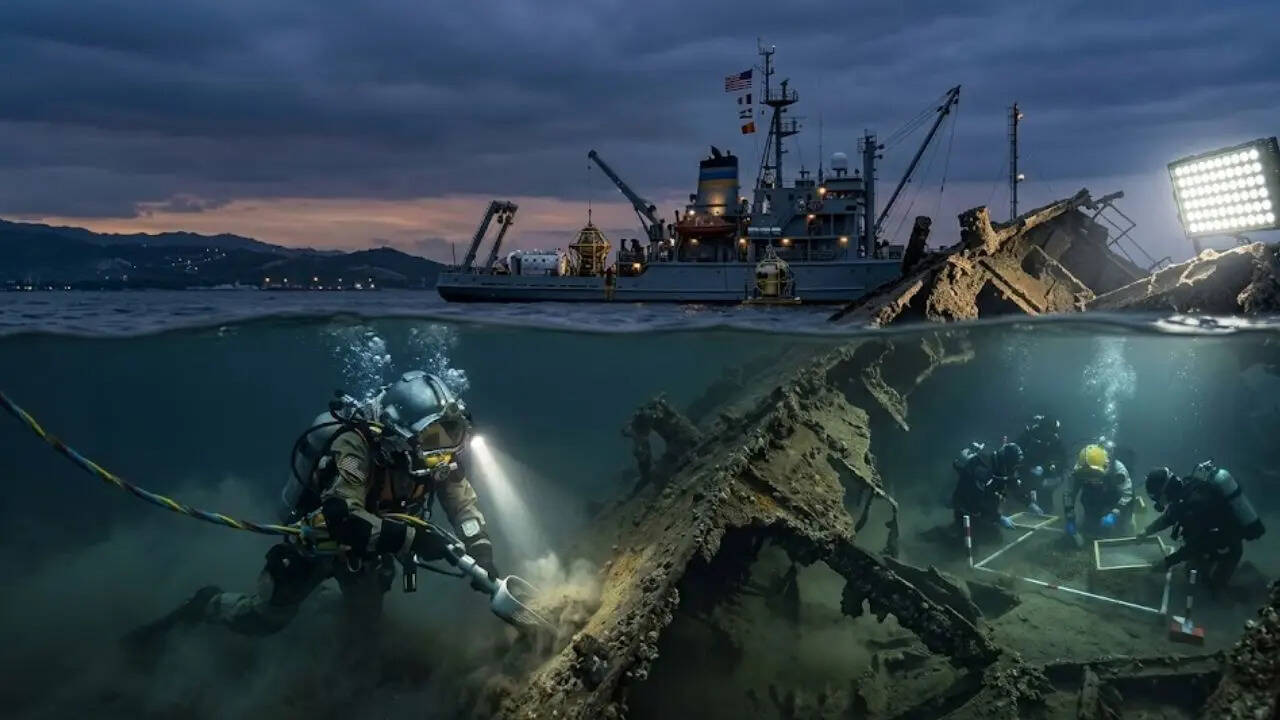
Now, the Pentagon is sending a specialized team of elite divers from the Defense POW/MIA Accounting Agency (DPAA) to find them. This isn't a salvage mission. It isn't a treasure hunt. It is a debt collection. BBC News has also covered this important topic in great detail.
The Weight of Salt and Silence
Imagine being trapped in a space the size of a shipping container with a hundred other men. The heat is 110 degrees. The air is thick with the smell of dysentery and unwashed skin. You haven't seen the sun in days. You can hear the muffled thrum-thrum-thrum of the ship's engines through the hull. Then, a violent shudder. The sound of metal screaming against metal. The cold, black ocean begins to pour in.
Most of the men on the Arisan Maru didn't stand a chance. Out of roughly 1,800 POWs on board, only nine survived the sinking. The rest became part of the seabed.
For decades, these men were "unaccounted for." That is a clinical, military term for a hole in a family tree. It means a mother who died never knowing if her son’s last moments were spent in prayer or in terror. It means a younger brother, now an old man in a nursing home, who still keeps a faded photograph on his nightstand, wondering if there is anything left of the boy who taught him how to throw a curveball.
The DPAA divers are stepping into that silence. These are not your weekend hobbyists with oxygen tanks and GoPro cameras. These are master divers trained to work at depths where the sun doesn't reach, where the water temperature hovers just above freezing, and where a single mistake in gas mixture means an agonizing death.
The Chemistry of a Miracle
The technical challenges of this mission are staggering. The Arisan Maru rests at a depth that pushes the limits of human physiology. When you go that deep, the very air you breathe becomes a poison. Nitrogen turns into a narcotic that makes you feel drunk and delusional. Oxygen can trigger seizures.
To survive, the divers use saturation diving techniques. They live for weeks in a pressurized chamber on the surface, their bodies slowly adapting to the immense pressure they will face on the bottom. They breathe a mix of helium and oxygen—heliox—which makes their voices sound like cartoon characters even as they perform the grim, meticulous work of sifting through silt for bone fragments and dog tags.
Every handful of mud is a potential answer.
They are looking for the smallest traces. A wedding ring. A tooth with a specific filling. A rusted locket. In the acidic environment of the deep ocean, the human body eventually dissolves, returning its minerals to the sea. But often, the artifacts remain. These objects are the "biological anchors" that allow forensic genealogists to connect a pile of wreckage back to a ZIP code in Ohio or a farm in Nebraska.
The Invisible Stakes
Why do we do this? Why spend millions of dollars and risk the lives of elite servicemen to find the remains of men who have been gone for nearly a century?
The answer isn't found in a budget report. It’s found in the concept of the "Empty Chair."
In the world of military families, an empty chair isn't just a piece of furniture. It is a presence. It is the ghost of a life that was interrupted. When a soldier is killed and their body is returned, there is a ritual. There is a flag, a bugle, and a plot of land with a name on it. There is a place to go on Sunday mornings to talk to the person you lost.
Without that, the grief never settles. It stays airborne, a fine dust that settles over generations. By finding these 250 men, the Pentagon isn't just recovering remains; they are performing a massive, collective act of surgery on the American psyche. They are stitching up a wound that has been weeping since 1944.
The divers feel this weight. When they are down there in the dark, with only the beam of a flashlight to guide them, they aren't just looking for wreckage. They are looking for "The Boys." That is how the DPAA teams refer to the missing. They are never "targets" or "remains." They are the boys.
The Ethics of the Abyss
There is a tension in this work. Some argue that the ocean floor is a natural cemetery and that we should let the dead sleep in peace. They see the intrusion of divers and ROVs (Remotely Operated Vehicles) as a violation of a sacred space.
But talk to the descendants. Talk to the granddaughters who grew up hearing stories about a "Great Uncle Charlie" who disappeared into the blue. To them, the "peace" of the ocean is actually a form of abandonment. To leave them there, nameless and forgotten, is to allow the Imperial Japanese Army’s cruelty to have the final word.
Bringing them home is a defiance of time and tide. It is a statement that no matter how deep the water, no matter how many years pass, the promise to "never leave a fallen comrade" doesn't have an expiration date.
The Descent
As the mission begins, the ship at the surface—the MV Salvor—acts as a life-support system for the divers below. They descend in a diving bell, a steel capsule that serves as their only sanctuary in the crushing dark.
Outside the bell, the world is alien. Bioluminescent creatures flicker like dying stars. The pressure is hundreds of pounds per square inch. The hull of the Arisan Maru looms out of the darkness, a distorted skeleton of what was once a 7,000-ton freighter.
The divers move slowly. Every kick of a fin must be calculated to avoid stirring up clouds of silt that would blind them for hours. They use "suction dredges"—essentially underwater vacuum cleaners—to delicately remove layers of sand from the debris field. The material is sent to the surface, where it is meticulously screened through fine mesh.
It is tedious. It is exhausting. It is often heartbreaking.
Sometimes, they find nothing but sea shells and pulverized metal. But then, a diver sees a glint. A piece of a uniform button. A fragment of a boot sole. In that moment, the sixty-eight-degree water doesn't feel quite so cold. The distance between 1944 and the present collapses.
A Final Accounting
We live in an era of disposable things. We move on from news cycles in hours. We replace our technology every eighteen months. In a culture of the "new," the DPAA’s mission to the Arisan Maru stands as a radical counter-cultural act. It is an assertion that a single human life—even one ended eight decades ago—is worth an infinite amount of effort.
The mission won't find everyone. The ocean is too vast, and the destruction of the ship was too complete. But for some families, the phone call will finally come.
"We found him."
Those three words have the power to change the DNA of a family. They transform a tragic mystery into a story of homecoming. They mean that a name carved into a "Wall of the Missing" can finally be etched into a headstone in a local cemetery, right next to his parents, right where he belongs.
As the divers finish their rotation and begin the long, slow process of decompression, the Philippine Sea continues to churn above them. It is still vast. It is still indifferent. But it is no longer holding quite as many secrets.
The water is a little less heavy now.
The sun sets over the horizon, casting a long, golden shadow across the waves where the Arisan Maru rests. Down in the silt, the quiet remains, but it is no longer the silence of the forgotten. It is the silence of those who are finally being heard.