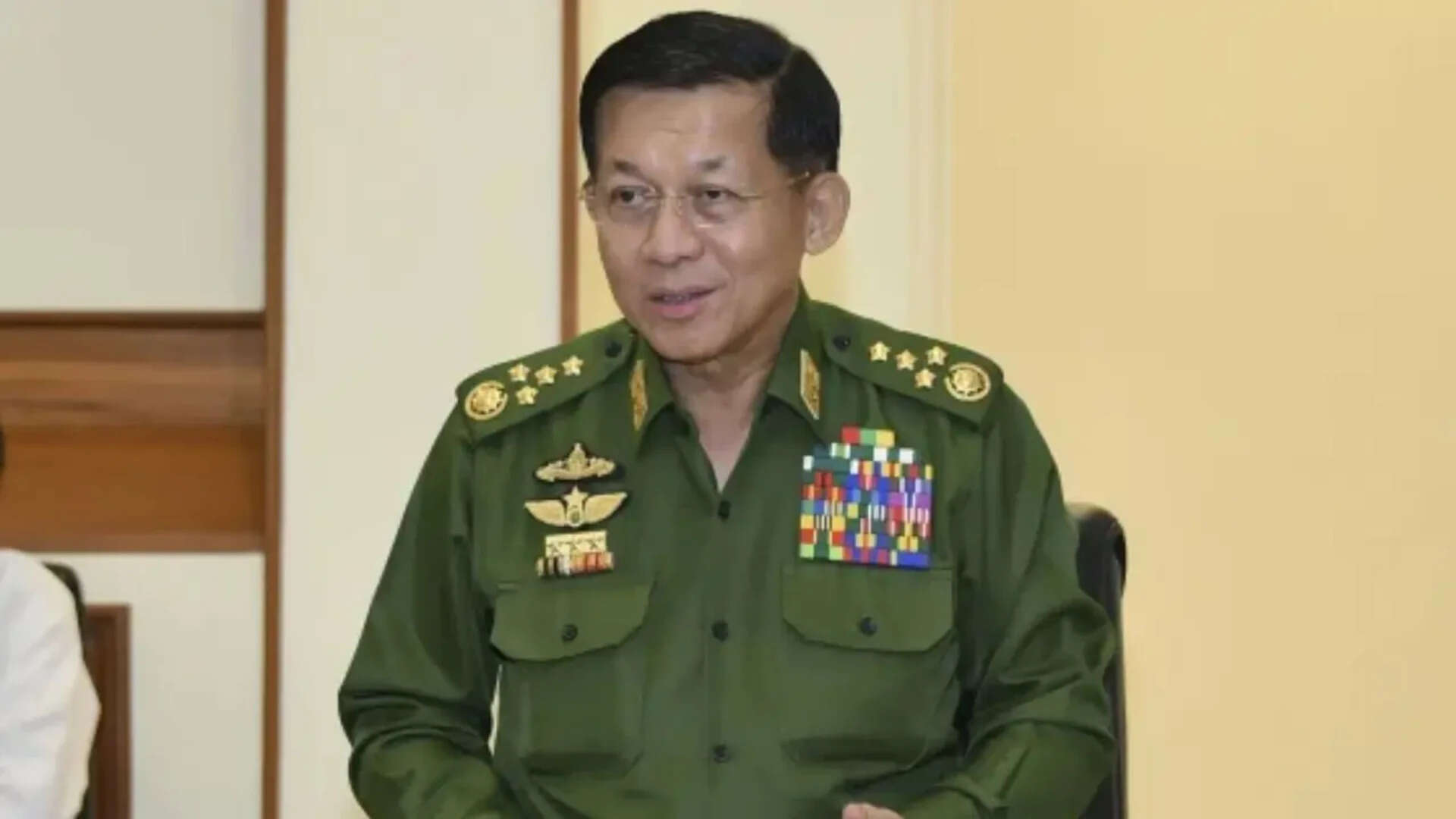
The nomination of Min Aung Hlaing for the presidency on March 30, 2026, marks the transition of the Myanmar military (Tatmadaw) from a state of emergency junta to a formalized, "civilian-clad" autocracy. This is not a withdrawal from power but a calculated structural pivot designed to solve the escalating crisis of domestic legitimacy and international isolation. By shedding the title of Commander-in-Chief and assuming the presidency, Min Aung Hlaing is attempting to codify military dominance within the framework of the 2008 Constitution, effectively legalizing a permanent state of praetorian rule.
The Tripartite Power Architecture
The current transition operates through three distinct structural maneuvers designed to insulate the leadership from both internal dissent and external pressure.
1. The Presidential Pivot
Under the military-drafted 2008 Constitution, the President serves as the formal head of state, but the position previously required the holder to be a civilian. By stepping down as Commander-in-Chief on March 30, 2026, Min Aung Hlaing satisfies the technical requirement for "civilian" status while retaining control over the executive apparatus. The nomination process in the military-stacked parliament ensures a predetermined outcome where:
- The Lower House, Upper House, and military appointees each nominate a candidate.
- The candidate with the highest vote count becomes President.
- The remaining two become Vice Presidents.
Because the Union Solidarity and Development Party (USDP) and the military bloc control the legislature, this process functions as a closed-loop system of self-appointment.
2. The Successor Selection: Ye Win Oo
The appointment of former spymaster Ye Win Oo as the new Commander-in-Chief is a strategic choice focused on internal security and loyalty. Replacing the long-standing number two, Soe Win, with a figure from the military intelligence apparatus signals a shift toward a "Securocrat" model.
Ye Win Oo’s primary function is to maintain the integrity of the Tatmadaw's internal command structure while Min Aung Hlaing manages the macro-political and diplomatic spheres. This division of labor creates a dual-layer defense for the regime: a formal state leader to engage in diplomacy and a loyalist enforcer to manage the frontlines of the ongoing civil war.
3. The Union Consultative Council (UCC)
To prevent the Presidency from becoming a mere figurehead role, the regime has established the Union Consultative Council. This body, chaired by Min Aung Hlaing, sits above the formal cabinet and the military command. It serves as the ultimate arbiter of:
- National Security Policy
- Foreign Relations Strategy
- Legislative Oversight
The UCC effectively decouples actual power from formal titles. Even without a uniform, Min Aung Hlaing retains the authority to direct military operations through this "extra-constitutional" body, ensuring that the new Commander-in-Chief remains a subordinate rather than a rival.
The Strategic Cost Function of the Transition
The junta’s decision to move toward a civilian facade is driven by a deteriorating cost-benefit ratio of direct military rule. The transition aims to mitigate three specific operational bottlenecks.
Diplomatic Friction and Sanctions
Direct military rule is a hard barrier to international recognition, particularly within ASEAN and the UN. By adopting a "Presidential" title, the regime seeks to provide regional partners—specifically China, India, and Thailand—with a legalistic pretext to resume normalized trade and diplomatic engagement. The goal is to shift the international narrative from "illegal coup" to "constitutional transition."
The Multi-Front Attrition Crisis
The Tatmadaw has faced unprecedented territorial losses to Ethnic Armed Organizations (EAOs) and People’s Defence Forces (PDFs). The military recognizes that it cannot win through kinetic force alone. The transition is a prerequisite for a "political solution" that might involve fractured ceasefires with specific ethnic groups, using the veneer of a civilian government to negotiate from a position of perceived legal authority.
Internal Purge and Consolidation
The removal of Soe Win and the elevation of Ye Win Oo indicates a "Loyalty over Seniority" doctrine. In a high-attrition environment, the risk of a mid-level coup or internal fragmentation is high. By concentrating power in a smaller, more ideologically aligned circle (Min Aung Hlaing, Nyo Saw, and Ye Win Oo), the regime is hardening its core against internal friction.
Institutional Constraints and Failure Points
Despite the precision of this reshuffle, the strategy faces three significant structural risks that could lead to systemic failure.
- The Legitimacy Deficit: The 2026 presidential process excludes the National League for Democracy (NLD) and occurs amidst a collapse of the central state's ability to provide services. A "President" who cannot secure the country’s main trade arteries or provide a stable currency remains a warlord in the eyes of the populace.
- Successor Ambition: In the history of the Tatmadaw, the relationship between the retired senior leader and the active Commander-in-Chief is historically volatile. If Ye Win Oo perceives that the Union Consultative Council is hampering his ability to prosecute the war effectively, the potential for a "palace" rift increases.
- Economic Insolvency: A change in titles does not address the fundamental economic collapse characterized by hyperinflation and the loss of the tax base. Without an infusion of foreign capital—unlikely given the continued dominance of sanctioned military businesses—the regime’s ability to fund its war machine remains precarious.
The transition of Min Aung Hlaing to the presidency is the final stage of the "State Administration Council" era and the beginning of a "Managed Democracy" facade. This maneuver is designed to preserve the military’s corporate interests and the personal safety of its top brass.
The strategic forecast for 2026 suggests that the regime will now use its new "civilian" status to propose a national peace conference, attempting to trade minor political concessions for a cessation of hostilities on the outskirts while maintaining absolute control over the central Bamar heartland. Success for the regime depends entirely on whether international actors accept the "costume change" as a genuine shift in governance.
Would you like me to analyze the specific economic impact of these leadership changes on Myanmar's military-owned conglomerates?