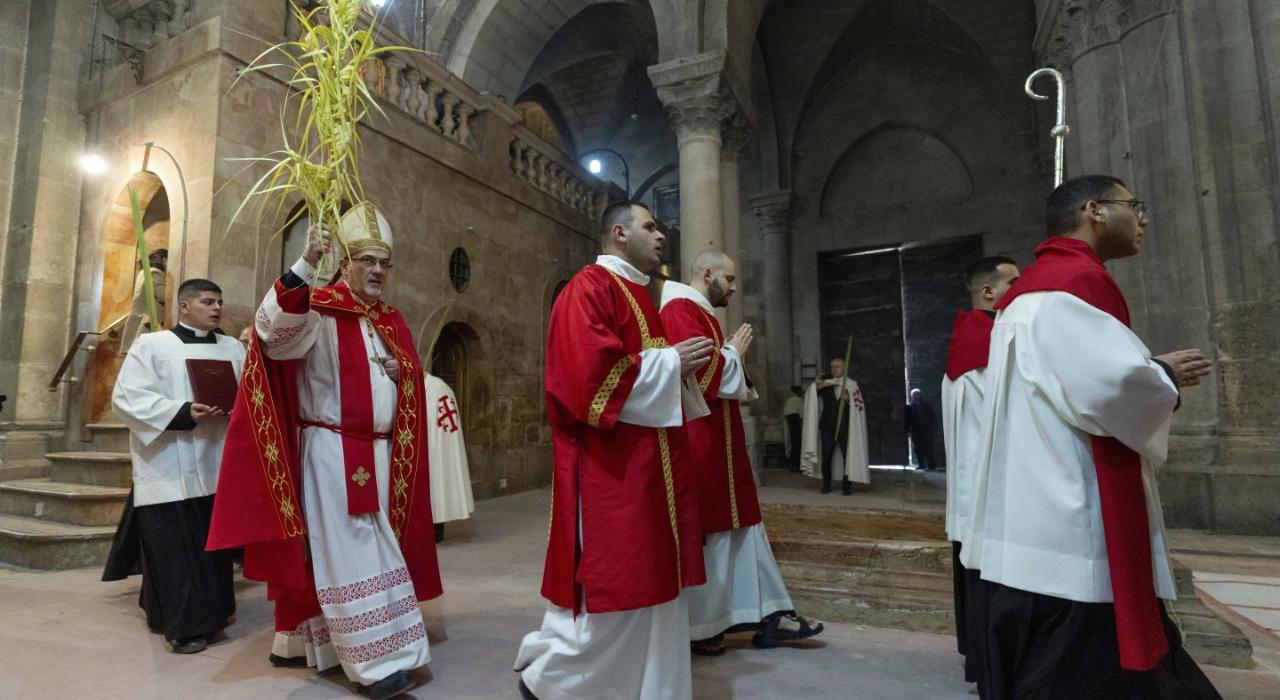
The air in the Old City usually tastes of incense, roasting coffee, and the centuries of dust kicked up by millions of seeking feet. On Palm Sunday, that air is supposed to vibrate. It is the day the narrow stone arteries of Jerusalem are meant to overflow with fronds of green and the rhythmic chanting of the faithful, marking the triumphal entry of Jesus into the Holy City. It is a sensory explosion.
But this year, for a few agonizing hours, the rhythm broke.
For the first time in centuries, the path to one of the most sacred sites in Christendom was not blocked by time, or war, or decay. It was blocked by a bureaucratic wall of security. Senior Catholic leaders, men who have spent their lives navigating the delicate geopolitical tightrope of the Levant, found themselves staring at metal barricades rather than the altar of the Holy Sepulchre.
Jerusalem is not just a city. It is a living, breathing paradox where the divine meets the deeply human, and where a single closed gate can ripple across the globe.
The Weight of an Iron Gate
Imagine a priest who has walked these stones for fifty years. Let’s call him Father Elias—a hypothetical figure, but one who represents the very real exhaustion felt by the clergy on the ground. For Elias, Palm Sunday is the pinnacle of the liturgical year. It is the moment when the "New Jerusalem" is celebrated within the walls of the old one.
He wakes before the sun. He prepares his vestments. He expects the friction of the crowds, the heat of the sun, and the occasional jostle of a pilgrim. What he does not expect is the cold, metallic "no" from a young soldier with a rifle.
The reports that surfaced this week were stark. Israeli authorities had restricted access to the Church of the Holy Sepulchre, preventing high-ranking Catholic officials from entering for the traditional services. While the Israeli government eventually restored access, citing "security coordination" and "crowd control," the damage to the spirit of the day was already done.
The "first time in centuries" tag isn't just a dramatic headline. It is a historical marker. Even during Ottoman rule, through the British Mandate, and through the scars of the 1967 war, the fundamental right of the high clergy to lead their flock on this specific day was a constant. When that constant breaks, the ground feels less stable for everyone.
The Invisible Stakes of Crowd Control
Safety is the ultimate trump card in modern governance. If you say a measure is for "public security," it becomes difficult to argue against without sounding reckless.
The Israeli police often point to the "Holy Fire" ceremony and other major Easter events as logistical nightmares. Thousands of people packed into a space built for hundreds, with only a few narrow exits, is a recipe for a crush. They remember the tragedies of the past. They don't want a stampede on their watch.
But there is a threshold where "management" becomes "marginalization."
When you stop the leaders of a faith from entering their own sanctuary, you aren't just managing a crowd. You are messaging a community. For the Palestinian Christians and the global Catholic community, this wasn't about the width of the alleyways or the number of fire extinguishers. It was about who owns the narrative of the city.
Jerusalem is a delicate ecosystem of "The Status Quo"—a literal legal agreement that governs who cleans which window and who opens which door in the holy sites. To disrupt this is to tug at a thread that holds a very large, very old sweater together.
A City of Mirrors
To understand the tension, you have to look at the eyes of those standing at the barricades.
On one side, you have the pilgrims. They have saved money for a decade to be here. They carry palm fronds woven into intricate braids. They are crying because they are so close to the spot where they believe the world changed, yet they are being told to wait behind a police line.
On the other side, you have the security forces. They are often barely out of their teens. They are tired. They have been told that any gathering is a potential flashpoint for violence. They see a crowd not as worshippers, but as a series of variables to be contained.
Between them lies the truth of the conflict: a total breakdown of trust.
When the news broke that access had been restored after an international outcry and intense diplomatic maneuvering, it was framed as a resolution. But a resolution isn't a healing. You can reopen a gate in ten minutes, but it takes ten years to rebuild the feeling that the gate will stay open.
The Human Cost of Geopolitics
We often talk about the Middle East in terms of maps and treaties. We use words like "sovereignty" and "jurisdiction." These are cold words. They don't capture the sound of a choir being muffled by a siren. They don't capture the look on a grandmother’s face when she realizes she won’t be able to light a candle for her grandson this year.
The incident on Palm Sunday is a microcosm of a larger, shifting reality. In recent years, Christian leaders in Jerusalem have become increasingly vocal about what they describe as an "existential threat" to their presence in the city. They point to an increase in harassment by extremist groups and a perceived indifference from the state.
When a senior Bishop is turned away, it sends a tremor through the local shopkeepers in the Christian Quarter. If the man with the golden cross can't get through, what hope does the man selling olive wood carvings have?
Economy and faith are intertwined here. Without the pilgrims, the Old City becomes a museum. Without the local worshippers, it becomes a shell.
The Restoration of a Fragile Peace
Access was eventually granted. The processions moved forward. The bells eventually rang.
From a purely factual standpoint, the "problem" was solved by midday. The Israeli authorities emphasized that they are committed to "freedom of worship for all faiths." They pointed to the hundreds of thousands of Muslims who pray at Al-Aqsa during Ramadan and the thousands of Jews at the Western Wall as proof of their success in balancing competing needs.
But the Catholic Church’s statement was uncharacteristically blunt. They didn't see this as a simple scheduling conflict. They saw it as an unprecedented infringement.
Consider the timing. Jerusalem is currently a pressure cooker. The shadow of the ongoing conflict in Gaza looms over every interaction. Every police officer is on edge; every worshipper is grieving. In this environment, a "security precaution" feels like a provocation, and a "tradition" feels like an act of resistance.
The restoration of access shouldn't be seen as a gift or a gesture of goodwill. It was a return to a baseline that should never have been moved.
The Silence Between the Chants
If you walk through the Jaffa Gate tonight, the stones will be cool. The tourists will be eating falafel, and the soldiers will be leaning against the walls, scrolling on their phones. It will look like peace.
But the silence of those few hours on Palm Sunday remains. It is a silence that speaks of the fragility of the "Status Quo." It reminds us that in Jerusalem, nothing is ever "just" a gate, and no delay is "just" about a crowd.
The stones of Jerusalem have seen empires rise and fall. They have been washed in blood and in holy water. They are indifferent to the politics of the day. But the people who walk upon them—the priests, the soldiers, the pilgrims—are not.
They are the ones who carry the weight of the silence when the bells stop ringing. They are the ones who have to decide if, next year, they will show up with a palm frond in their hand and hope in their heart, or if they will stay home, fearing that the wall has finally become too high to climb.
The gate is open for now. But the hand that holds the key is still trembling.