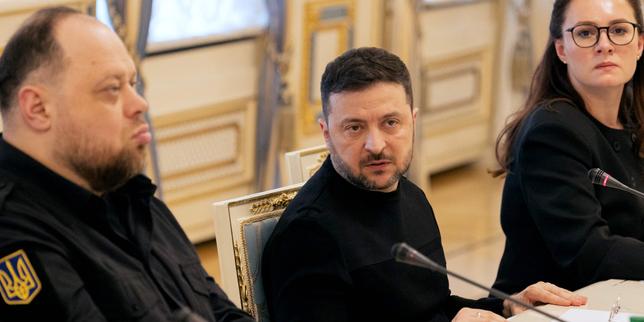
The political immunity once enjoyed by Volodymyr Zelenskyy within the walls of the Verkhovna Rada is evaporating. For the first time since the 2019 landslide victory that swept his "Servant of the People" party into power, the Ukrainian President faces a legislative body that is no longer content to act as a rubber stamp. This is not merely a localized dispute over policy; it is a structural breakdown of the governing majority that threatens the stability of Ukraine’s wartime domestic front.
The friction stems from a core reality of Ukrainian governance that has been obscured by the fog of war. While the international community sees a unified front centered on the presidency, the internal mechanics of the Rada are grinding to a halt. Deputies from Zelenskyy’s own party are increasingly absent, disillusioned, or actively seeking to resign their posts. The central command-and-control structure that Bankova—the presidential administration—relied upon for years is failing to hold the line on essential legislation, ranging from mobilization reforms to tax hikes necessary to fund the defense budget.
The Mirage of the Monomajority
When Zelenskyy’s party took 254 seats in 2019, it created Ukraine’s first ever "monomajority." It was a historic anomaly. In a political system traditionally defined by shifting oligarchic alliances and fragile coalitions, the President finally had the raw numbers to bypass the usual horse-trading. But that majority was built on a foundation of political novices, television personalities, and activists who lacked a unified ideological core.
Five years later, the novelty has worn thin. The "Servant of the People" faction has effectively ceased to exist as a monolithic voting bloc. On any given day, the President’s office can only rely on roughly 170 to 180 of its 235 current members to support controversial executive initiatives. This deficit forces the administration into the very backroom deals it once promised to abolish, frequently leaning on remnants of former pro-Russian parties or independent business-aligned groups to pass laws.
This fragmentation is driven by a profound sense of disenfranchisement among rank-and-file lawmakers. Many deputies feel they have been relegated to the role of "voting buttons," excluded from the decision-making process by a small circle of advisors around Zelenskyy. When the executive branch treats the legislature as an obstacle rather than a partner, the legislature eventually stops performing.
The Mobilization Deadlock as a Symptom of Rot
The struggle to pass updated mobilization laws serves as the clearest indicator of this breakdown. While the military identifies an urgent need for fresh manpower, members of the Rada are hesitant to put their names on a bill that is deeply unpopular with their constituents. In a functioning democracy, the executive provides political cover for such difficult decisions. In Kyiv, the deputies feel they are being asked to take the heat while the President’s office remains insulated from the legislative fallout.
It is a classic case of responsibility without authority. Lawmakers are being pressured to approve draconian measures, yet they have no say in how the war is being managed or how the economy is being restructured to support the front. This imbalance has led to a "quiet strike" within the parliament. Deputies simply fail to show up for sessions, or they bury sensitive bills in thousands of amendments, a tactic known as "legislative spamming."
The human element cannot be ignored. Being a member of parliament in a country under martial law is a grueling, often thankless existence. Travel restrictions prevent deputies from engaging in traditional diplomacy or visiting families abroad, while the "marathon" of unified news broadcasting leaves little room for individual political branding. Dozens of "Servants" have reportedly expressed a desire to resign their seats entirely, a move that the party leadership has blocked to avoid a total collapse of the quorum.
The Rise of the Presidential Office Power Vertical
The real source of the tension lies in the shifting center of gravity toward the Office of the President (OP). Under the leadership of Andriy Yermak, the OP has consolidated power to an extent that arguably exceeds constitutional boundaries. Decisions that should be debated in the Rada or decided by the Cabinet of Ministers are often handed down as completed directives from Bankova.
This "power vertical" has created a shadow government. While the official ministers and heads of parliamentary committees are the public faces of policy, the actual levers of influence are held by unelected advisors. For a veteran legislator, this is a bitter pill to swallow. It undermines the institutional relevance of the Rada and creates a culture of resentment.
The President’s team argues that the exigencies of war demand a centralized, rapid-response command structure. They aren't entirely wrong. War does not wait for parliamentary debates or committee hearings. However, the cost of this efficiency is the alienation of the very people needed to maintain the legal framework of the state. Without a functioning parliament, Ukraine risks a constitutional crisis that could be as damaging as any Russian offensive.
Economic Stress and the End of the Honeymoon
Money is the ultimate friction point. As international financial aid becomes more unpredictable, the Ukrainian government has been forced to look inward for revenue. This means tax increases, tighter regulations, and a crackdown on the "gray" economy. Every one of these measures hits the interests of the various regional power brokers who still hold sway over groups of deputies in the Rada.
The era of "easy" patriotism in the halls of government is over. In the first months after the 2022 invasion, the existential threat created a natural unity. That unity has been replaced by the "politics of the mundane." Lawmakers are now arguing over budget allocations for road repairs versus drone production, or tax exemptions for specific industries. These are the standard brawls of any democracy, but they are happening in a pressure cooker.
The Lack of a Succession Path
The internal crisis is exacerbated by the suspension of elections under martial law. While this is a legal necessity, it has created a stagnant political pool. There is no fresh blood entering the system, and those currently in power have no clear path to exit or promotion. This stagnation breeds paranoia.
Zelenskyy’s team is rightfully concerned about any figure who gains enough popularity to challenge the President’s narrative. Conversely, ambitious deputies feel their careers are being mothballed. This has led to a series of high-profile "purges" where officials deemed insufficiently loyal—or perhaps too popular—are removed from their posts. Each removal sends a shiver through the Rada, further eroding the trust between the executive and the legislative branches.
Rebuilding the Broken Bridge
If the President wants to regain control of the legislative agenda, he cannot do it through intimidation or further centralization. The strategy of the "iron fist" is reaching the point of diminishing returns. To fix the Rada, the administration must return to the basics of political coalition-building.
This requires a move toward a "government of national unity" or at least a more inclusive consultative process. The President must stop treating the Rada as a subordinate entity and start treating it as a co-equal branch of government. This isn't just about optics; it’s about survival. A fractured parliament is a gift to the Kremlin, which relies on the perception of Ukrainian internal instability to demoralize the population and discourage Western allies.
The "Servant of the People" brand was designed for a different time—a time of peace and populist hope. In the reality of 2026, a brand is not enough. Ukraine needs a robust, functioning political machine where the people making the laws feel they have a stake in the outcome.
The current path leads to a legislative vacuum. If the President’s office continues to bypass the Rada, the Rada will eventually become entirely irrelevant, or worse, an active center of opposition. Neither outcome is acceptable for a nation fighting for its life. The tension between Zelenskyy and his deputies is not a minor personality clash; it is the cracking of the spine of the Ukrainian state.
The next legislative session will be the litmus test. If the administration cannot pass the necessary budgetary and mobilization frameworks without resorting to coercion or questionable alliances, then the monomajority is officially dead. The President will have to decide whether to govern through a genuine coalition or to continue the drift toward an increasingly isolated executive rule.
Would you like me to analyze the specific voting patterns of the "Servant of the People" faction on recent defense-related bills to see which sub-groups are most frequently breaking ranks?