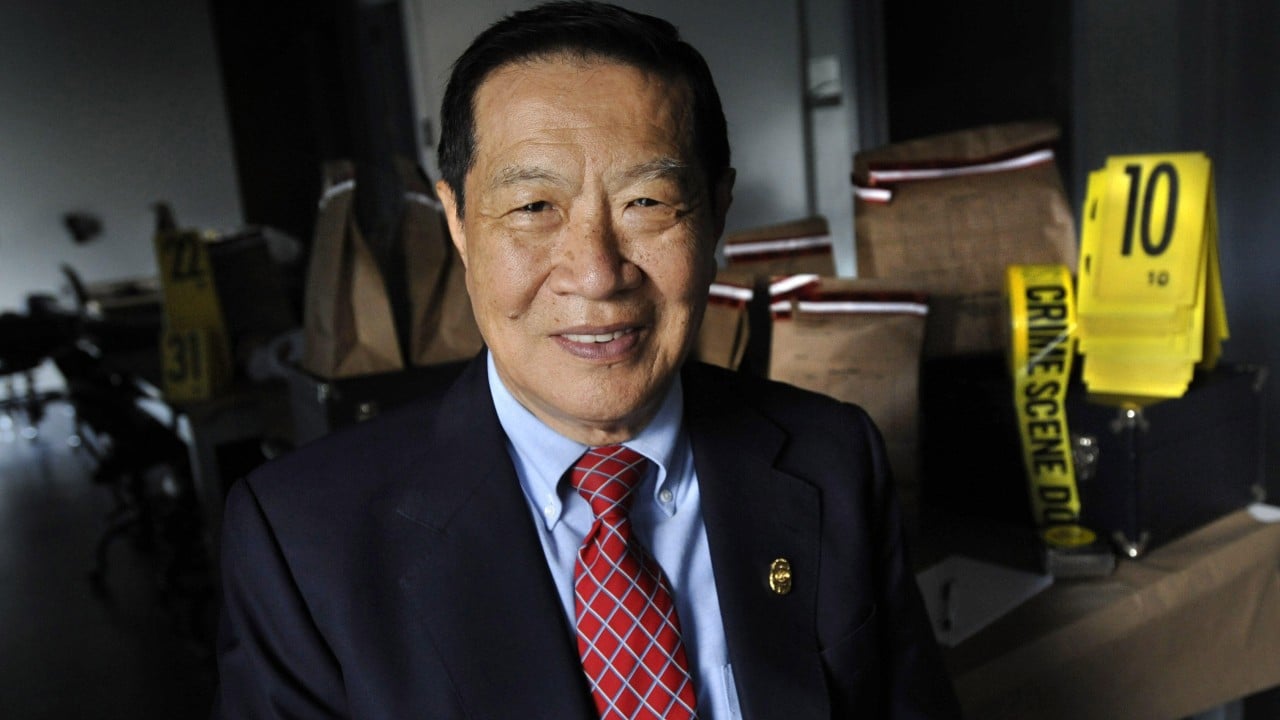
The man who famously held up a blood-stained swatch of fabric and told a jury that "something is wrong" has died at 87. Henry Lee was more than just a forensic scientist. He was a television fixture, a bridge between the laboratory and the living room, and the person who arguably invented the modern "CSI" archetype. While his death marks the end of an era for criminal justice, it also forces us to look at the massive, sometimes messy footprint he left on the American legal system.
You probably remember him best from the O.J. Simpson "Trial of the Century." He was the defense's star witness, the one who poked holes in the LAPD’s evidence handling with a charisma that most scientists simply don't have. He didn't just talk about DNA or blood spatter. He performed. He made the jury feel like they were part of the investigation. That wasn't just good science; it was brilliant theater.
Lee’s career spanned over 8,000 cases, including the JonBenét Ramsey murder, the disappearance of Laci Peterson, and the reinvestigation of the JFK assassination. He served as the commissioner of public safety in Connecticut and founded the Henry C. Lee Institute of Forensic Science. But to understand his impact, you have to look past the honors and the TV cameos. You have to look at how he changed our expectations of what happens in a courtroom.
The Simpson Effect and the Rise of the Expert Celebrity
Before Henry Lee, forensic scientists were usually dry, academic types who spoke in jargon. Lee changed that. He understood that a jury isn't a peer-review board. They’re people who need a story. In the Simpson trial, he gave them a narrative of incompetence and potential corruption. When he pointed out those mysterious blood drops on the back gate of the Bundy Drive condo, he wasn't just presenting data. He was sowing doubt.
That doubt was the engine of the acquittal. It also birthed what we now call the "CSI Effect." Suddenly, every juror expected a smoking gun or a perfect DNA match. If a case didn't have a "Henry Lee moment," it felt incomplete. This shifted the burden of proof in the public’s mind. Prosecutors started losing cases because they couldn't provide the Hollywood-style clarity that Lee made look so easy.
He was a master of the "hunch" backed by credentials. He’d walk into a crime scene, look at a smudge on a wall, and tell you exactly where the attacker was standing. Sometimes he was right. Sometimes, he was just very convincing. This blend of intuition and science made him the most sought-after expert in the world, but it also invited scrutiny that would follow him into his final years.
When the Science Faced the Microscope
No one stays at the top of a field like forensics for five decades without hitting some turbulence. In recent years, Lee’s reputation took some hits that are hard to ignore. The most significant blow came from a 1985 murder case involving Shawn Henning and Ricky Birch. Lee testified that a stain on a towel found in the victims' home was blood. That testimony helped put two teenagers in prison for decades.
Decades later, DNA testing proved the stain wasn't blood at all. It was probably just an old inorganic smudge. The convictions were vacated, and in 2023, a federal judge found Lee liable for fabricating evidence in that case. Lee defended himself vigorously, claiming he never faked anything and that science simply evolves.
It’s a tough pill to swallow. How does the world’s most famous forensic scientist misidentify blood? It highlights a broader issue in the field. Forensics isn't always as "hard" a science as chemistry or physics. It involves a massive amount of human interpretation. When the interpreter is a superstar like Lee, their word becomes gospel. That’s dangerous. It’s a reminder that even the best experts are fallible, and the system often fails to check that power until it’s too late.
A Global Influence Built on Hard Work
Lee’s story is a classic immigrant success tale. He moved to the United States from Taiwan in the 1960s with almost nothing. He worked three jobs while earning his degrees. He climbed the ranks of the Connecticut State Police when forensic labs were basically just glorified closets in the basement of precinct buildings.
He didn't just use science; he built the infrastructure for it. He pushed for better training, better equipment, and more rigorous standards. He consulted for police departments in dozens of countries. If there was a high-profile body found anywhere from Sarajevo to San Francisco, Lee’s phone usually rang.
His work on the "Woodchipper Murder" in 1986 remains a textbook example of forensic grit. Without a body, Lee and his team sifted through melted snow to find tiny fragments of bone, a tooth, and a fingernail. It was painstaking work that proved a murder had happened when most investigators were ready to give up. That’s the Lee people want to remember—the guy who found the needle in the haystack.
Navigating the Shift in Modern Forensics
Forensic science is in a state of flux right now. Many techniques that were common in the 80s and 90s—like bite mark analysis or certain types of hair microscopy—are being debunked or heavily restricted. Lee lived through this transition. He was a bridge between the "old school" of detective intuition and the "new school" of strict genomic sequencing.
His death happens at a time when we’re re-evaluating the entire criminal justice system. We’re asking more questions about how expert testimony influences juries and whether we've put too much faith in the "white coat" at the witness stand. Lee was the ultimate symbol of that faith.
Even with the controversies, you can't deny his brilliance or his work ethic. He wrote or co-wrote over 40 books. He mentored thousands of students who are now running labs across the globe. He was a force of nature who made science "cool" long before it was trendy.
What We Can Learn from the Lee Legacy
If you're a true crime fan or someone interested in the law, Lee’s career offers a massive lesson. Science is only as good as the people conducting it. We have to balance our respect for expertise with a healthy dose of skepticism. The "Henry Lee way" was about looking closer, but it also taught us that what we see depends heavily on who is pointing the flashlight.
If you want to understand the cases he touched, don't just watch the old news clips. Read the trial transcripts. Look at the appeals that followed. Seeing how his testimony was constructed—and how it was later challenged—is a masterclass in the power of persuasion in the courtroom.
To really get a handle on the state of forensics today, start by looking into the Innocence Project’s work on "junk science." Compare those findings with the methods used in the 1990s. It’s the best way to see where the field is going and why the standards are much higher now than they were when Lee was at his peak.
The era of the "celebrity expert" might be fading, replaced by data-driven consensus and more rigorous peer review. That’s probably a good thing for justice, even if it makes for less exciting television. Henry Lee was a one-of-a-kind figure who defined an age of investigation. We won't see another like him, and honestly, the legal system might not be able to handle another one anyway.
For anyone looking to dive deeper into the reality of forensic evidence, your next step is to look up the 2009 National Academy of Sciences report on forensic science. It's the document that changed everything and remains the gold standard for understanding what works, what doesn't, and why the "expert" on the stand isn't always right.