The air inside a home without heat doesn't just get cold. It gets heavy. It carries a specific, metallic stillness that settles into the fabric of the sofa and the marrow of your bones. For families tucked away in the glens of Scotland, or the sprawling rural stretches of the UK, this isn't a metaphor. It is the reality of a fuel tank running dry while the world waits for a spreadsheet to balance in London.
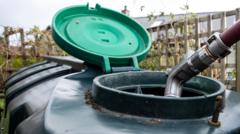
Most of the country lives and breathes by the flick of a thermostat. Natural gas flows through subterranean arteries, invisible and constant. But for nearly four million people, warmth is a physical delivery. It arrives on the back of a truck. It is bought in bulk. And lately, it has become a luxury that feels increasingly out of reach.
John Swinney, Scotland’s First Minister, recently stood before the cameras with a message that was less of a political nudge and more of an exasperated demand. He told the UK government to get a move on. The subject? The promised support for those who rely on heating oil—the "off-grid" households who have watched their energy bills skyrocket while the traditional safety nets seemed to snag on every piece of bureaucratic red tape imaginable.
The Geography of Inequality
Imagine a cottage on the edge of the Cairngorms. To a tourist, it is a postcard. To the person living inside, it is a stone box that requires constant, expensive feeding to remain habitable.
In these regions, "energy poverty" isn't a buzzword. It is the choice between filling the tank halfway or keeping the lights on. When the UK government announced support packages to combat the global surge in energy prices, the mechanisms were designed for the majority. If you have a direct debit with a major power company, the credit appeared on your bill. It was automatic. It was easy.
But if you live off the gas grid, you are an outlier.
You have to apply. You have to prove. You have to wait.
The delay in getting this support to the people who need it most creates a secondary chill. It is the feeling of being forgotten by a centralized system that views your lifestyle as an administrative quirk rather than a human necessity. Swinney’s frustration stems from this exact disconnect. The money was promised, the need is documented, yet the delivery remains stalled in the transition between policy and reality.
The Math of a Shivering House
Let’s look at the numbers, stripped of their political gloss. Heating oil prices are notoriously volatile. Unlike regulated gas prices, which have a ceiling, heating oil is subject to the whims of the global market, shipping lanes, and local supply chains.
A single delivery can cost upwards of £800. For a pensioner on a fixed income or a young family in a rural village, that is an impossible lump sum. The UK government’s Alternative Fuel Payment was intended to bridge this gap, but the rollout has been plagued by confusion.
- The Missing Link: Thousands of households were told they would receive the payment automatically, only to find themselves staring at empty bank accounts weeks later.
- The Application Barrier: For those who didn't receive it automatically, the online portal became a labyrinth of digital hurdles that many elderly residents found impossible to navigate.
- The Timing Gap: Winter does not wait for a portal to go live. The coldest months hit long before the first payments were processed.
Swinney’s argument is built on a simple premise: a citizen in a rural village is worth exactly as much as a citizen in a London suburb. If the state can facilitate instant relief for the latter, the former shouldn't have to wait for months of "technical verification."
Beyond the Political Theatre
It is easy to dismiss this as another chapter in the ongoing friction between Holyrood and Westminster. Political sparring is the background noise of British life. But look closer at the stakes.
When a house stays cold for too long, the walls begin to weep. Damp sets in. Mold follows. In the damp climate of the Scottish Highlands, this isn't just a nuisance; it’s a respiratory time bomb. The health service ends up paying for the government’s delay in fuel support. We see the cost in GP appointments, in hospital admissions for the vulnerable, and in the quiet, crushing anxiety of parents who tuck their children into bed wearing three layers of wool.
The "invisible stakes" are the erosion of trust. When a government promises relief and then fails to deliver it with the necessary urgency, it sends a message that some lives are harder to help than others—and therefore, less of a priority.
The Breaking Point
Pressure works.
Swinney’s public intervention is a calculated attempt to break the inertia. By framing the issue as a matter of basic fairness and administrative competence, he is forcing the UK government to address the "last mile" of their energy policy.
It is a reminder that policy is only as good as its delivery. You can announce a billion-pound fund with all the fanfare in the world, but if that money doesn't reach the person shivering in a kitchen in Aberdeenshire, the fund might as well not exist. It is a ghost.
The transition to greener energy is the long-term goal, of course. We all know the future cannot be paved with oil deliveries. But you cannot ask a family to transition to a heat pump they cannot afford while they are currently unable to pay for the fuel they already use. Survival comes first.
The Weight of the Wait
Wait.
That is the word that defines the rural experience in this crisis. Wait for the tanker. Wait for the price to drop five pence. Wait for the government to fix the website. Wait for the "move on" that Swinney is demanding.
The reality of the situation is that the infrastructure of the UK is skewed toward the urban. Our systems are built for density. When we try to apply those same systems to the edges of the map, they fray. The heating oil crisis is just a symptom of a much larger ailment: a failure to see the people who live outside the lines.
The First Minister isn't just asking for money. He is asking for the machinery of government to work with the same urgency for a farmer as it does for a financier. He is asking for the silence in those cold houses to finally be broken by the sound of a heating system kicking into gear.
The frost is still on the ground in the north. The days are short. The sun offers light but no warmth. Somewhere in a quiet village, an elderly woman checks her oil gauge and sees the needle hovering over the red. She looks at her phone, waiting for a notification that the support has arrived. She waits, while the gears of government turn with an agonizing, indifferent slowness.
The red line on that gauge doesn't care about parliamentary schedules. It only knows that time is running out.