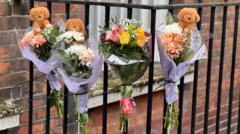
The rain in this part of the world doesn’t wash things away; it just makes them heavy. It clings to the wool of coats and turns the petals of supermarket carnations into sodden, translucent weights. On a nondescript street corner, tucked against a brick wall that has seen better decades, a small pile of color is fighting against the grey.
Pink cellophane. A moth-eaten teddy bear with a ribbon that used to be white. A handwritten note protected by a plastic freezer bag, the ink already starting to bleed at the edges despite the precaution.
These are the artifacts of a tragedy that has no vocabulary. When a baby girl dies, the neighborhood doesn't just lose a resident; it loses a future that hadn't even been written yet. The news reports will give you the dry skeleton of the event: the time the emergency calls were placed, the age of the child, the formal police statement regarding a "suspicious" or "unexplained" death. But the news rarely talks about the silence that follows.
The Anatomy of a Shrines
There is a specific, heartbreaking ritual to these makeshift memorials. It begins with one person. Usually, it’s a neighbor who didn't know the family well but heard the sirens and couldn't sleep. They bring a bouquet. They place it on the pavement.
Then comes the second person. And the tenth.
Within forty-eight hours, the brickwork is obscured by a hedge of grief. We do this because we are biologically wired to seek meaning in the meaningless. When a life ends before it has truly begun, the vacuum left behind is so immense that we try to fill it with nylon fur and $5 roses. It is a physical manifestation of a collective "sorry" directed at a universe that seems, in that moment, entirely too cruel.
Consider the logistics of this sorrow. People who are struggling to pay their own heating bills will spend their last few pounds on a bunch of lilies for a child they never met. They stand in the rain, head bowed for three seconds, and walk away. This isn't just about the child. It’s about the terrifying realization that the walls of our homes are thinner than we think. If it can happen there, behind that door with the chipped blue paint, it feels like it could happen anywhere.
The Invisible Stakes of a Neighborhood
Behind the police tape and the floral tributes, a different kind of story is unfolding. This is the story of a community’s mental health. When these events occur, the "invisible stakes" involve the shattering of a shared sense of safety.
Statistical data on infant mortality or local crime rates can provide a bird's-eye view of a region’s health, but they don't capture the way the grocery store clerk's hands shake the morning after the news breaks. They don't account for the sudden, fierce way parents in the surrounding blocks hug their own children a little too tight, a little too long, until the kids squirm to be let go.
The "suspicious" nature of a death adds a layer of toxic fog to the air. Trust, which is the currency of any functional street, begins to devalue. People look at the windows of their neighbors and wonder what they missed. Did they hear a cry? Was there a sign in the way the stroller was pushed last Tuesday? The guilt of the bystander is a heavy, phantom limb. We feel responsible for what we didn't see, even if there was nothing to see at all.
Beyond the Cellophane
We have a habit of turning these tragedies into spectacles of sympathy, but we rarely stay for the cleanup. Three weeks from now, the flowers will be brown mush. The teddy bear will be sodden and grey, its plastic eyes staring at nothing. The police tape will be gone, leaving only sticky residue on the lamp posts.
This is the most dangerous phase for a grieving family and a wounded community.
When the cameras leave and the "tributes" stop appearing, the reality of the loss truly sets in. This is when the "dry facts" of the competitor's news report fail the public. A report tells you that a girl died; it doesn't tell you how to live in the house where her toys are still scattered under the sofa. It doesn't tell you how to navigate the supermarket aisle where the baby formula is kept.
If we want to understand the "human element," we have to look past the initial shock. We have to look at the systemic failures that often precede these headlines. While we don't know the specifics of every case until the coroners and the courts finish their grim work, we do know that the safety nets in our cities are often frayed.
Social services are stretched to the snapping point. Health visitors have too many doors to knock on. Neighbors are too busy surviving to truly know the person living six feet away. The floral tribute is a beautiful gesture, but it is also a quiet admission of a failure that happened long before the sirens started.
The Weight of the Note
Among the pile of flowers on that damp pavement, there is often one note that stands out. It isn't a poem or a generic card. It’s a scrap of paper that says, "I wish I had known."
That sentence is the core of the tragedy.
It represents the gap between our digital connectivity and our physical isolation. We can see what a celebrity had for breakfast three thousand miles away, but we don't know that the mother in 4B hasn't slept in three days or that the baby in 4C has been quiet for too long.
The flowers are an attempt to bridge that gap after it’s already too late. They are a bridge built over a grave.
The investigators will eventually release a report. It will be full of cold, clinical language. It will talk about "trauma," "intervals," and "evidence." It will be a necessary document for justice, but it will be entirely useless for healing.
Healing doesn't come from a police report. It comes from the uncomfortable, messy work of looking out for one another when there isn't a tragedy to prompt it. It’s the decision to say hello in the hallway. It’s the offer to help carry a heavy bag. It’s the refusal to look away when something feels "off."
The rain continues to fall. A woman stops, adds a small wooden angel to the pile, and wipes her eyes. She doesn't know the family. She just felt she had to do something.
As she walks away, the wind catches a stray petal and sends it skittering across the wet asphalt. The street is quiet again, save for the hum of distant traffic and the rhythmic dripping of water from the gutters. The shrine remains—a bright, fragile scream in a world that has already moved on to the next headline.
We keep placing the flowers because we are afraid that if we stop, the memory of that little girl will vanish into the grey, as if she were never here at all. We are desperately trying to prove that her short life mattered, even if we only realized it once it was over.
A soggy bear sits slumped against the brick. Its ribbon is ruined. But for tonight, it is the only guard at the gate of a memory that a whole city is suddenly, painfully sharing.