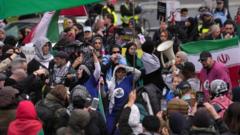
The management of large-scale geopolitical demonstrations in a metropolitan environment is not merely a policing challenge; it is an exercise in managing the friction between protected expression and statutory thresholds for public order. When twelve individuals were detained during the Al Quds Day march in London, the event provided a data point for a broader trend: the transition from "passive monitoring" to "proactive enforcement" under revised legislative frameworks. The core tension lies in the Threshold of Intervention, the specific point where symbolic speech violates the Public Order Act or counter-terrorism statutes.
The Architecture of Public Order Enforcement
Effective crowd management during high-tension demonstrations rests on three structural pillars. If any pillar fails, the operational cost—measured in both legal liability and physical safety—increases exponentially.
1. Legislative Scoping and Pre-Event Conditions
Before a single officer is deployed, the Metropolitan Police Service (MPS) establishes the legal boundary for the event. Under Sections 12 and 14 of the Public Order Act 1986, authorities can impose "conditions" on moving marches and static assemblies. These conditions are not suggestions; they are the baseline for criminal liability. During the Al Quds Day event, the primary constraints focused on:
- Temporal Boundaries: Specified start and finish times to prevent the "static sprawl" that complicates evening dispersal.
- Geographic Corridors: Defined routes designed to prevent the "clash of ideologies" by keeping opposing protest groups separated by a physical buffer.
- Symbolic Restrictions: The prohibition of specific iconography associated with proscribed organizations under the Terrorism Act 2000.
2. Real-Time Intelligence and Identification
The arrest of twelve individuals was not a random outcome of crowd density but a result of targeted identification. The MPS utilizes a Visual Intelligence Loop. This involves "spotters" and high-resolution CCTV to identify individuals wearing masks or carrying placards that cross the legal threshold into "incitement of racial hatred" or "support for a proscribed organization." The bottleneck in this system is the delay between identification and extraction. If an officer attempts to arrest a suspect in the heart of a 10,000-person crowd, the risk of a "flashpoint" (a localized riot) increases.
3. The Extraction vs. Containment Trade-off
Tactical commanders must choose between two competing philosophies:
- Immediate Extraction: Arresting a suspect the moment a violation occurs. This reinforces the "rule of law" but risks inciting the surrounding crowd.
- Deferred Enforcement: Identifying the suspect and arresting them at the perimeter or after the event has concluded.
Of the twelve arrests made during the London march, the majority occurred when individuals crossed a physical cordon or refused to comply with specific directions at the march's terminus. This indicates a preference for Perimeter Enforcement, where the environment is more controlled and the risk of collateral crowd violence is minimized.
Quantifying the Arrest Profiles
Analyzing the specific reasons for the twelve arrests reveals the current priorities of urban security forces. These arrests can be categorized into three distinct "Legal Buckles."
The Public Order Violations
The most common friction point occurs when individuals refuse to follow the "conditions" set by the Commissioner. This includes deviating from the prescribed route or failing to disperse. These arrests serve a dual purpose: they remove the immediate agitator and signal to the remaining crowd that the "containment envelope" is rigid.
The Iconography Breach
A significant portion of the legal complexity in Al Quds Day protests involves the Terrorism Act 2000. Under Section 13, it is an offense to wear items of clothing or carry articles that arouse "reasonable suspicion" that an individual is a member or supporter of a proscribed organization. The challenge here is Semiotic Ambiguity. A flag or a headband may be interpreted by the protester as a symbol of resistance, while the state interprets it as a symbol of a banned entity. The arrests made for "incitement" or "support" reflect a lower tolerance for ambiguity in the current political climate.
Assault on Emergency Workers
Arrests categorized as "assault on police" are often a secondary effect of the primary intervention. When an officer attempts to enforce a Section 12 condition, the physical resistance of the subject—or the interference of bystanders—triggers a separate criminal charge. This creates a Negative Feedback Loop: the more proactive the policing, the higher the incidence of physical confrontation, which in turn justifies further proactive policing.
The Economics of Modern Protest Policing
The deployment of thousands of officers for a single afternoon represents a massive allocation of "sunk costs" for a municipal government.
Opportunity Cost of Deployment
Every officer assigned to the Al Quds Day march is an officer removed from local "sector policing" (burglary response, domestic violence, etc.). The MPS must balance the high-visibility requirement of the protest against the degradation of service in other boroughs. This creates a Security Deficit that persists for 24–48 hours after the event as officers recover or process paperwork.
The Cost of Legal Aftermath
An arrest is merely the start of the "Legal Processing Chain."
- Transport and Custody: Moving twelve detainees to secure locations while ensuring the transport vehicles are not swarmed by protesters.
- Evidence Review: Hours of body-worn camera (BWC) footage must be synchronized with third-party social media clips to prove "intent" or "identity."
- Prosecutorial Review: The Crown Prosecution Service (CPS) must decide if the "public interest" test is met. Many public order arrests do not lead to convictions, which critics argue makes the arrest a "temporary tactical tool" rather than a true criminal justice outcome.
Structural Bottlenecks in Mass Arrest Scenarios
While twelve arrests may seem statistically insignificant compared to the total number of attendees, the process of making those arrests reveals three systemic bottlenecks.
- The Identification Bottleneck: Masking remains the primary tool for protesters to evade deferred enforcement. Even with high-definition optics, if a subject cannot be identified via facial recognition or unique clothing markers, the "deterrence value" of the police presence evaporates.
- The Custody Bottleneck: Processing twelve individuals simultaneously requires dedicated custody suites and legal representation. If the number of arrests were to scale to 100, the municipal infrastructure for processing would likely fail, forcing police to utilize "kettling" (containment) rather than arrest.
- The Narrative Bottleneck: In the age of decentralized media, every arrest is recorded from multiple angles. The "police narrative" of a lawful arrest for a Section 13 violation is immediately countered by "viral snippets" showing the physical struggle of the arrest. This creates a Legitimacy Gap that the state must manage through rapid PR releases and the release of their own body-cam footage.
The Strategic Shift: From Management to Deterrence
The Al Quds Day arrests suggest that the Metropolitan Police are moving away from the "facilitation" model of the early 2010s toward a "compliance-first" model. This shift is driven by increased political pressure to ensure that protests do not "paralyze" urban centers or create environments of perceived lawlessness.
The primary mechanism for this shift is the Pre-Emptive Condition. By setting strict geographic and symbolic boundaries weeks in advance, the police move the "Line of Violation" closer to the protester. It is no longer enough to be peaceful; one must be "compliant."
To optimize future operations, authorities will likely focus on:
- AI-Enhanced Evidence Processing: Reducing the man-hours required to scan thousands of hours of footage for specific iconography or faces.
- Modular Barriers: Moving away from "human cordons" (police lines) toward physical, modular infrastructure that reduces the risk of officer injury.
- Digital Dispersal Orders: Utilizing geo-fencing technology to send dispersal orders directly to the mobile devices of individuals within a specific radius, creating a digital record of "notice" that simplifies future prosecution for non-compliance.
The success of a policing operation is no longer measured by the absence of arrests, but by the precision of the arrests made. The twelve detainees from the Al Quds Day march represent the "surgical" application of law in a high-entropy environment. The strategic goal is to minimize the "Total Friction" of the event while maximizing the "Accountability Factor" for those who exceed the legislative boundaries. Future protest groups must account for this increased "Legal Friction" in their organizational calculus, recognizing that the threshold for intervention has fundamentally tightened.