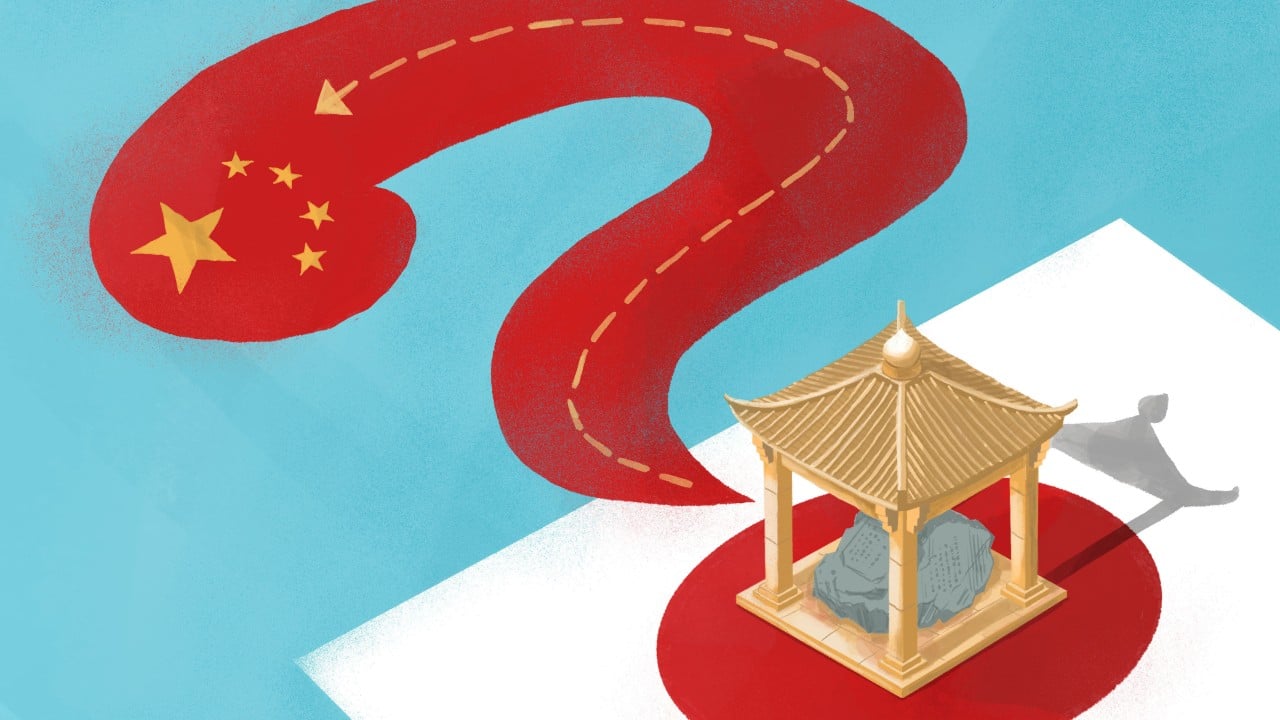
The Hongkehe Tablet is a slab of stone that weighs two tons, but its political weight is currently immeasurable. For over a century, this Tang Dynasty artifact has sat in the private gardens of the Japanese Imperial Palace, a trophy of the Russo-Japanese War. Now, Beijing is demanding its return with a ferocity that suggests this isn't just about art. It is about the formal dismantling of the post-war order and the reclamation of a Sinocentric hierarchy in East Asia.
The dispute centers on a piece of granite inscribed in 713 AD. It chronicles a mission by a Tang envoy to the Bohai Kingdom, an ancient state that once spanned parts of modern-day Northeast China, North Korea, and Russia. To the casual observer, it is an archaeological curiosity. To the Chinese Communist Party, it is a "national shame" carved in rock. By demanding the tablet back, China is testing Japan’s diplomatic resilience and signaling that the era of "quiet observation" regarding stolen heritage is over.
The Spoils of Port Arthur
To understand the current tension, one must look at the chaos of 1905. During the Russo-Japanese War, Japanese forces seized the tablet from the city of Lushun, then known as Port Arthur. It was presented to the Meiji Emperor as a victory gift. This wasn't a simple archaeological find; it was a deliberate extraction of cultural DNA. At the time, Japan was cementing its role as the new hegemon of Asia, and possessing the Hongkehe Tablet served as a physical manifestation of that transition.
The tablet remained largely forgotten by the public for decades, tucked away behind the high walls of the Imperial Palace. However, the rise of digital nationalism in China has dragged it back into the spotlight. Grassroots organizations in China, backed by state-aligned scholars, have spent years documenting the "theft" of the stone. They argue that because the tablet was taken during an act of imperialist aggression, its presence in Tokyo is a continuing violation of Chinese sovereignty.
Japan’s stance has remained consistently rigid. The Imperial Household Agency treats the tablet as part of the Emperor’s private collection, placing it outside the reach of standard diplomatic repatriation channels. This creates a legal fortress. If the Japanese government admits the tablet was looted, they open the floodgates for thousands of other claims involving artifacts taken during the occupation of China and the Korean Peninsula.
The Geopolitical Engine of Repatriation
Beijing’s sudden obsession with the Hongkehe Tablet isn't happening in a vacuum. It is a calculated component of the "Great Rejuvenation of the Chinese Nation." For decades, China was content to focus on economic growth while ignoring historical slights. That patience has evaporated. Under current leadership, the recovery of cultural relics is framed as a moral necessity to heal the wounds of the "Century of Humiliation."
This isn't just about one stone. It is a strategic tool used to paint Japan as an unrepentant aggressor. By focusing on a specific, high-profile object located within the Emperor's own grounds, China forces Tokyo into a defensive crouch. If Japan refuses, they look like imperialist relics. If they comply, they acknowledge that the Meiji-era gains were illegitimate, potentially destabilizing their internal historical narrative.
The timing is equally sharp. As Japan increases its defense spending and strengthens ties with Washington, China uses "cultural diplomacy" to remind its neighbor—and the world—of the bloodier chapters of the 20th century. It is a way of saying that Japan’s modern military ambitions cannot be separated from its past crimes.
The Legal Gray Zone
International law on the return of cultural property is notoriously weak. The 1970 UNESCO Convention prohibits the illicit import and export of cultural property, but it is not retroactive. This means it generally does not apply to items taken during the colonial era or early 20th-century conflicts.
Japan relies on this lack of retroactivity. From a strictly legal standpoint, the tablet was taken during a time when "right of conquest" was a recognized, if brutal, reality of international relations. China, however, is pushing for a shift toward "moral restitution." They are following a global trend where Western museums—from the British Museum to the Louvre—are under increasing pressure to return colonial loot regardless of legal technicalities.
The difference here is the players involved. Unlike a museum in London returning bronzes to Nigeria, the Hongkehe dispute involves two nuclear-capable economies with a deep-seated rivalry. The tablet is a pawn in a much larger game of regional dominance.
Chasing the Ghost of Bohai
There is a deeper, more academic layer to this fight that often gets missed. The Hongkehe Tablet is the primary evidence for the relationship between the Tang Dynasty and the Bohai Kingdom. Both China and South Korea claim Bohai as part of their respective national histories. By securing the tablet, China isn't just winning a fight against Japan; it is also solidifying its claim over the historical narrative of Northeast Asia.
If the tablet is returned to China, it becomes the cornerstone of a museum dedicated to proving that Bohai was a subordinate vassal state of the Tang. This effectively "Sinicizes" the history of the region, marginalizing Korean claims. The stone is a witness. If China controls the witness, they control the story.
The Emperor’s Dilemma
For the Japanese Imperial family, the tablet is a poison pill. Returning it would be seen by Japan’s right-wing nationalists as a sign of weakness and a betrayal of the Meiji legacy. Yet, keeping it provides China with an endless supply of diplomatic ammunition.
The Imperial Palace has recently allowed a small number of scholars to view the tablet, perhaps as a half-measure to lower the temperature. It didn't work. The Chinese state media responded by calling for nothing less than full repatriation. They are not interested in shared access or academic cooperation. They want the physical object back on Chinese soil.
This hardline stance reflects a broader shift in Chinese foreign policy. The "Wolf Warrior" era may have softened in tone, but the underlying objectives remain ironclad. The Hongkehe Tablet is a test case. If China can successfully pressure Japan into returning an item from the Emperor’s private grounds, it proves that the balance of power has shifted irrevocably in Beijing’s favor.
Digital Warfare and Public Sentiment
Social media has weaponized this archaeological dispute. On platforms like Weibo, the Hongkehe Tablet is a recurring viral topic. Each time a Japanese official visits the Yasukuni Shrine or a new defense pact is signed with the West, the tablet re-emerges as a symbol of Japanese "arrogance."
This bottom-up pressure makes it impossible for the Chinese government to back down, even if they wanted to. The public has been conditioned to see the stone as a missing piece of the national soul. In Japan, the sentiment is the opposite: a mix of confusion and irritation. Most Japanese citizens were unaware the tablet even existed until the Chinese demands became headline news. Now, it is viewed as another example of Chinese "bullying."
The danger is that the tablet becomes a trigger for actual escalation. While it is unlikely that two nations would go to war over a piece of granite, the rhetoric surrounding it poisons the well for cooperation on trade, climate, and security. It ensures that the "history problem" remains an open wound, easily poked whenever one side needs a domestic distraction.
The Failure of Traditional Diplomacy
Traditional diplomacy is built on compromise, but there is no middle ground for the Hongkehe Tablet. You cannot return half a stone. The idea of a "long-term loan" has been floated by some moderate academics, but both governments have ignored it. For China, a loan acknowledges Japanese ownership. For Japan, a loan is a precursor to a permanent loss.
We are witnessing the limits of soft power. If the tablet remains in Tokyo, it stands as a monument to a world where Japan was the master of Asia. If it goes to Beijing, it marks the definitive end of that era. There is no "synergy" to be found here, only the cold reality of a zero-sum game played out in the halls of power and the dusty corners of history.
Check the digital archives of the Chinese Ministry of Foreign Affairs for the most recent official statements on "stolen cultural relics" to see how the Hongkehe Tablet is being bundled with broader territorial claims.