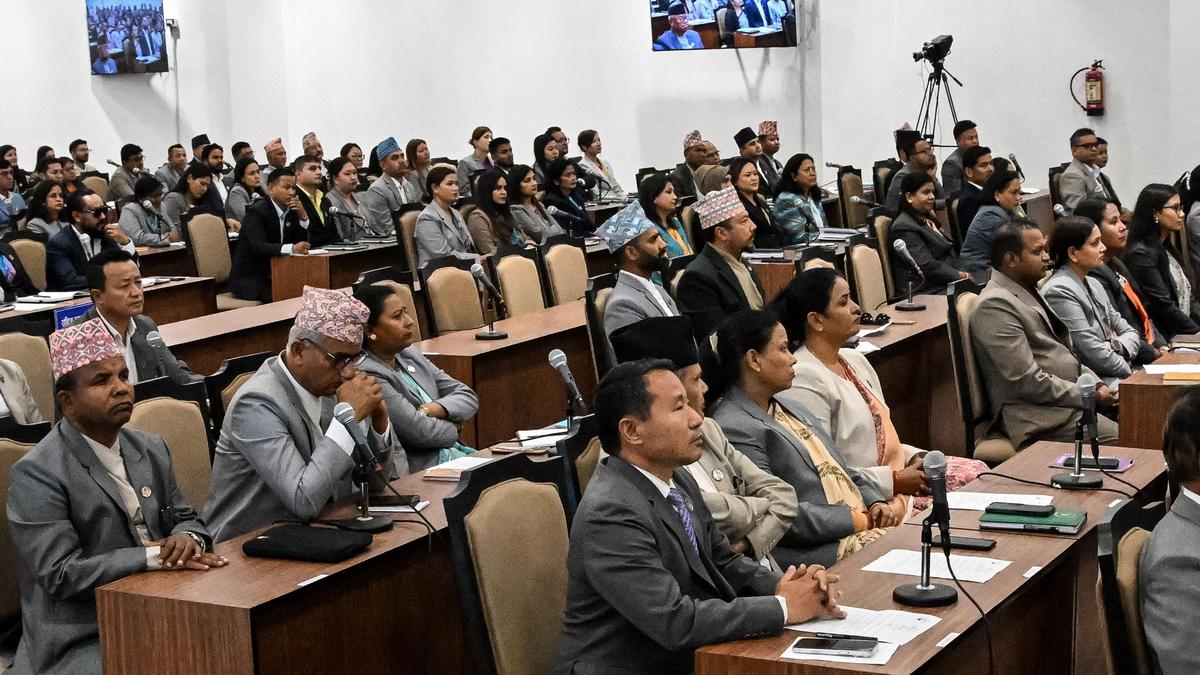
The doors of the International Convention Centre in Kathmandu opened to a scene of forced smiles and uneasy handshakes as Nepal’s newly elected parliament sat for its first session. While state media painted a picture of a triumphant return to democratic stability, the reality inside the hall was far more volatile. This was not a celebration of a new era. It was the opening act of a high-stakes survival game. Pushpa Kamal Dahal, better known by his nom de guerre "Prachanda," has reclaimed the Prime Minister’s seat, but his grip on power is as thin as the mountain air. This session marks the beginning of a coalition that defies logic, bringing together former Maoist rebels and the very royalist forces that once fought to keep them out of the capital.
The central problem facing Nepal is a chronic inability to maintain a government for a full five-year term. Since the monarchy fell in 2008, the country has burned through over a dozen prime ministers. This revolving door at Singha Durbar has stalled infrastructure projects, scared off foreign investors, and left the public in a state of permanent exhaustion. The 275 members of the House of Representatives now face a simple, brutal choice. They can find a way to govern together, or they can let the economy slide further into the abyss while they squabble over cabinet portfolios.
The Architect of Chaos
Prachanda is a man who knows how to survive. He did not win the most seats in the November elections; that honor went to the Nepali Congress, led by Sher Bahadur Deuba. However, in a move that blindsided his former allies, Prachanda walked away from a pre-election pact to strike a deal with his arch-rival, K.P. Sharma Oli of the CPN-UML. This backroom maneuver secured him the premiership but at a staggering cost to his credibility. He is now the head of a "seven-party jigsaw puzzle" where every piece wants to be the center of the picture.
To understand why this matters, one must look at the ideological friction within this alliance. You have the Maoist Center, which wants to push a socialist agenda, sitting at the same table with the Rastriya Prajatantra Party (RPP), a group that openly advocates for the return of the Hindu monarchy. It is a marriage of convenience where neither partner trusts the other. They are united only by their desire to keep the Nepali Congress out of power. This setup ensures that every legislative move will be a grinding process of compromise.
A Broken Economic Engine
While politicians trade favors in the hallways of parliament, the street-level reality in Nepal is grim. The country is grappling with a liquidity crunch that has brought small businesses to their knees. Interest rates have spiked, and foreign exchange reserves are under constant pressure because the nation imports almost everything it consumes. Nepal relies heavily on remittances from migrant workers in the Gulf and Southeast Asia. When that money stops flowing or gets diverted into the informal market, the government loses its primary lifeline.
Inflation is hitting the average household hard. The price of basic goods like cooking oil and rice has climbed steadily, yet the parliament’s first session spent more time on ceremonial speeches than on fiscal policy. There is a disconnect between the political elite and the economic reality of the citizens. If the new government cannot provide immediate relief to the middle and working classes, the "stability" promised by this coalition will evaporate in the heat of street protests.
The Specter of Foreign Influence
Nepal is often described as a "yam between two boulders," referring to its position between India and China. Both neighbors are watching this new parliament with intense scrutiny. India has traditionally viewed Nepal as part of its natural sphere of influence, focusing on shared culture and security. China, meanwhile, has ramped up its presence through the Belt and Road Initiative and massive infrastructure investments.
The UML-Maoist alliance is often perceived as being more "pro-China," while the Nepali Congress is seen as closer to New Delhi. This binary is an oversimplification, but it drives the underlying tension in Kathmandu. Prachanda must now perform a delicate balancing act. If he leans too far toward Beijing, he risks alienating India, which controls the vital supply lines for fuel and food. If he pivots too hard toward Delhi, he risks a backlash from his coalition partners who use "nationalism" as a political weapon against Indian involvement.
The Youth Vote and the Rise of the Outsiders
One of the most significant shifts in this parliament is the presence of the Rastriya Swatantra Party (RSP). Led by a former television host, this party capitalized on the deep-seated anger of young voters who are tired of the same three old men—Deuba, Oli, and Prachanda—recycling power among themselves. The RSP and other independent candidates have entered the chamber with a mandate to disrupt.
They represent a demographic that doesn't care about the revolutionary credentials of the Maoists or the historical legacy of the Congress. They want digital governance, an end to the "syndicate" system in transport and education, and jobs that don't require moving to Qatar. This new bloc acts as a wild card. If the traditional parties try to return to their old ways of horse-trading and corruption, these newcomers have the social media reach to mobilize a frustrated generation against them.
The Looming Constitutional Crisis
Nepal’s constitution is a young document, and it is already showing signs of strain. The federalism model, which was supposed to decentralize power and bring the government to the doorsteps of the people, has instead created a massive, expensive bureaucracy. Many citizens feel that they have simply traded one central tyrant for seven regional ones. The cost of maintaining these provincial governments is draining the national treasury.
There are growing calls to scrap the federal system entirely and return to a more centralized structure. This is a dangerous path. The Maoists fought a decade-long civil war specifically to achieve this decentralization. Any attempt to roll back these reforms could reignite the very tensions that led to the deaths of 17,000 people. The parliament is sitting on a powder keg of unresolved identity politics and structural flaws.
The Federalism Failure
The provincial governments have struggled to define their roles. Most have spent their time arguing over their own names and permanent capitals rather than passing laws that help their constituents. This legislative paralysis at the local level puts more pressure on the central parliament to act as a fixer for every minor grievance. It is a system designed for cooperation that is currently being fueled by competition.
The Transparency Gap
Corruption in Nepal isn't just about bribes; it’s about a deeply entrenched system of patronage. Contracts for major hydropower projects or highway expansions are often handed out to "contractor-politicians" who sit on the very committees supposed to oversee them. This conflict of interest is the primary reason why projects like the Melamchi Water Project took decades to complete.
The first session of parliament should have addressed the need for a truly independent anti-corruption body. Instead, the focus remained on the election of the Speaker and the Deputy Speaker—roles that are being used as bargaining chips in the coalition deal. Until the "big three" parties agree to separate their business interests from their legislative duties, the "New Nepal" remains a hollow slogan.
A Legislative Logjam
Dozens of crucial bills have been gathering dust for years. These include laws regarding citizenship, the transition of civil service employees, and the long-delayed "Truth and Reconciliation" process for war-era crimes. Victims of the civil war are still waiting for justice. By prioritizing political survival over these sensitive issues, the leadership is effectively telling the public that the past doesn't matter as much as the next vote of confidence.
The Fragility of the Vote of Confidence
Prachanda’s biggest hurdle is not the opposition; it is the expiration date on his own deal. Rumors suggest a "gentleman's agreement" where Oli and Prachanda will swap the Prime Minister’s post halfway through the term. History shows that these agreements rarely hold. As soon as one leader feels the other is weakening, the alliance will fracture. This makes for a government that is constantly looking over its shoulder rather than looking at the road ahead.
The parliament is currently a house of cards. The smaller parties in the coalition hold enough seats to topple the government at any moment. This gives them disproportionate leverage to demand lucrative ministries and policy concessions. It is a recipe for a "vetocracy," where nothing gets done because everyone has the power to say no, but no one has the power to say yes.
The Hidden Cost of Political Apathy
When the sessions end and the lawmakers retreat to their private quarters, the people of Nepal are left to navigate the wreckage of a stalled economy. The exodus of the country’s best and brightest continues. Every day, thousands of young men and women line up at the airport, carrying their dreams in a suitcase because they see no future in a country governed by a musical-chairs elite.
This is the real crisis that the new parliament refuses to acknowledge. It is not just about who sits in the Speaker’s chair or which party gets the Home Ministry. It is about whether the state can prove it has a reason to exist beyond serving the interests of its political class. The first session of the post-poll parliament was a masterclass in pageantry, but it offered no evidence that the underlying rot has been addressed.
Stop looking at the red carpet and start looking at the spreadsheets. The math of this coalition does not add up to stability. It adds up to a stay of execution for a political system that is rapidly running out of time. If this parliament fails to deliver more than just speeches, the next time the doors of the convention center open, it may not be for a session, but for an autopsy of the republic.