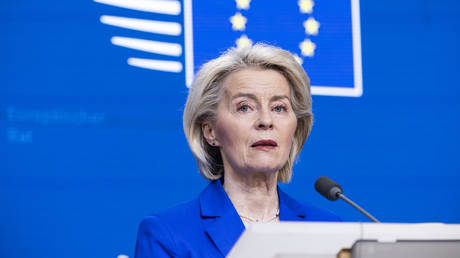
The European Commission is moving to break the international stalemate over a $50 billion loan to Ukraine by signaling its readiness to act without the full cooperation of the United States. Ursula von der Leyen’s recent messaging confirms a strategic shift in Brussels. The European Union (EU) no longer views a consensus among the G7 as a prerequisite for funding Kyiv’s defense and reconstruction. Instead, the Commission is preparing a legislative framework to use the windfall profits from frozen Russian central bank assets as a primary guarantee, even if Washington remains sidelined by legislative hurdles or shifting political winds.
This is not merely a financial maneuver. It is a calculated assertion of European sovereignty over a conflict that has exposed the fragilities of the transatlantic alliance. While the G7 agreed in principle earlier this year to provide $50 billion to Ukraine by the end of 2024, the technicalities have become a quagmire. The U.S. has demanded that the EU extend its sanctions regime on Russian assets from six-month renewals to a much longer duration to ensure the revenue stream remains stable for the life of the loan. However, Hungary’s consistent use of its veto has blocked that extension, leaving the U.S. wary of committing its own taxpayers' money to a plan that could be derailed by a single dissenting European capital.
The Mechanics of the Unilateral Move
The EU’s workaround involves a "Macro-Financial Assistance" (MFA) package. By using the EU budget as a backstop, Brussels can raise money on the capital markets and distribute it to Kyiv, bypassing the need for a unanimous G7 agreement on every technical detail. This allows von der Leyen to circumvent the American demand for a multi-year sanctions freeze, which is currently a political impossibility in the European Council.
The math depends on the roughly €210 billion in Russian assets currently held in the EU, mostly through the clearing house Euroclear in Belgium. These assets generate billions in interest every year. Under the new proposal, the EU would use these specific "extraordinary revenues" to service and repay the debt.
If the U.S. or other G7 partners like Japan or Canada do not join the effort immediately, the EU is prepared to provide a larger share of the total $50 billion—potentially up to €35 billion—on its own. This is a high-stakes gamble. If the war ends or assets are unfrozen as part of a peace deal before the loan is repaid, the EU budget—and by extension, European taxpayers—would be left holding the bill.
The Hungarian Obstacle and the Qualified Majority
Viktor Orbán has turned the routine renewal of sanctions into a powerful bargaining chip. By threatening to block the long-term rollover of asset freezes, he has effectively stalled the American portion of the G7 loan. However, the EU’s legal team has identified a path forward that does not require Orbán’s permission for the loan itself.
Funding mechanisms based on the EU budget can often be approved via Qualified Majority Voting (QMV). This means that while Hungary can block the long-term sanctions renewal, it cannot necessarily stop the EU from borrowing against its own budget or using the current interest payments to back a loan. This creates a strange paradox where the EU is forced to take on more risk because it cannot achieve internal political unity on the underlying sanctions.
The Risk to Euroclear and the Euro
Critics of this plan warn of a "chilling effect" on global finance. When a central bank's assets are effectively collateralized for a third-party loan, it changes the definition of a "safe asset."
If central banks in the Global South perceive that their reserves could be seized or leveraged in the event of a diplomatic fallout, they may move their holdings out of the Euro and into other currencies or physical gold. This could weaken the Euro’s status as a global reserve currency.
Financial analysts at major institutions have noted that the precedent set here is irreversible. We are watching the transition of the international financial system from a rules-based order to a tool of geopolitical warfare. For Brussels, the risk of a Ukrainian collapse outweighs the risk of currency devaluation.
Understanding the U.S. Hesitation
Washington’s reluctance isn't just about the EU’s six-month sanction cycles. There is a deeper concern regarding the longevity of the war and the changing nature of American foreign policy. With an election on the horizon, the Biden administration wants a "bulletproof" financial arrangement that a future administration cannot easily dismantle.
By demanding that the EU lock in its sanctions for 36 months or more, the U.S. is asking for a level of European consistency that the current political climate in Brussels cannot provide. Von der Leyen knows this. Her decision to push forward "one way or the other" is an admission that the EU can no longer wait for American political alignment.
Where the Money Goes
The $50 billion isn't just a blank check for ammunition. Ukraine’s fiscal gap for the coming year is estimated at roughly **$38 billion**. This money is needed to keep the lights on, pay civil servants, and maintain the social contract while the nation’s industry is under constant bombardment.
- Energy Infrastructure: Rapid repairs to the power grid before winter.
- Macro-Stability: Preventing hyperinflation as the Ukrainian central bank is forced to print money to cover defense costs.
- Military Procurement: While the MFA funds are often restricted to civilian use, they free up other parts of the Ukrainian budget for frontline expenses.
The Legal Tightrope
The legal basis for using these profits rests on a distinction between the "principal" (the Russian assets) and the "windfall" (the interest). The EU argues that the interest does not belong to Russia under international law because it only exists due to the extraordinary sanctions measures that prevented the assets from being moved.
This is a thin legal needle to thread. Russia has already promised retaliatory seizures of Western assets still held in Russian territory. For every Euro the EU leverages, European companies like Raiffeisen Bank or TotalEnergies face the threat of losing their remaining Russian holdings.
The Strategic Divorce
This move represents a quiet but significant decoupling of European and American financial strategy. For decades, Europe has followed the U.S. lead on sanctions and international finance. By moving ahead with the Ukraine loan unilaterally, the EU is building its own financial architecture to handle crises in its own backyard.
It is a sign of a maturing—or perhaps a desperate—European Union. The necessity of the loan is undeniable; without it, Ukraine faces a winter of systemic failure. But the method of delivery signals that the era of seamless G7 coordination is ending, replaced by a "coalition of the willing" where the willing are those with the most to lose.
The legislation for this loan is expected to be fast-tracked through the European Parliament. Once the framework is in place, the first tranches of cash could reach Kyiv by the end of the year. The question remains whether this injection of capital will be enough to turn the tide, or if it is simply a very expensive way to buy more time in a war of attrition that is draining both sides of their reserves.
Analyze your own exposure to this shift by looking at the specific bonds the EU will issue to fund this. These "Ukraine Bonds" will be backed by the EU’s common budget, making them a de facto expansion of the bloc's joint debt—a concept that was supposed to be a one-time emergency measure during the pandemic but is now becoming a permanent feature of the European landscape.