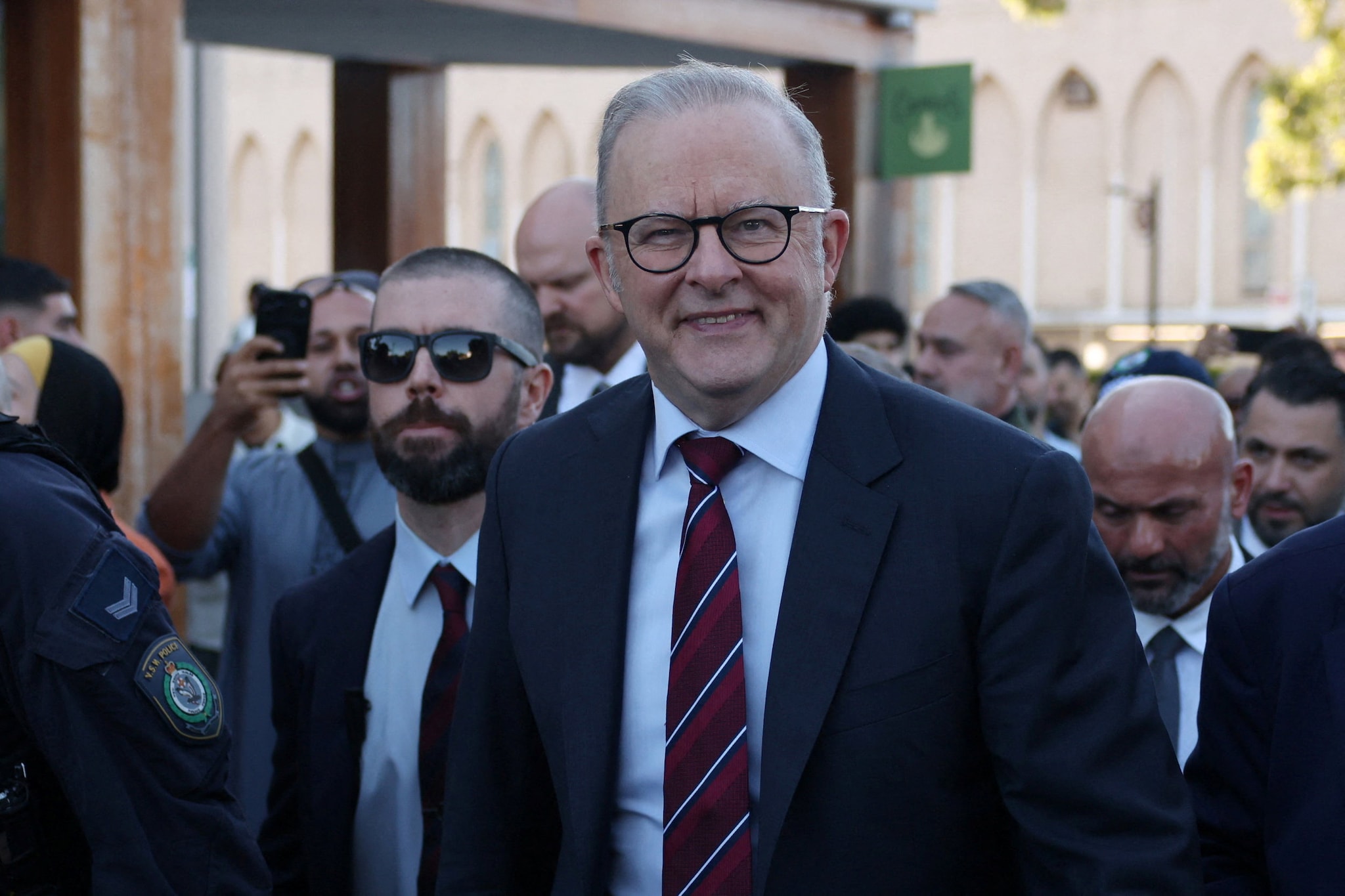
The air inside the Lakemba Mosque on a Friday afternoon usually carries a specific weight. It is the scent of aged carpet, the low hum of a thousand whispered intentions, and the collective exhale of a community seeking a moment of sanctuary from the friction of Sydney life. But when Prime Minister Anthony Albanese stepped toward those doors recently, the atmosphere didn't just shift. It fractured.
Security details in dark suits always look out of place in sacred spaces. They carry a stiffness that contradicts the fluidity of prayer. On this particular day, that stiffness was met by a wall of noise—not the rhythmic chanting of the faithful, but the jagged, desperate roar of people who felt their presence was being used as a backdrop for a political stage-managed performance.
"You are not welcome!"
The words didn't come from a singular megaphone. They erupted from the crowd. It was a visceral rejection that bypassed the usual protocols of diplomatic visits. For the Prime Minister, a man who has built a career on the image of the "everyman" from the inner west, the vitriol was a sharp departure from the handshake-and-smile circuit. He wasn't just a politician visiting a constituency; he was a symbol of a government that many in that crowd believe has turned a cold shoulder to a humanitarian catastrophe.
The Geography of Grief
To understand why a visit to a mosque in Western Sydney became a flashpoint, you have to look past the headlines of the day. You have to look at the living rooms in suburbs like Auburn, Bankstown, and Lakemba. In these homes, the television is almost always tuned to international news feeds. The faces on the screen—covered in gray dust, screaming into the camera, or wrapped in white shrouds—are not abstract figures. They are cousins. They are childhood friends. They are the sons and daughters of people who immigrated to Australia with the promise that this was a place where human rights were more than just a campaign slogan.
When the Prime Minister arrives at the mosque, he brings the weight of the Australian state with him. For those shouting from the sidelines, his presence was a reminder of what they see as a hollow middle ground. They see a government that speaks of "restraint" while the body counts in Gaza climb. They see a leader who calls for a ceasefire in a tone that feels, to them, like a polite suggestion rather than a moral demand.
Consider a man in the crowd—let’s call him Omar. Omar didn't wake up that morning planning to heckle a world leader. He woke up, checked his phone, and saw that another family member’s home in Deir al-Balah had been leveled. He spent his morning looking at a blurry photo of a pile of rubble that used to be a kitchen where he once ate olives and warm bread. By the time he reached the mosque, the sight of a motorcade and a phalanx of cameras felt like an insult. It felt like his grief was being treated as a PR opportunity.
The Impossible Walk
Albanese’s walk from the car to the entrance was short, but it must have felt like a mile. Every step was punctuated by cries of "Shame!" and "Free Palestine!" This wasn't the fringe agitation of professional protesters. This was the raw, unpolished anger of a voter base that feels betrayed.
For years, the Labor Party has relied on the migrant vote in Western Sydney. It was a silent contract: we provide you a home and a fair go, and you provide the numbers. But that contract is being torn up in real-time. The conflict in the Middle East has moved from the "foreign affairs" folder to the "kitchen table" folder. It is now a domestic issue that determines whether a citizen feels seen by their own leader.
The Prime Minister’s face remained a mask of practiced neutrality, the kind politicians wear when they are told to "keep moving" by their handlers. But the cameras caught the flicker of the moment. You can’t ignore a wall of sound that loud. You can’t ignore the fact that the very people you are trying to "outreach" to are telling you to turn around and leave.
The Language of the Middle Ground
The Australian government has tried to walk a razor-thin line. They condemn the attacks of October 7th while expressing concern for the civilian toll in Gaza. They vote for UN resolutions but include enough caveats to keep their traditional allies comfortable. In the air-conditioned offices of Canberra, this is called "nuanced diplomacy."
In the streets of Lakemba, it is called cowardice.
There is a fundamental disconnect between the language of the state and the language of the street. The state speaks in "strategic interests" and "bilateral ties." The street speaks in "blood" and "justice." When these two languages collide at the gates of a mosque, there is no translator. There is only friction.
The protesters weren't just angry about what was happening 12,000 kilometers away. They were angry about the perceived silence here. They were angry that their tax dollars and their democratic mandate are tied to a government they see as complicit through its hesitation. To them, the Prime Minister wasn't a guest; he was a trespasser on a moral high ground he hadn't earned the right to stand on.
When the Photo Op Fails
The modern political machine is built on the "visit." The leader goes to a school, a factory, or a place of worship. They wear the appropriate attire, they nod solemnly, and the evening news runs a thirty-second clip that signals "inclusion." It’s a ritual of governance.
But rituals only work when there is a shared belief in the ceremony.
The Lakemba visit failed because the belief has evaporated. You cannot perform a gesture of solidarity when the people you are visiting feel you are actively undermining their humanity on the world stage. The "Watch" tag on the news clips wasn't just an invitation to see a protest; it was an invitation to witness the collapse of a specific kind of political theater.
The heckling was disorganized, loud, and messy. It lacked the polish of a televised debate. And that is exactly why it was so potent. It was an intrusion of reality into a curated schedule. It forced the Prime Minister to see, if only for a few minutes, the human cost of a "balanced" position.
The Invisible Stakes
If you look past the shouting, you see a deeper crisis of identity within the Australian fabric. For decades, we have congratulated ourselves on our successful multiculturalism. We point to festivals and food as proof that we all get along. But true multiculturalism isn't about eating together when times are good; it’s about standing together when times are horrific.
The protesters at the mosque are asking a question that the Australian government isn't ready to answer: Are we a community only when it's convenient? Or does the "fair go" extend to the people our allies are bombing?
This isn't just about one afternoon in Lakemba. It’s about the crumbling of a political alignment that has lasted for decades. The Labor Party is finding that "empathy" is an insufficient currency when people are looking for "action." You can't hug your way out of a genocide accusation. You can't "consult" your way out of a moral crossroads.
The Echo in the Halls of Power
Back in Canberra, the fallout will be managed. Advisers will look at polling data. They will talk about "vocal minorities" and "managing expectations." They will suggest the Prime Minister pivot to cost-of-living issues or housing—topics that feel safer, more domestic, more "manageable."
But they are missing the point. For the people outside that mosque, there is no "pivoting." You cannot pivot away from a hole in your heart. You cannot pivot away from the feeling that your leader considers some lives more "complex" to defend than others.
The Prime Minister eventually made it inside. He did the meeting. He spoke the words. But the story isn't what happened inside the mosque. The story is the shouting that followed him through the doors and waited for him when he left. It is the sound of a community finding its voice, not in the ballot box, but in the roar of the crowd.
The motorcade eventually sped away, leaving the streets of Lakemba to return to their usual rhythm. The sunset prayer began, and the mosque returned to its quiet dignity. But the air had changed. The carpet still smelled of age, and the whispers of the faithful continued, but the silence was gone. In its place was the memory of a day when the highest office in the land was told, in no uncertain terms, that some spaces cannot be entered with a hollow promise.
A leader's power is often measured by the rooms they can enter. But in the end, it is truly defined by the ones where they are told to stay outside.