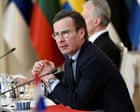
The coffee in the Swedish Riksdag’s cafeteria tastes exactly like the politics upstairs: bitter, functional, and served in cups that have survived a dozen different administrations. For decades, there was a silent agreement among the people holding those cups. You could argue about taxes. You could scream about schools. But you did not sit down with the Sweden Democrats. You did not invite them into the room where the real decisions are made.
That silence just shattered.
Ulf Kristersson, a man whose career has been defined by the careful balancing act of center-right pragmatism, has finally looked across the aisle and made the offer that was once unthinkable. He didn't just suggest a conversation. He offered a deal that could place the far-right—a party with roots buried deep in neo-Nazi soil—directly into the gears of the Swedish government.
To understand why this feels like an earthquake in Stockholm, you have to look past the polling percentages and the dry legislative jargon. You have to look at the dinner tables in Malmö and the quiet, wooden porches in the northern forests of Norrland. Sweden’s identity has long been built on a foundation of "Folkhemmet"—the People’s Home. It was a promise of a tidy, safe, and radically inclusive society. Now, the architect of the center-right is suggesting that the only way to save the house is to let in the people who spent years trying to tear down its front door.
The Architect’s Dilemma
Kristersson is not a villain in a melodrama. He is a man who wants to be Prime Minister, and in the brutal arithmetic of Swedish parliamentarianism, the numbers simply stopped adding up. Imagine a builder trying to support a roof with three beams when the blueprint requires four. He can keep holding the weight himself until his bones snap, or he can pick up a piece of scrap wood from the yard. It’s dirty. It’s weathered. It carries a history he doesn't like. But it’s the only thing that fits the gap.
The Sweden Democrats, led by Jimmie Åkesson, have spent twenty years scrubbing their boots. They traded the bomber jackets for slim-fit suits and swapped the overt rhetoric for a polished, nationalist message centered on crime and immigration. For years, the "Blue-Yellow" bloc—the traditional conservatives—treated them like a contagious disease. They were the pariahs.
Then, the world changed. Gang violence, once a foreign concept to the Swedish psyche, began to dominate the nightly news. Explosions in apartment complexes and daylight shootings in shopping malls created a climate of fear that the traditional parties struggled to address. The Sweden Democrats didn't create the fire, but they were the only ones standing there with a bucket of water, even if the water smelled like gasoline.
Kristersson’s gamble is born of exhaustion. By offering a deal that could lead to ministerial posts or a formal coalition, he is betting that the responsibility of governing will temper the radicals. He is betting that the "cordon sanitaire"—the policy of isolation—has only made the far-right stronger by allowing them to play the martyr.
The Ghost at the Table
Consider a hypothetical voter named Henrik. Henrik lives in a suburb of Gothenburg. He’s worked in logistics for thirty years. He used to vote for the Social Democrats because his father did. But lately, Henrik feels like a stranger in his own neighborhood. He sees the headlines about "no-go zones" and feels a creeping anxiety that his political leaders are more interested in looking virtuous than in keeping the streets safe.
When Henrik hears that Kristersson is willing to work with the Sweden Democrats, he doesn't feel a sense of moral outrage. He feels a sense of relief. To him, the "far-right" label is an academic distinction. He sees people who finally seem to be speaking his language, even if the accent is a bit harsh.
But then consider Elin, a second-generation Swede whose parents fled conflict in the Middle East. For Elin, this deal isn't about "pragmatic governance." It’s a betrayal of the Swedish promise. She has spent her life integrating, working as a nurse, and believing that her Swedishness was a matter of shared values, not bloodlines. When the Prime Minister candidate opens the door to a party that has historically questioned her right to belong, the air in the room turns cold.
The stakes aren't just about tax brackets or NATO membership. The stakes are the definition of what it means to be Swedish. If Kristersson follows through, the "Broken Blue Wall" becomes a permanent feature of the landscape.
The Arithmetic of Power
The proposed deal is a masterclass in political desperation. Kristersson needs the Sweden Democrats' votes to pass a budget. Without them, he is a king without a kingdom. In exchange, the Sweden Democrats want more than just influence; they want legitimacy. They want to be able to tell their voters that they aren't just shouting from the sidelines anymore—they are holding the pen.
But power is a corrosive thing. When a mainstream party absorbs the rhetoric of the fringe to survive, they often find that the fringe starts absorbing them. We have seen this play out across Europe, from the Alps to the North Sea. The center-right believes they can "tame" the populists by bringing them into the fold. Usually, they just end up moving the entire political center of gravity several degrees to the right.
Kristersson is walking a tightrope over a canyon filled with his own supporters' doubts. If he gives away too much, he loses the moderate liberals who find the Sweden Democrats' social policies abhorrent. If he gives away too little, Åkesson can simply walk away, collapse the government, and watch the chaos from the safety of the opposition benches.
The Invisible Cost
There is a psychological price to pay when a nation's "unbreakable" rules are broken. For decades, Sweden held itself up as a moral superpower, a place where the extremes were kept in check by a collective commitment to decency. That exceptionalism is dying.
The deal isn't signed in blood yet, but the ink is dry on the table. By even making the offer, Kristersson has changed the chemistry of the country. He has signaled that there is no longer a "forbidden" side of the aisle. Every future election will now be a different game, played with different pieces.
The real danger isn't necessarily a radical shift in policy overnight. Sweden’s bureaucracy is deep and slow; it resists sudden movements. The danger is the slow erosion of the social contract. It’s the way people look at each other in the grocery store. It’s the quiet realization that the "fringe" is now the "center."
As the sun sets over the Stockholm archipelago, reflecting off the water in shades of bruised purple and gold, the city looks as peaceful as ever. But inside the halls of power, the air is thick with the scent of a bargain. It’s the smell of a man who has decided that a seat at the head of the table is worth the company he has to keep.
The cups of coffee in the Riksdag are still bitter. But for the first time in a generation, no one is sure who will be sitting down to drink them tomorrow. The wall is down, and once the stones are scattered, you can never quite stack them back the same way again.