Twenty-one miles.
That is the width of the Strait of Hormuz at its narrowest point. To a long-distance swimmer, it is a morning’s grueling work. To a modern naval commander, it is a claustrophobic nightmare. To the rest of us, it is the fragile carotid artery of the global economy, a sliver of blue water where the world’s pulse is measured in barrels and insurance premiums.
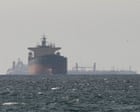
Imagine a merchant sailor named Elias. He is not a diplomat. He does not sit in the gilded rooms of Whitehall. He stands on the bridge of a massive crude carrier, watching the radar screen as his vessel creeps through the Omani and Iranian waters. For Elias, this isn't a geopolitical chess match; it is a calculation of survival. If a single mine drifts into the path of his hull, or if a drone swarm silhouettes against the dawn, the ripple effect doesn't just stop with his ship. It reaches your local gas station, the cost of your morning grocery run, and the heat in your radiator three thousand miles away.
Keir Starmer understands that the peace of the world often rests on the quiet passage of ships like Elias’s. This is why Britain has summoned thirty-five nations to the table. This isn't just another summit. It is an act of collective breath-holding.
The Weight of the World on a Narrow Blue Line
Why thirty-five? Because the math of a maritime crisis is unforgiving. One-fifth of the world’s total oil consumption passes through this single gateway every day. When the Strait trembles, the markets scream.
In the dry language of a standard press release, this is "maritime security cooperation." In reality, it is a desperate attempt to prevent a spark from hitting a powder keg. The British Prime Minister is positioning the UK as the convener, the middleman in a world that is rapidly unravelling. By hosting these talks, the UK isn't just flexing its diplomatic muscles; it is trying to shore up a global order that feels increasingly like a house of cards.
The stakes are invisible until they are agonizingly real. We take the flow of goods for granted. We assume that the smartphone in our pocket and the fuel in our car will always be there, arriving via some magic, frictionless process. But that process relies on the silence of the Strait. If the music stops in Hormuz, the silence is deafening.
Consider the hypothetical, yet grounded, scenario of a "gray zone" escalation. No one declares war. No one fires a nuclear missile. Instead, a series of "accidents" happen. A tanker is seized under a legal pretext. A GPS signal is jammed, sending a cargo ship veering into a restricted zone. These small frictions create a cumulative heat. Insurance companies, the ultimate arbiters of global trade, begin to hike their rates. Suddenly, shipping a container doesn't cost five thousand dollars; it costs fifty thousand.
That is the hidden cost of instability. It is a tax on existence, levied by geography and guarded by steel.
The Ghost of Diplomacy Past
Starmer is walking a tightrope that has snapped many times before. The history of the Middle East is littered with the remains of well-intentioned summits. Britain’s role here is complicated by its own history in the region—a legacy of drawing lines in the sand that didn't always account for the people living on them.
But this time, the urgency is different. We are no longer in a unipolar world where one navy can play global policeman. The presence of thirty-five countries—ranging from regional powers to European allies and Asian giants—suggests a realization that no one is coming to save us. We have to save ourselves.
The talks are designed to build a "maritime architecture." It sounds cold. It sounds like something a bureaucrat would say. But think of it as a neighborhood watch for the ocean. If thirty-five flags are flying in the region, the cost of aggression becomes too high for any one actor to bear. It is the logic of the crowd.
The Human Cost of a Blown Fuse
If these talks fail, the person who suffers most isn't the politician in the motorcade. It is the family deciding whether to buy meat or pay the electricity bill. When the Strait of Hormuz is threatened, the price of energy spikes instantly. Because oil is the fundamental ingredient in almost everything we touch—from the plastic in a medical syringe to the fertilizer used to grow wheat—a blockage in the Gulf is a blow to the stomach of the global poor.
We often talk about "national security" as if it were a high-altitude concept, something handled by men in dark suits. But national security is actually about the stability of the dinner table. It is about the certainty that the lights will turn on when you flip the switch. Starmer’s summit is, at its heart, an attempt to protect that certainty.
The challenge is that trust is at an all-time low. How do you get thirty-five nations, many of whom harbor deep-seated animosities toward one another, to agree on anything? You focus on the common enemy: chaos. Chaos is bad for business. Chaos is bad for reelection. Chaos is the only thing that every nation in that room fears more than their neighbors.
The Strategy of the Soft Power
Britain is using its "soft power" to prevent a "hard power" catastrophe. By acting as the host, the UK avoids the optics of a direct military intervention while still exerting influence over the outcome. It is a gamble. If the talks result in nothing but a vague communique, the UK looks weak. But if they can establish a real-time communication channel between these nations—a way to de-escalate a crisis before the first shot is fired—it will be one of the most significant diplomatic achievements of the decade.
The invisible threads of globalization have made us all neighbors. A tremor in a narrow stretch of water off the coast of Iran can cause a quake in a boardroom in London or a factory in Tokyo. We are bound together by our needs, if not by our values.
The room where these thirty-five representatives meet will be silent, save for the shuffle of papers and the hum of air conditioning. But outside those walls, the world is shouting. The waves are crashing against the hulls of tankers. The radar sweeps are painting green lines across dark screens.
Elias, our sailor on the bridge, looks out into the darkness of the Strait. He sees the lights of other ships, a constellation of commerce moving through the shadows. He doesn't know what is being said in London. He only knows that he needs the water to remain calm. He needs the world to keep its word.
The success of these talks won't be measured in headlines. It will be measured in the things that don't happen. The tankers that aren't seized. The prices that don't skyrocket. The wars that never begin. It is the most difficult kind of victory to claim—the victory of the status quo, the triumph of the uneventful morning.
In a world addicted to drama and obsessed with the spectacular, we have forgotten the profound beauty of a boring day. Starmer is inviting thirty-five nations to join him in the pursuit of the ordinary. Because for the person standing on the deck of a ship or the person sitting at a kitchen table, the ordinary is the only thing that matters.
The water remains blue. The ships continue to move. The pulse beats on, twenty-one miles at a time.