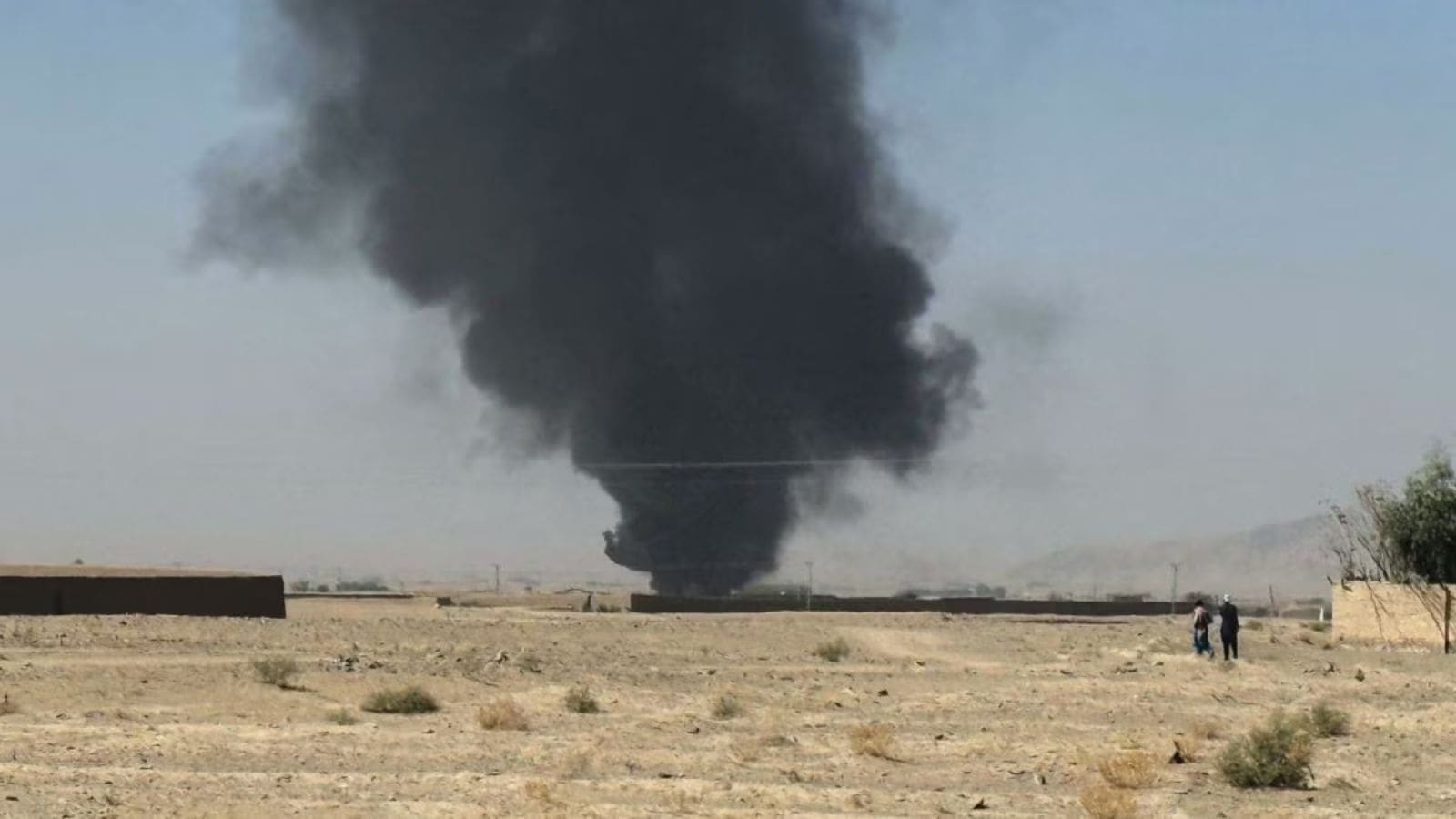
The transition of the Taliban from an insurgent force to a state actor has fundamentally altered the security architecture of Central and South Asia, turning the 2,640-kilometer Durand Line from a porous militant corridor into a flashpoint of conventional state-on-state friction. Recent retaliatory strikes by Afghan forces against Pakistani border posts are not isolated tactical outbursts; they represent a deliberate calibration of asymmetric pressure designed to challenge Pakistan’s historical strategic depth. This conflict is driven by a structural divergence in security priorities, where Kabul seeks territorial sovereignty and Islamabad seeks a neutralized western frontier.
The Triad of Kinetic Friction
The escalation of cross-border violence operates through three distinct mechanical drivers that dictate when and how the Afghan interim government chooses to engage Pakistani military assets.
- Territorial Legitimacy and Fencing: The physical barrier constructed by Pakistan is viewed by the Taliban as a violation of historical claims. Each "retaliatory" strike serves as a functional veto against the solidification of a permanent border. By targeting border posts, Kabul disrupts the engineering and maintenance of the fence, maintaining a status quo of ambiguity that favors local tribal mobility.
- Internal Militant Management: The presence of the Tehrik-i-Taliban Pakistan (TTP) creates a binary trap for the Afghan administration. If Kabul suppresses the TTP, they risk internal fracturing and defections to more radical groups like IS-K. If they allow the TTP to operate, they invite Pakistani kinetic responses. Afghan "retaliation" is often a signaling mechanism to appease internal hardliners by demonstrating that the Taliban will not be a subservient proxy to Islamabad.
- Domestic Diversion and Sovereignty Signaling: Faced with economic isolation and a lack of international recognition, the Taliban utilize border skirmishes to consolidate domestic support. Acting against a historically dominant neighbor allows the interim government to project the image of a "protector of the soil," a crucial component of state-building for a former guerrilla movement.
The Cost Function of Border Skirmishes
For both Kabul and Islamabad, the decision to engage in cross-border shelling involves a complex calculation of diminishing returns. The "cost" is not merely measured in munitions or casualties, but in the degradation of critical trade infrastructure.
The Chokepoint Variable
The Torkham and Chaman border crossings serve as the primary respiratory system for the Afghan economy. When skirmishes escalate, these gates close.
- For Afghanistan: Closure results in an immediate spike in the price of essential goods, particularly wheat and fuel, which fuels domestic unrest.
- For Pakistan: Obstruction of these routes hinders transit trade to Central Asia, a key pillar of Pakistan’s regional economic connectivity strategy.
The paradox of this conflict is that while both sides use military force to signal strength, the economic interdependence of the two nations acts as a hard ceiling on escalation. A full-scale conventional war remains improbable because neither state possesses the fiscal reserves or the logistical depth to sustain a high-intensity conflict while managing internal economic crises.
Mapping the Escalation Ladder
The current cycle of violence follows a predictable sequence that moves from diplomatic friction to kinetic exchange.
- Phase I: Intelligence and Safe Haven Allegations. Pakistan identifies a TTP-linked strike within its borders and attributes it to Afghan-based sanctuaries.
- Phase II: Kinetic Encroachment. Pakistan conducts targeted strikes (often via drones or artillery) against alleged militant hubs inside Afghan territory.
- Phase III: The Taliban Counter-Strike. Afghanistan utilizes heavy weaponry—including tanks and mortars seized during the 2021 withdrawal—to target Pakistani frontier paramilitary posts. This is framed as "retaliation" to maintain the narrative of defensive sovereignty.
- Phase IV: Economic Strangulation. Pakistan closes the border crossings, and both sides enter a period of "shuttle diplomacy" mediated by tribal elders or regional actors to restore the status quo.
This cycle is self-perpetuating because the underlying issue—the status of the TTP and the legitimacy of the Durand Line—remains unaddressed. Kabul views the TTP as a leverage point; Islamabad views it as an existential threat.
The Structural Failure of Bilateral Mechanisms
The breakdown in communication is not due to a lack of channels, but a lack of shared definitions. When Pakistan speaks of "counter-terrorism," the Taliban interpret it as "infringement on sovereignty." This linguistic and conceptual gap renders joint border commissions ineffective.
Furthermore, the Taliban’s military structure remains decentralized. Local commanders along the Kunar and Nangarhar provinces often initiate contact without direct orders from the Ministry of Defense in Kabul. This "commander’s agency" makes the border inherently volatile, as a local grievance over a checkpost can rapidly scale into a regional diplomatic crisis.
Regional Geopolitical Spillover
The Afghan-Pakistani friction does not exist in a vacuum. It recalibrates the influence of neighboring powers, specifically China and India.
- China’s Stability Mandate: Beijing’s primary interest is the security of the China-Pakistan Economic Corridor (CPEC). Sustained instability on Pakistan’s western flank threatens the viability of these investments. China has increasingly moved into a mediatory role, attempting to tether the Taliban to a regional security framework through economic incentives.
- India’s Strategic Observation: New Delhi views the Taliban-Pakistan rift as a significant shift in the regional balance of power. The erosion of the "strategic depth" doctrine—where Pakistan expected a friendly regime in Kabul—provides India with an opening to engage the Taliban on a pragmatic basis, focusing on humanitarian aid and technical support.
Strategic Forecast: The Move Toward a Permanent Friction State
The most probable trajectory for the Afghan-Pakistani border is a transition into a "Permanent Friction State." This is characterized by low-to-medium intensity skirmishes that never escalate into full-scale war but never settle into a lasting peace.
To manage this, the strategic play for regional actors is the institutionalization of the "Tribal Buffer." Since the central governments in Kabul and Islamabad are locked in a zero-sum game over sovereignty and security, the only stabilizing force is the local informal governance structure. Strengthening the role of the Jirga (tribal assembly) in resolving border disputes provides a "face-saving" exit for both militaries during periods of escalation.
For the Taliban, the endgame is the decoupling of Afghan trade from Pakistani ports. By aggressively pursuing transit corridors through Iran (Chabahar) and toward the Central Asian republics, Kabul aims to reduce the leverage Pakistan holds via border closures. Once this economic dependency is neutralized, the frequency and intensity of "retaliatory" strikes are likely to increase, as the cost of kinetic engagement for Afghanistan will have been significantly lowered.
The immediate requirement for Pakistan is a recalibration of its Afghan policy from one of "influence through proximity" to "containment through fortification." This necessitates a shift away from expecting ideological alignment with the Taliban and moving toward a cold, interest-based relationship defined by border management and intelligence-led operations rather than broad-based political support.