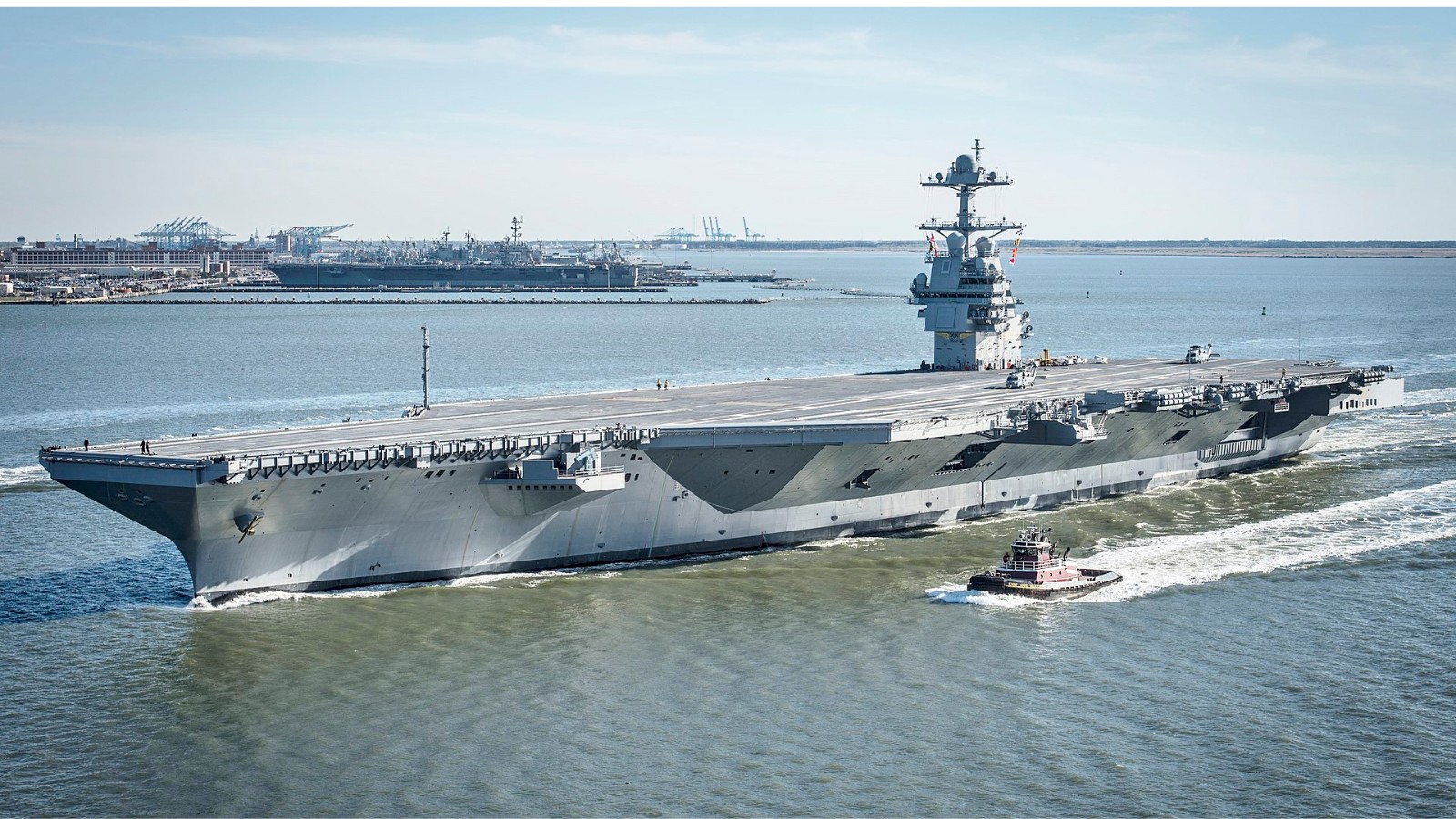
The deployment of the USS Gerald R. Ford (CVN 78) into the Eastern Mediterranean serves as a case study in the diminishing returns of carrier-based deterrence when disconnected from sustainable human capital management. While the vessel represents a $13 billion investment in naval supremacy, its extended 263-day deployment highlights a critical failure in the Force Generation (FORGEN) model. The strategic objective—deterring a multi-front regional escalation involving Iran—was achieved at the expense of the carrier strike group’s long-term operational readiness and the retention of its specialized labor force.
Analyzing this deployment requires moving beyond the surface-level reports of missed personal milestones. Instead, we must examine the Triad of Operational Degradation: the mechanical strain on first-in-class systems, the depletion of "Human Readiness" reserves, and the distortion of the Navy's Global Force Management Allocation Plan (GFMAP).
The Mechanics of First-in-Class Friction
The USS Gerald R. Ford is not merely a replacement for the Nimitz class; it is a fundamental shift in sortie-generation architecture. However, new technologies introduce high-variance failure rates that compound during unplanned extensions.
- Electromagnetic Aircraft Launch System (EMALS) Lifecycle Stress: Unlike traditional steam catapults, EMALS uses a linear induction motor. Extended deployments increase the cycle count beyond the predicted maintenance windows, forcing shipboard engineers to perform "mid-mission" resets that are typically reserved for port-side availabilities.
- Advanced Weapons Elevators (AWE): The transition from cable-driven to motor-driven, software-controlled elevators was intended to increase the Sortie Generation Rate (SGR). In a high-tension environment like the Eastern Mediterranean, the duty cycle of these elevators is near-constant. When a deployment is extended, the lack of pier-side software calibration leads to a degradation in ammunition throughput.
- The Waste Management Bottleneck: Reports of "blocked toilets" are often dismissed as minor quality-of-life issues. In reality, they indicate a failure in the Vacuum Collection, Holding, and Transfer (VCHT) systems. On a Ford-class carrier, these systems are more sensitive to particulate matter than those on older ships. A failure here is a bio-hazard risk that directly impacts the "habitability metric," a key lead indicator for crew fatigue and cognitive decline in high-stakes environments.
The Cost Function of Human Readiness
The Navy operates on a "redline" logic regarding crew endurance. When a deployment exceeds the standard six-to-seven-month window, the crew enters a state of Negative Training Value. This is the point where the risk of a "Class A" mishap—defined as an incident resulting in $2.5 million or more in damage, or a fatality—increases exponentially due to cognitive tunneling and chronic sleep deprivation.
The Breakdown of Personal Predictability
Military effectiveness relies on a psychological contract: the service member accepts high-risk environments in exchange for a predictable schedule of return. Breaking this contract via "at-sea extensions" triggers a Retention Death Spiral.
- Social Capital Depletion: Missing funerals or births is not just a moral weight; it removes the sailor from their civilian support network, increasing the burden on the Navy’s internal family support programs, which are often underfunded.
- Skill Atrophy: While sailors are performing their primary duties at sea, they are missing the formal schooling and certifications required for promotion. An extended deployment creates a "promotion lag," making the private sector—which is currently aggressive in recruiting nuclear-trained technicians—far more attractive.
Geopolitical Deterrence vs. Material Readiness
The decision to keep the Ford on station was a tactical success but a strategic liability. By keeping the carrier in the Mediterranean to signal resolve to Iran and Hezbollah, the Department of Defense accepted a Future Readiness Debt.
- The Maintenance Backlog: Every day a carrier spends at sea is a day it is not in the shipyard. The Ford’s extension pushed back its scheduled Planned Incremental Availability (PIA). Because shipyard slots in the United States are extremely limited and scheduled years in advance, one ship’s delay creates a "bullwhip effect" across the entire fleet.
- The Pivot to the Pacific: While the Ford was held in the Atlantic/Mediterranean theater, the "Indo-Pacific" requirement remained constant. This forced other carriers, such as the USS Dwight D. Eisenhower, into similarly punishing cycles. The Navy is effectively "cannibalizing" the future availability of its fleet to meet the immediate demands of the present.
Quantifying the "Extension Tax"
The true cost of the Ford's deployment can be calculated through the Total Ownership Cost (TOC) framework. This includes:
- Direct Operational Costs: Fuel, ordnance replacement, and high-tempo maintenance parts.
- Indirect Retention Costs: The cost to recruit and train a replacement for a mid-career E-5 or E-6 (Petty Officer) who decides to "separate" from the Navy due to deployment fatigue can exceed $500,000 per individual in the nuclear or aviation communities.
- Opportunity Costs: The loss of the carrier’s availability for future high-end conflict because its reactors or catapults require longer-than-usual overhauls.
Structural Failures in the 2+2=5 Logic
The Pentagon often operates under the assumption that "Presence equals Deterrence." This logic fails when the presence is static and predictable. A carrier strike group sitting off the coast of Israel is a powerful symbol, but it is also a target and a massive resource drain.
The Asymmetric Cost Imbalance is stark: it costs the U.S. Navy millions of dollars per day to keep the Ford on station, while regional adversaries can maintain tension using low-cost drones and proxy rhetoric. This creates a "war of attrition" where the U.S. burns through its most expensive and hard-to-replace assets (carrier deployments) to counter low-cost threats.
Identifying the Operational Breaking Point
There is a measurable limit to how long a crew can maintain Condition II (modified battle stations) without a drop-off in reaction time. Data from previous long-duration deployments (such as the 290-day deployment of the USS Dwight D. Eisenhower during the COVID-19 pandemic) suggests that after month seven, the rate of "near-miss" aviation accidents increases by approximately 15%.
The Ford's crew was operating at the edge of this threshold. The "strained sailors" are not just a human interest story; they are a critical system component that is currently being operated outside of its designed parameters.
Strategic Realignment Requirements
To prevent the Ford deployment from becoming the new, unsustainable baseline for naval operations, three structural shifts are necessary:
- Dynamic Force Employment (DFE) Recommitment: The Navy must return to the DFE model, which emphasizes being "strategically predictable but operationally unpredictable." This means shorter, higher-intensity deployments rather than the nine-month marathons that have become the default.
- The "Habitability as a Weapon System" Initiative: Future ship designs and current refits must treat VCHT systems, Wi-Fi connectivity, and crew quarters not as luxuries, but as critical components of the ship's endurance. If the ship can stay at sea for a year but the crew breaks after six months, the ship’s 50-year lifespan is irrelevant.
- Redefining Deterrence in the Age of Proxies: The U.S. must develop lower-cost methods of regional presence that do not involve moving a 100,000-ton "city" every time a regional proxy issues a threat. This includes increased investment in unmanned surface vessels (USVs) and long-range, land-based strike capabilities.
The Ford’s deployment was a demonstration of American engineering and willpower, but it was also a warning. The Navy cannot continue to bridge the gap between a shrinking fleet and an expanding global threat environment by simply asking more of its human capital. Without a disciplined return to scheduled maintenance and deployment cycles, the "Flagship of the Navy" will become a symbol of overreach rather than strength.
The immediate strategic play for the Navy is a mandatory "Readiness Reset" for the Atlantic fleet, accepting a temporary reduction in Mediterranean presence to clear the maintenance backlog and stabilize the personnel pipeline. Failure to do so will result in a "hollow fleet" where the hulls are new, but the crews are gone.