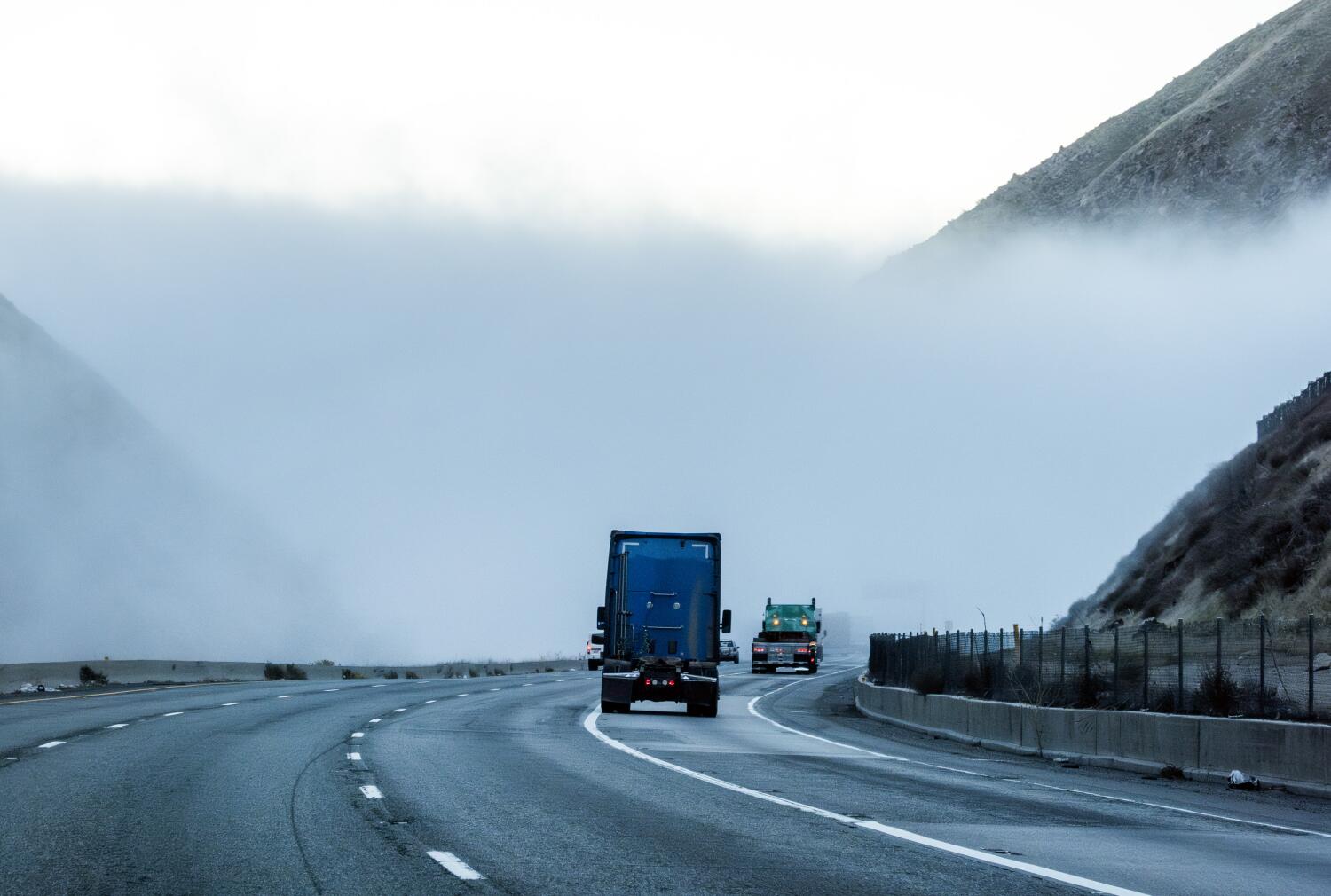
The sun doesn't set in the Central Valley during the Tule season; it simply dissolves. One minute you are looking at the jagged silhouette of a walnut orchard, and the next, the world is a bowl of milk. It is a thick, wet, blinding presence that swallows the yellow lines on Highway 99 and turns high beams into useless, glowing Orbs.
We are used to the silence of the fog. We are used to the way it tastes like wet pennies and damp earth. But lately, the silence has been replaced by a low-frequency hum of digital anxiety.
On local Facebook groups from Bakersfield to Modesto, the tone has shifted from "drive safe" to "what is this?" People are posting photos of the mist under streetlights, claiming it looks iridescent, or oily, or unnaturally heavy. The rumors are spreading faster than a visibility warning: it’s a chemical experiment, it’s a byproduct of a new pesticide, it’s a fallout from a distant industrial accident.
The fear is visceral because the fog is intimate. It doesn’t just sit on the landscape; it gets into your clothes, your hair, and your lungs.
The Weight of the Air
To understand why a simple weather phenomenon is triggering a mass identity crisis, you have to look at the chemistry of a closed system. The Central Valley is a bathtub. To the east, the Sierras rise like a granite wall. To the west, the Coast Ranges form a jagged rim. When a high-pressure system parks itself over the state, it acts like a lid.
Meteorologists call this an inversion. Normally, warm air rises and carries pollutants away. During an inversion, a layer of warm air traps a pool of cold, moist air at the bottom of the bathtub. This is where the Tule fog is born.
But it isn’t just water vapor anymore.
Consider a hypothetical resident—let’s call her Elena. Elena has lived in Fresno for forty years. She remembers the "Great Fogs" of the eighties, when you couldn't see your own mailbox from the front porch. To her, this year feels different. Her throat is scratchier. Her inhaler, once a "just in case" tool for high-pollen spring days, is now on her nightstand in the dead of winter.
Elena’s anecdotal evidence isn't just "freaking out" for the sake of clicks. It’s a biological response to a changing atmospheric cocktail. When the fog forms, it doesn't just hang there; it acts as a solvent. It picks up the leftovers of our daily lives: the nitrogen oxides from the thousands of trucks hauling produce, the ammonium nitrate from the vast dairies, and the microscopic particles of dust and tire rubber.
The moisture in the fog binds these pollutants together. Instead of a gas that might dissipate, you are breathing a liquid aerosol of concentrated valley life.
The Ghost in the Machine
The digital panic stems from a lack of trust in the visible world. When users on TikTok post videos of the fog "glowing" green or blue, they are often seeing a simple optical trick called Mie scattering. This occurs when the droplets in the air are roughly the same size as the wavelength of light hitting them.
However, telling a mother whose child is coughing that it’s just "Mie scattering" is like giving a lecture on thermodynamics to someone whose house is on fire.
The reality is that our air quality has become a ghost. We can’t see the PM2.5—the particles smaller than 2.5 micrometers—but we feel them. These particles are small enough to bypass the defenses of the nose and throat, entering the bloodstream and traveling to the heart and brain. In the Central Valley, the rates of childhood asthma are among the highest in the country.
The "unusual" nature of the fog this year isn't necessarily about its color or its density. It's about the timing. We are seeing longer periods of stagnation. The storms that used to "scrub" the valley clean are becoming more erratic. When the rain doesn't come to wash the bathtub, the water vapor simply recycles the same dirty air, day after day.
A Breach of the Senses
The psychological toll of living in a white-out cannot be overstated. There is a specific kind of claustrophobia that happens when you lose the horizon. In the Valley, the horizon is our only luxury. When it vanishes, the world shrinks to the distance between your face and your windshield.
This sensory deprivation makes the brain look for patterns. It makes the mind fertile ground for conspiracy. If you can’t see the sun for two weeks, and your chest feels tight, and the local news is talking about "atmospheric anomalies," it is a very short leap to believing that the fog is being "managed" or "seeded."
We have lost the ability to view the weather as a natural event. Every cloud is now scrutinized for a motive.
But the truth is more mundane and far more haunting. The fog isn't a weapon launched by a shadowy entity. It is a mirror. It is a visual representation of every gallon of diesel burned, every ton of fertilizer spread, and every mile driven in our pursuit of feeding the world.
The Cost of the Invisible
There is a moment in the middle of a Tule event where the world feels like it has ended. You pull over to the side of a farm road because the white-out is so absolute that you can no longer tell if you are on the pavement or in the dirt. You turn off the engine.
The silence is heavy.
In that silence, you realize that the "freak out" on social media isn't really about the fog. It’s about the realization that we are breathing our own choices. We are living in the exhaust of our own economy.
The unusual "glow" or the "strange smell" isn't a mystery to be solved by a whistleblower. It is the signature of a landscape that has been pushed to its limit. We have built a world where the very air we need to survive has become a medium for our waste.
When the fog eventually lifts—and it always does, usually with a sudden, violent wind from the north—the relief is short-lived. We see the mountains again. We see the sky. We look at the blue expanse and we forget what was hiding in the white.
We go back to our cars. We go back to our offices. We wait for the next high-pressure system to settle in, for the bathtub to fill up, and for the white wall to return, bringing with it the ghosts of everything we've tried to ignore.
The screen glows in the dark of a Stockton bedroom. A user types: "Does anyone else think the fog smells like burnt hair tonight?"
Fifty people like the post. Three people share it.
The fog doesn't answer. It just waits at the window, heavy and damp, pressing against the glass like a lung gasping for a version of the valley that no longer exists.