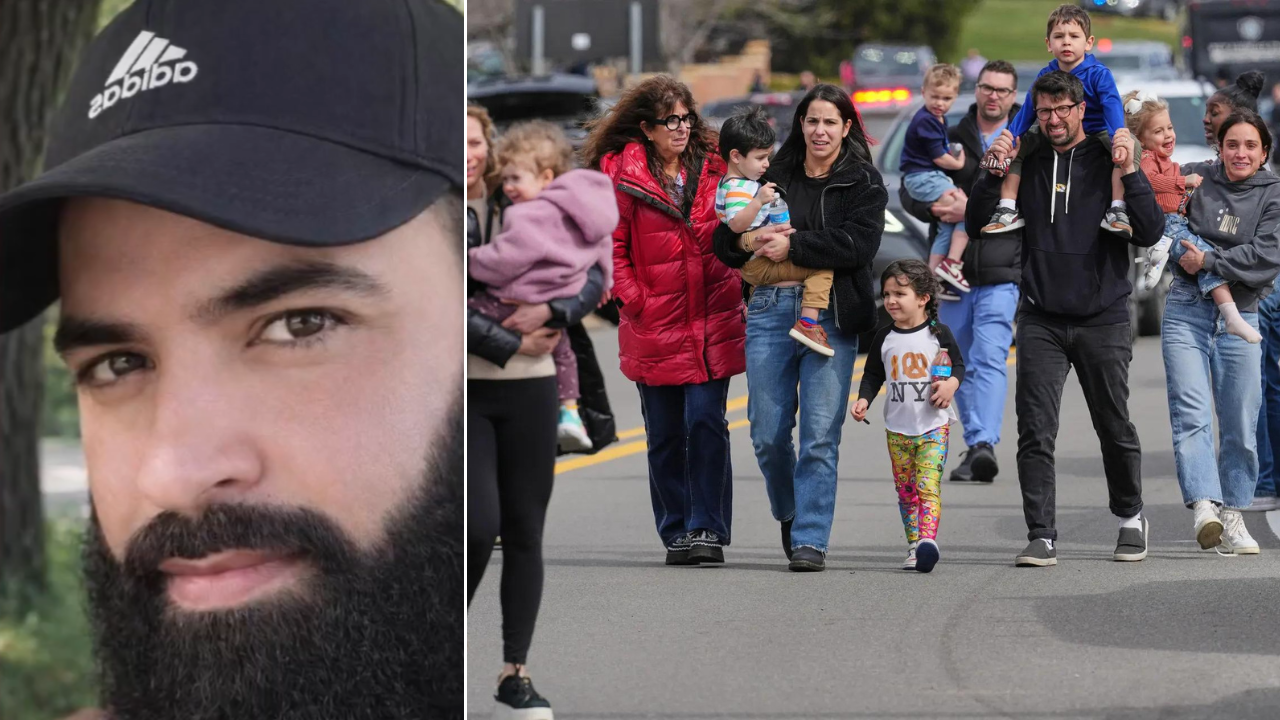
The Department of Homeland Security has identified Ayman Mohamad Ghazali, a 41-year-old naturalized U.S. citizen born in Lebanon, as the individual who rammed an SUV into Temple Israel in West Bloomfield, Michigan, on Thursday. Ghazali breached the facility by driving directly through the doors and down a central hallway before his vehicle erupted in flames, prompting a lethal exchange with armed synagogue security. While the FBI officially labels the event a targeted act of violence against the Jewish community, the investigation is now pivoting toward a devastating personal catalyst linked to the widening conflict between the U.S., Israel, and Iran.
The Breach at Temple Israel
The attack was not a random act of suburban drift. At roughly noon on March 12, 2026, Ghazali piloted his vehicle with what Oakland County Sheriff Michael Bouchard described as "purpose," navigating the narrow corridors of one of the largest Reform synagogues in the country. Inside, 140 children were attending the early childhood center. The carnage was only mitigated by the presence of a professional, private security team that engaged Ghazali immediately.
While first responders fought a blaze that sent thick black smoke over the Detroit suburbs, bomb technicians discovered what appeared to be mortar-type explosives in the rear of the charred SUV. Ghazali died at the scene, though it remains unclear if he was neutralized by security fire or took his own life as the vehicle became an inferno.
A Trail of Grief and Radicalization
To understand the "how," we must look at the "when." Sources within the Lebanese American community in Dearborn Heights reveal that Ghazali’s trajectory toward violence accelerated ten days prior to the attack. On March 2, 2026, an airstrike hit his family’s ancestral village in Lebanon. The strike—part of the ongoing military operations following the February 28 missile exchanges between the U.S., Israel, and Iran—reportedly killed Ghazali’s two brothers and two of their children.
Ghazali had been a resident of the United States since 2011, arriving on an IR1 immigrant visa as the spouse of a U.S. citizen. He was granted citizenship in 2016. However, his life in Michigan had recently fractured. Court records indicate a finalized divorce in March 2025, and former coworkers at a local restaurant noted he had stopped showing up for shifts following the news of the airstrike. Shortly before the siege, he reportedly called his ex-wife to tell her to "take care of the children," a red flag that prompted family members to contact local authorities—too late.
The New Face of Domestic Blowback
This incident highlights a terrifying reality for domestic intelligence agencies. Ghazali was not a "sleeper agent" in the traditional sense. He was a naturalized citizen whose radicalization appears to have happened in a matter of days, fueled by real-time grief and digital connectivity. Hours before the attack, Ghazali posted images of his deceased relatives on WhatsApp, a digital mourning process that turned into a manifesto of action.
The FBI’s Detroit field office, led by Special Agent in Charge Jennifer Runyan, is now tasked with determining if Ghazali acted entirely alone or if he was "inspired" by specific extremist directives currently flooding encrypted platforms. The presence of sophisticated explosives in the vehicle suggests a level of preparation that exceeds a simple crime of passion.
Security as the New Normal
The failure here was not tactical. Temple Israel’s security protocols worked; they maintained a "hardened" posture that saved dozens of lives. The failure is systemic. As the conflict in the Middle East spills over into unconventional theater, the "front line" has moved to the hallways of suburban Michigan.
Michigan has become a flashpoint for this friction. Thursday’s attack follows a similar incident last September where a former Marine targeted a church in Wayne County. The pattern is clear: international grievances are being litigated in American houses of worship.
The investigation into Ayman Mohamad Ghazali will likely conclude that he was a man broken by war and personal loss. But for the 140 families whose children were nearly caught in the crossfire, the "why" matters less than the "what now." Law enforcement across the country has already shifted to a state of heightened alert, recognizing that as long as the missiles fly in the Middle East, the echoes will be felt in the American heartland.
Check the security protocols of your local community centers and remain vigilant for signs of rapid-onset radicalization in your professional circles.