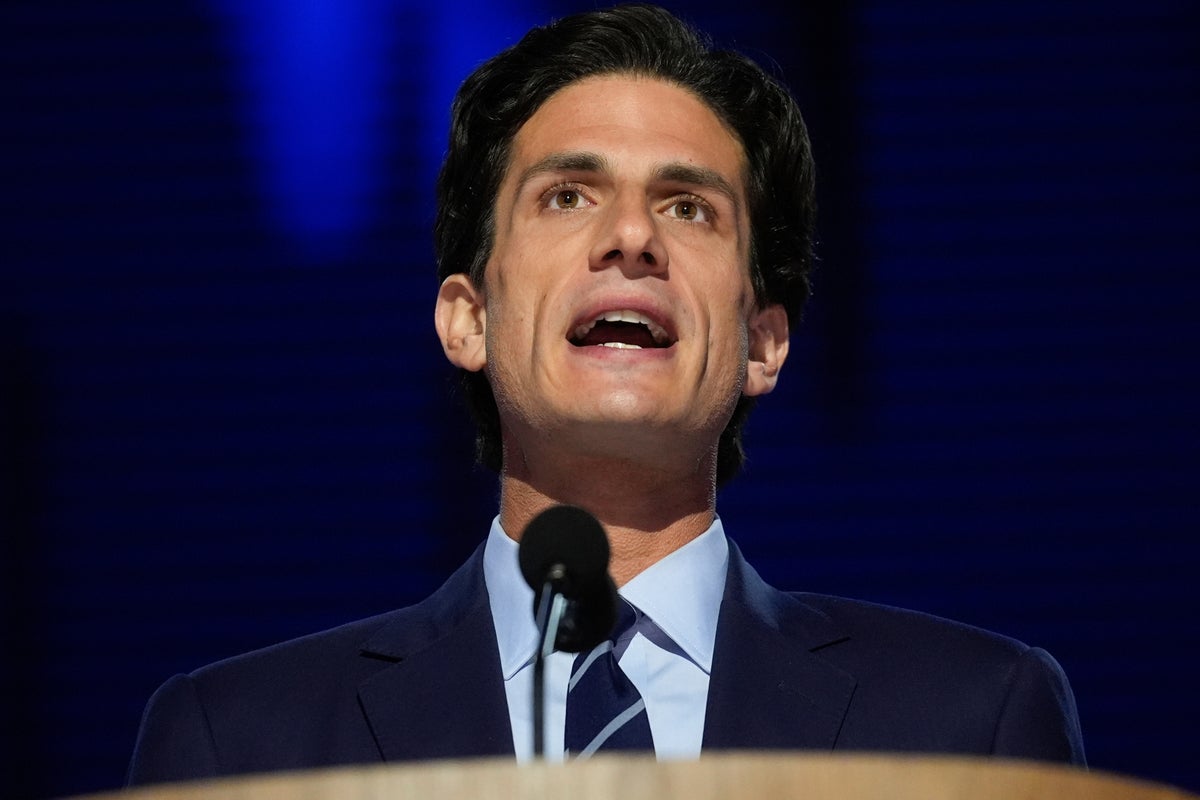
The floorboards of the Kennedy Compound in Hyannis Port don’t just creak; they whisper. They carry the weight of a dynasty that has, for nearly a century, served as America’s unofficial royalty—a family defined by immense privilege and even more immense tragedy. Now, a new set of footsteps is echoing through those halls. Jack Schlossberg, the only grandson of John F. Kennedy, is no longer just a figure in the background of grainy family photos. He is stepping into the light of a modern, fractured political arena.
The question isn't just whether he can win a seat in Congress. The question is whether the "Kennedy Brand" still possesses the alchemy required to turn a TikTok following into a political mandate.
Politics in 2026 is a strange, jagged thing. It is no longer enough to have the right jawline or a storied last name. You need to be a protagonist. You need a "vibe." Schlossberg, 33, understands this intuitively, perhaps better than any Kennedy before him. While his grandfather mastered the flickering black-and-white television screen to project an image of "vigah," Jack is mastering the vertical video, the self-deprecating caption, and the chaotic energy of the digital age.
He is the heir to a throne that may no longer exist.
The Specter of the 1970s
To understand the stakes, you have to look at the shadows. There is a specific kind of gravity that comes with being a Kennedy. It is the expectation of greatness coupled with the looming threat of the "Kennedy Curse." For decades, the family name acted as a skeleton key, opening doors to the Senate, the Cabinet, and the Oval Office.
But the key is rusting.
Consider the recent political trajectory of the clan. Joe Kennedy III’s unsuccessful Senate primary run in 2020 was a seismic shift. It signaled that in a world of populist rage, a famous name can sometimes feel like a relic of an establishment that voters are desperate to burn down. Jack Schlossberg is operating in the wake of that cooling embers. He isn't running on a platform of "I am a Kennedy." He is running as a man who happens to be a Kennedy, but who lives in the same chaotic, meme-driven reality as his constituents.
He is playing a dangerous game of high-low. On one hand, he is the Harvard Law graduate and the grandson of a martyr. On the other, he is the guy posting videos of himself eating a bowl of cereal while discussing climate change. This isn't accidental. It is a calculated attempt to humanize a monument.
The Love Story Effect
The media has been quick to draw parallels between Jack and his uncle, John F. Kennedy Jr. The resemblance is undeniable—the same thick hair, the same easy athletic grace. But the obsession with "Love Story," the 1970 film that defined a generation’s view of tragic, upper-class romance, is more than just a pop-culture reference. It is a metaphor for the way the public views the Kennedys: as characters in a drama that belongs to everyone.
When Schlossberg leans into his "hunky" image or engages with the "Girlies for Jack" fanbases on social media, he is tapping into a reservoir of nostalgia that most politicians can’t touch. He is a celebrity first and a candidate second. In the current attention economy, that is a superpower.
But fame is a volatile fuel.
If you lean too hard into the celebrity, you are dismissed as a lightweight—a "nepo baby" playing at public service. If you lean too hard into the policy, you lose the "it factor" that makes you competitive. Jack is walking a tightrope stretched over the Atlantic.
The Invisible Stakes
Behind the scenes, the democratic establishment is watching with a mixture of hope and profound anxiety. They need a star. The party is hungry for a figure who can bridge the gap between the aging donor class and the disaffected Gen Z voters who see the political process as a slow-motion car crash.
Schlossberg represents a potential bridge. He carries the DNA of the New Frontier, but he speaks the language of the disillusioned.
Think of a hypothetical voter—let’s call her Sarah. She’s twenty-four, lives in a cramped apartment in South Boston, and feels like the government is a giant machine designed to turn her student loan payments into bombs. She doesn't care about what happened in Dallas in 1963. She doesn't care about the myth of Camelot. But she sees a video of Jack Schlossberg talking about the absurdity of the housing market while he walks his dog, and for a second, the machine feels human.
That is the "Kennedy magic" updated for the age of anxiety. It isn’t about being better than the people; it’s about being with them, even if you’re doing it from a multi-million dollar estate.
The Price of Admission
Success in this arena requires more than just charisma. It requires the stomach for the mud. The opposition isn't going to fight him on policy alone; they will weaponize his privilege. They will turn his family’s wealth into a cage. Every vacation, every expensive suit, every slip-up will be magnified by the lens of his lineage.
To win, Schlossberg has to prove he can bleed.
The American public has a complicated relationship with its icons. We love to build them up, but we love the demolition even more. There is a deep, subconscious desire to see if the young Kennedy can survive the scrutiny that broke or buried so many of his relatives.
He is not just running for a seat in the House of Representatives. He is running for the right to define what a Kennedy is in the 21st century. Is the family a spent force, a collection of tragic anecdotes and black-tie galas? Or is it still a laboratory for leadership?
The Echo in the Room
There is a specific kind of silence that follows a Kennedy speech. It’s the silence of people waiting for the ghost to appear. They want to hear the cadence of the grandfather, the idealism of the great-uncle Bobby, the stamina of Teddy.
Jack Schlossberg’s challenge is to fill that silence with his own voice.
He has spent years being the "observer." He wrote for various publications, worked at the State Department, and stayed largely on the periphery of the family business. That period of observation is over. The "hype" is a double-edged sword; it grants him a platform, but it also creates an impossible standard. You cannot just be a good congressman when your last name is Kennedy. You have to be a savior. Or at the very least, a legend.
The digital landscape is littered with the careers of those who thought their followers would translate into votes. Likes are cheap. Retweets are free. A vote is a sacrifice—an act of trust in a time when trust is the rarest commodity on earth.
As the campaign season begins to heat up, the image of Schlossberg on the shoreline of Cape Cod serves as a hauntingly familiar tableau. The wind catches his hair, the grey Atlantic churns behind him, and for a moment, the decades collapse. The past is present. But then, he pulls a smartphone out of his pocket, hits record, and the illusion shatters. He isn't a ghost. He is a man trying to convince a cynical nation that some things—duty, service, the pursuit of a better world—are still worth the weight of the water.
He is standing on the edge of history, waiting to see if the tide will carry him out or bring him home.
The water is cold. The current is strong. And the whole world is watching to see if he knows how to swim.