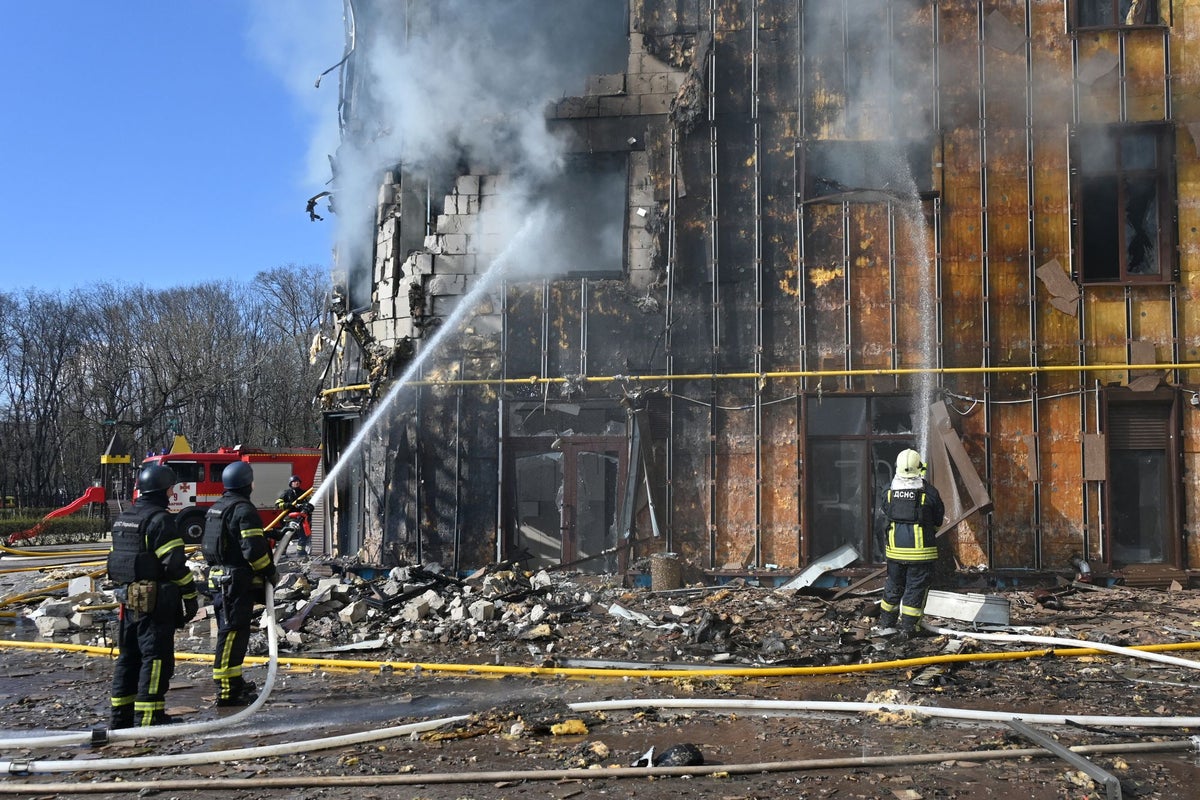
The sheer volume of the assault was designed to paralyze. Over the Easter weekend, Russian forces launched a coordinated swarm of 280 strike drones against Ukrainian infrastructure, a numerical surge that signals a fundamental shift in Moscow’s attrition strategy. While President Volodymyr Zelensky condemned the "Easter escalation" as a moral failing of the Kremlin, the tactical reality is far more clinical. Russia is no longer just hitting targets; it is conducting a stress test on the Western-supplied interceptor stocks that keep Ukraine’s cities habitable.
The Calculus of Saturated Skies
Air defense is a game of simple, brutal arithmetic. When 280 Shahed-style loitering munitions enter a specific corridor of airspace simultaneously, they create a target saturation environment. Ukraine’s success rate in downing these drones often exceeds 80 percent, but that metric is becoming a dangerous distraction from the underlying problem.
The problem is the cost-to-kill ratio. A single Iranian-designed Geran-2 (the Russian designation for the Shahed) costs roughly $20,000 to $50,000 to produce. To intercept it reliably, Ukraine often relies on Western systems like the NASAMS or Iris-T, where a single interceptor missile can cost between $1 million and $2 million. Even the more affordable, shoulder-fired Man-Portable Air-Defense Systems (MANPADS) represent a significant financial and inventory drain when used against a swarm of this magnitude.
Russia isn't just trying to blow up power plants. They are trying to empty the magazines of Ukraine's most sophisticated defense batteries before the next wave of hypersonic missiles arrives.
Why the Easter Timing Mattered
Military analysts often look for symbolic dates to explain escalations, but the "Easter escalation" served a dual purpose. Beyond the psychological warfare of striking during a major religious holiday, the timing exploited a specific gap in Western political cycles.
With legislative bodies in Washington and Brussels often slowed by spring recesses and holiday breaks, the surge was timed to highlight the exhaustion of current aid packages. By forcing Ukraine to expend a massive portion of its remaining interceptors in a single weekend, Moscow creates a window of vulnerability that cannot be closed by a simple press release or a promise of future "deliveries."
The Rise of the Machine Attrition Model
We are witnessing the first sustained campaign of machine-led attrition. In previous wars, attrition meant losing men. Today, for Russia, it means losing cheap, expendable plastic and lawn-mower engines to force the opponent to lose high-tech, irreplaceable radar-guided interceptors.
The 280 drones launched this weekend weren't sent to win the war in one night. They were sent to ensure that by mid-summer, when the heat hits the Ukrainian grid and the need for cooling rises, there will be no missiles left to stop the larger, slower cruise missiles that take out the actual transformers.
The Technical Evolution of the Swarm
The drones used in this latest assault were not the same models seen in 2022. Recovered wreckage indicates several key upgrades that make the 280-drone threshold even more significant.
- Carbon-Fiber Reinforcement: Newer variants feature airframes that are harder to detect on older Soviet-era radar systems still used by local territorial defense units.
- Glush-type Electronic Warfare Resistance: Russia has begun integrating simplified CRPA (Controlled Reception Pattern Antennas) that allow these drones to ignore localized GPS jamming.
- Dark-Coat Thermals: Many of the drones in the Easter wave were painted with black, radar-absorbent, or thermally-retardant coatings to make them nearly invisible to the "Searchlight Teams" that Ukraine uses to save expensive missiles.
These light-weight "acoustic teams"—soldiers sitting in the dark with microphones and heavy machine guns—are Ukraine's best hope for maintaining their missile stocks. But even they are being overwhelmed. A human being can track one or two drones by sound. They cannot track fifty passing overhead at once.
The Failure of the Western Supply Chain
The hard truth that nobody in the Pentagon wants to admit is that the West cannot build interceptors as fast as Russia can build drones. The industrial base of the United States and Europe is built for "Quality over Quantity." We build Ferraris; Russia is throwing thousands of beat-up pickup trucks at us until our Ferraris run out of gas.
Ukraine has been pleading for more Patriot batteries, but there is a finite number of those systems in existence. More importantly, there is a finite number of missiles produced per year. If Russia continues to launch "mini-swarms" of 200 to 300 drones every two weeks, the math for Ukrainian city defense becomes impossible by autumn.
The Overlooked Factor: Domestic Russian Production
For much of 2023, the narrative was that Russia was "running out of chips" and relying on Iranian shipments. That narrative is dead. The Alabuga Special Economic Zone in Tatarstan has transitioned into a massive, 24-hour drone factory. Satellite imagery and leaked internal documents suggest they are ahead of schedule in their goal to produce 6,000 drones annually within their own borders.
This domestic capacity means Russia no longer has to wait for a ship to cross the Caspian Sea. They can scale their "escalations" based on the weather and the political temperature in NATO capitals.
Zelensky’s Tactical Dilemma
When Zelensky "hits out" at the escalation, he isn't just talking to Putin. He is talking to the air defense commanders in Kyiv who are currently making the most difficult choices of the war.
Every time a swarm of 280 drones appears on the radar, a commander has to decide:
- Do I use a $2 million missile to save a substation that costs $500,000 to repair?
- Do I let the drone hit, risking civilian lives but saving the missile for a potential MiG-31 strike tomorrow?
- Do I move the defense batteries closer to the front lines to protect the troops, or keep them in the cities to protect the kids?
There is no "right" answer. There is only the least-bad option.
The Reality of the "New Normal"
The 280-drone assault is a preview of the next phase of the conflict. We are moving away from the era of "Precision Strikes" and into the era of "Mass Saturation." The goal is no longer to be subtle. The goal is to be undeniable.
If the West does not pivot to producing low-cost, high-volume counter-drone technologies—such as microwave emitters, laser-based defense, or their own "interceptor drones"—Ukraine will be forced into a position where they have the best air defense systems in the world, and nothing to fire out of them.
The 280 drones were not just a holiday attack. They were a bill being handed to the West, and the balance is due.
Stop looking at the wreckage on the ground and start looking at the empty silos in the launch batteries. That is where the war is being won or lost. Move the production lines or prepare to see the lights go out across Ukraine for good.