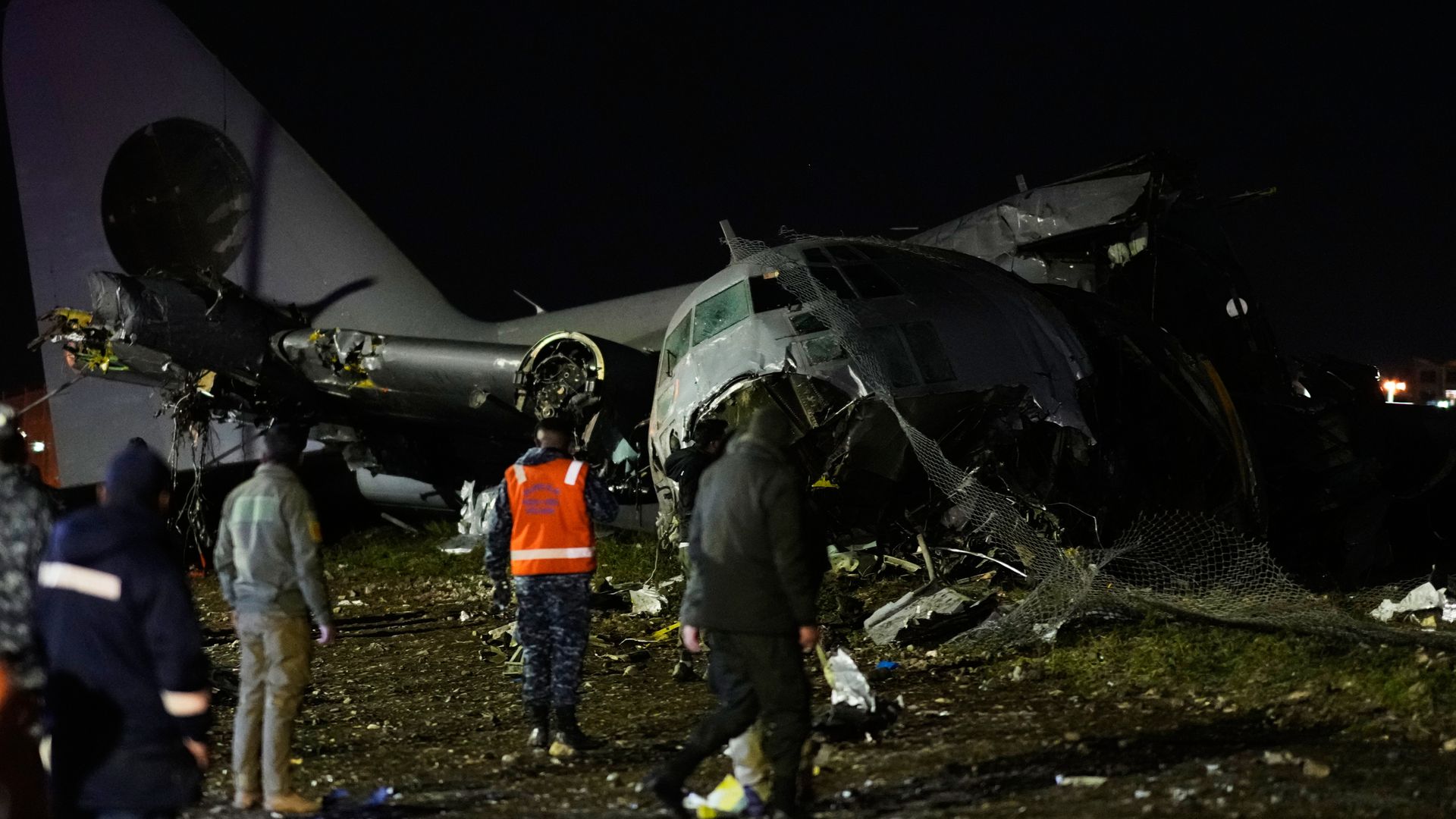
The air in the Altiplano doesn't behave like the air anywhere else. It is thin, fickle, and crystalline. At four thousand meters above sea level, your lungs work twice as hard for half the reward, and the engines of a C-130 Hercules—a beast of a machine designed for war and heavy lifting—must scream against the vacuum to stay aloft.
On a Tuesday afternoon that should have been mundane, that scream turned into a stutter. Then, a silence.
When fifteen tons of military-grade aluminum and fuel lose their argument with gravity, the result isn't just a headline. It is a violent reordering of a neighborhood. In the moments before the impact on the outskirts of La Paz, there were people deciding what to cook for dinner. There were drivers grumbling about the rhythmic congestion of the busy highway below. There were children looking up, perhaps marvelling at how low the gray belly of the plane seemed to be hanging.
Then the world tore open.
The Anatomy of an Instant
Witnesses didn't hear a crash so much as they felt a displacement of reality. A military transport plane isn't a car; it is a building that has learned to fly. When it strikes a populated road, the physics are incomprehensible. The kinetic energy alone is enough to liquify asphalt.
Fifteen people are dead. That is the official tally, a cold number provided by government officials in pressed suits. But fifteen isn't a number. It is fifteen empty chairs. It is fifteen unmade phone calls. Among the dead are the crew, men who likely spent their final seconds fighting the yoke, trying to pull the nose up away from the teeming life of the city. There are the passengers, soldiers or perhaps civilians hitched to a routine transport. And then there are the bystanders—the people who were simply in the wrong square meter of the Earth’s surface at the wrong microsecond.
We talk about "accidents" as if they are unpredictable lightning bolts. In aviation, however, accidents are almost always the final link in a long, invisible chain. One rusted bolt. One overlooked sensor. One pilot’s fatigue. When that chain breaks, it breaks over the heads of the innocent.
The Invisible Stakes of High-Altitude Flight
To understand why this happened in Bolivia, you have to understand the geography of survival. La Paz is a city tucked into a bowl, surrounded by peaks that look like the teeth of a saw. The El Alto International Airport is one of the highest in the world.
Operating here is an act of defiance.
Because the air is so thin, planes must take off and land at much higher speeds than they would in Miami or London. There is no margin for error. If an engine fails at sea level, you have a glide ratio that offers a sliver of hope. If an engine fails over the Altiplano, the plane drops like a stone tossed into a well.
The Hercules is known as a workhorse. It is the plane that brings supplies to remote villages and transports troops across the rugged Andean spine. It is built to be rugged. It is built to endure. But even the strongest workhorse has a breaking point, and when that point is reached over a crowded thoroughfare, the "work" it does becomes a tragedy.
Consider the driver of a small microbus, a common sight on Bolivian roads. These buses are usually packed, music blaring, the smell of diesel and dust thick in the cabin. The driver is focused on the bumper in front of him. He is thinking about his shift, his family, the cold beer at the end of the day. He never sees the shadow growing larger. He never hears the whistling of the wind through the flaps. He is simply erased.
The Aftermath of the Fire
By the time the sirens began to wail, the smoke had already climbed higher than the surrounding mountains. Black, oily plumes—the unmistakable signature of burning jet fuel—choked the thin air.
Rescuers moved through the wreckage not with the speed of a movie, but with the heavy, somber pace of people who know they are too late. The heat from a plane crash is a physical wall. It melts the rubber on your boots. It sears the back of your throat. They found the fuselage crumpled like a discarded soda can, the camouflaged paint charred to a ghostly white.
The road, usually a vein of commerce and movement, became a graveyard of twisted metal and shattered glass. Local residents stood on their balconies, some weeping, some silent, watching the military cordons move in to reclaim their own.
There is a specific kind of silence that follows a disaster of this magnitude. It isn't the absence of sound—there are still sirens, shouting, and the crackle of flames. It is the silence of shock. It is the collective realization that the ceiling we all live under is much thinner than we care to admit.
The Question of Accountability
In the coming days, there will be an investigation. Men with clipboards will sift through the blackened debris looking for the "black box." They will analyze flight data, maintenance logs, and weather reports. They will look for a scapegoat or a technical glitch to blame so that everyone else can feel safe flying tomorrow.
But the investigation won't answer the human question.
Why was a heavy military transport maneuvering over a high-density civilian area at an altitude that left no room for recovery? Why are the flight paths of aging military fleets still cutting through the heart of the world’s highest cities?
We often treat military equipment with a sense of awe, viewing it as a symbol of national strength. Yet, when that equipment is poorly maintained or improperly routed, it becomes a liability to the very people it is meant to protect. The cost of a "budget-friendly" maintenance schedule is paid in blood on the streets of El Alto.
The families of the fifteen victims will receive condolences. There might even be a state funeral with flags and medals. But a medal is a poor substitute for a father, a daughter, or a friend. The "logic" of the state rarely accounts for the "logic" of grief.
The Weight We Carry
I remember standing on a hillside in the Andes years ago, watching a similar plane bank hard against the wind. I remember the vibrating roar in my chest and the feeling that something so heavy shouldn't be able to stay up there. It felt like a miracle of engineering, but also a fragile one.
When you live in the shadow of an airport, especially one as treacherous as El Alto, you develop a subconscious habit of tracking the sound of engines. You listen for the steady drone. You fear the hiccup.
This crash isn't just about fifteen lives lost in Bolivia. It is about the systemic vulnerability of our modern infrastructure. We build our homes under flight paths. We drive our cars under bridges. We trust that the people in charge of the machines have checked every bolt and accounted for every liter of fuel.
We live in a state of assumed safety.
That safety is an illusion. It is a fragile agreement we make with the world so that we can get out of bed in the morning. On Tuesday, for fifteen people, that agreement was unilaterally cancelled.
The road will be cleared. The asphalt will be repaved. The military will eventually fly another Hercules over the same route, its engines roaring in defiance of the thin air. But the people who live along that road will never look at the sky the same way again. They will see the clouds, they will see the peaks, and they will see the heavy, invisible weight of everything that could fall.
The smoke eventually cleared, leaving only the smell of scorched earth and the haunting sight of a missing horizon.
There are no more facts to list. There are no more statistics to cite. There is only the image of a child's shoe sitting in the middle of a highway, miles away from the nearest playground, covered in a fine layer of gray ash.
The sky is heavy today.