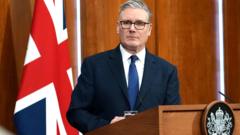
The geopolitical map of the 2020s just suffered a violent rewrite, and Downing Street knows it. Prime Minister Keir Starmer is now signaling that the United Kingdom must accelerate its pursuit of closer security and economic ties with the European Union, driven by the escalating conflict involving Iran. This shift is not a matter of sentimentalism or a sudden longing for the single market. It is a cold, hard calculation of survival. As the Middle East slides toward a wider regional war, the British government has realized that its "Global Britain" aspirations are currently tethered to a crumbling status quo. To maintain any semblance of influence and national security, the UK must bridge the gap with Brussels far faster than the original ten-year plan suggested.
The urgency stems from a simple reality. Britain’s traditional reliance on the United States as its primary security guarantor is facing its most significant stress test since the Suez Crisis. While Washington remains the dominant military force in the Middle East, the political volatility of the American election cycle and the increasing pivot toward the Indo-Pacific leave London in a precarious spot. If the UK is to manage the fallout of an Iranian conflict—ranging from energy price spikes to massive displacement of people—it cannot do so as a solitary island.
The Security Necessity of the European Footprint
Defense policy used to be a slow-moving beast. Now, it is sprinting. The Starmer administration is moving beyond the rhetorical "reset" of EU relations and into the territory of integrated military planning. For years, the UK sat on the sidelines of Permanent Structured Cooperation (PESCO) projects, wary of losing sovereignty over its defense industry. That hesitation is evaporating.
The threat from Tehran does not just involve ballistic missiles or regional proxies. It involves the disruption of global shipping lanes in the Red Sea and the Strait of Hormuz. When the Suez Canal is effectively throttled by regional instability, the UK's inflation targets become a fantasy. By aligning more closely with European naval initiatives and intelligence-sharing frameworks, the UK seeks to create a unified diplomatic and military front that the US can support, rather than lead.
This isn't about creating a "European Army," a phrase that still triggers hives in certain wings of the Conservative Party. It is about logistical interoperability. The UK and France remain the only two European powers with significant "blue-water" naval capabilities and nuclear deterrents. In a world where Iran’s reach extends through drone technology and cyber warfare, the UK needs the scale of the European bloc to effectively sanction and contain hostile state actors.
Economic Realism in a High Tension Environment
War is expensive, and the economic ripple effects of a sustained conflict with Iran would be devastating for a British economy already struggling with low growth. The most immediate concern for the Treasury is the price of Brent Crude. Any significant disruption in the Persian Gulf sends energy markets into a tailspin.
Starmer’s logic is straightforward. If the UK is facing an external economic shock of this magnitude, it cannot afford the friction of its current trade barriers with its largest market. Closer alignment on veterinary standards, chemicals, and financial services isn't just a "pro-business" move anymore. It is a defensive economic measure. By reducing the cost of trade with the EU, the government hopes to create a buffer against the rising costs of energy and raw materials that a Middle Eastern war would inevitably produce.
The City of London also has a massive stake in this transition. Financial stability during wartime requires deep cooperation between the Bank of England and the European Central Bank. If a conflict leads to a global liquidity crunch, the "splendid isolation" of the post-Brexit regulatory framework becomes a liability. We are seeing the beginning of a quiet, systematic re-linking of regulatory nodes that will eventually make the UK a "satellite" member of the European economic zone in everything but name.
The Energy Security Paradox
Britain’s energy grid is more connected to Europe than most voters realize. Subsea interconnectors provide a vital lifeline for electricity during peak demand. As the threat to global oil supplies grows, the UK’s dependence on the European energy market will only intensify.
Starmer is likely to push for a formal energy security pact with Brussels. This would involve shared strategic reserves and a coordinated transition to renewables that prioritizes regional self-sufficiency over global supply chains. The North Sea, once the jewel of British energy independence, is a maturing basin. The future lies in offshore wind and nuclear power, both of which require massive capital investment and integrated supply chains that span the English Channel.
The Diplomatic Tightrope
Walking this path requires a level of diplomatic finesse that has been absent from British politics for a decade. Starmer must convince the British public that he is not "reversing Brexit" while simultaneously convincing EU leaders that he is a reliable partner who won't be replaced by a populist insurgent in five years.
The war in the Middle East provides the perfect political cover. It allows the government to frame closer ties as a "national security emergency" rather than a political choice. It shifts the conversation from "sovereignty" to "safety."
However, Brussels is not a charity. EU negotiators are well aware that the UK is coming to the table from a position of relative weakness. They will demand concessions. These could range from a return to the Erasmus program to more flexibility on the movement of people for specific sectors. The Prime Minister will have to decide which "red lines" are worth holding onto when the alternative is isolation in a world on fire.
Countering the Critics
The inevitable backlash from the Euroskeptic right will focus on the loss of independent foreign policy. They will argue that the UK is being dragged into a European foreign policy consensus that is often slow, bureaucratic, and prone to internal divisions. There is some truth to this. Germany’s historic hesitation to project military power and France’s desire for "strategic autonomy" often clash, leaving the EU paralyzed during fast-moving crises.
Yet, the alternative for the UK is becoming a junior partner to a US administration that may or may not share British interests in the next four years. In the context of an Iran war, the "special relationship" is a variable, not a constant. European cooperation, for all its flaws, is a geographical and economic certainty.
The Intelligence Gap
One of the most overlooked aspects of this shift is the role of intelligence sharing. The UK's "Five Eyes" membership is its greatest geopolitical asset, but that data is often siloed away from European partners. In a conflict with a sophisticated actor like Iran, the UK needs real-time cooperation with European domestic intelligence agencies to monitor proxy threats and cyber-attacks on home soil.
We are entering an era of "hybrid warfare" where the front line is as likely to be a London power station as it is a desert in the Middle East. Starmer is gambling that by bringing British intelligence expertise to the European table, he can secure a seat at the center of the EU’s decision-making process without being a member of the Union. It is a high-stakes play for influence.
The Impact on Global Trade Routes
The UK is a maritime nation. Our prosperity depends on the free flow of goods through narrow chokepoints. If the conflict with Iran leads to a long-term closure or high-risk status for the Suez Canal, trade must be diverted around the Cape of Good Hope. This adds weeks to transit times and millions to shipping costs.
A closer relationship with the EU allows for a coordinated response to these shipping disruptions. This includes joint maritime patrols and the development of "land bridges" or alternative rail routes through the continent. Without this coordination, the UK risks being at the back of the queue for diverted goods, further hammering its manufacturing sector and consumer prices.
The government is currently reviewing its strategic maritime policy. Expect to see a heavy emphasis on "corridor security" and a deeper integration with European port authorities. This is the granular, unglamorous work of rebuilding a relationship that was fractured by years of ideological bickering.
Managing the Domestic Fallout
Foreign policy never stays foreign for long. A war involving Iran will have immediate repercussions on British streets. This includes the potential for increased radicalization, protests, and a rise in communal tensions.
By aligning with the EU, the UK gains access to broader social and security frameworks designed to mitigate these risks. Shared databases on extremist financing and coordinated policing strategies are essential tools that the UK cannot afford to lose. The Starmer government is betting that the British public will trade a degree of theoretical sovereignty for the practical reality of safer streets and a more stable economy.
The End of the Post-Brexit Limbo
For the last several years, the UK has existed in a state of geopolitical purgatory. It was out of Europe but not yet settled into its new role on the world stage. The threat of a regional war in the Middle East has acted as a catalyst, ending the period of drift.
Starmer’s move is a recognition that the "middle power" status of the UK is only sustainable through deep, institutionalized partnerships. The days of "going it alone" are over, buried under the weight of drone strikes and disrupted oil flows. This pivot to Europe is not a U-turn; it is a forced march toward the only available high ground.
The real test will come when the first major disagreement between London and Brussels occurs over the conduct of the war or the implementation of sanctions. If the relationship can survive that stress, the "reset" will be more than just a slogan. It will be the new foundation of British statecraft.
Stop looking for a return to the 2016 status quo. That world is gone. What is emerging is a pragmatic, security-first alliance that prioritizes the stability of the European continent over the abstract promises of a global trade fantasy. The war in the Middle East has simply made the choice unavoidable.
Work on the technical details of the new security pact has already begun in the quiet corridors of the Foreign and Commonwealth Office. This isn't a public-facing campaign; it is a bureaucratic realignment. The government is moving fast to lock in these changes before the political winds shift again.
The strategy is clear: bind the UK so tightly to European security and energy structures that any future government would find it impossible to untangle them. This is the "de-risking" of British foreign policy. In a world of increasing chaos, Starmer is choosing the most stable neighborhood available.
Monitor the upcoming NATO summits and bilateral meetings with European leaders. The language will be focused on "interoperability" and "shared challenges." Underneath that diplomatic speak lies the reality of a nation reintegrating into its own backyard because the rest of the world has become too dangerous to navigate alone.
The pivot is happening now. It is driven by fear, fueled by economic necessity, and accelerated by the shadow of war.