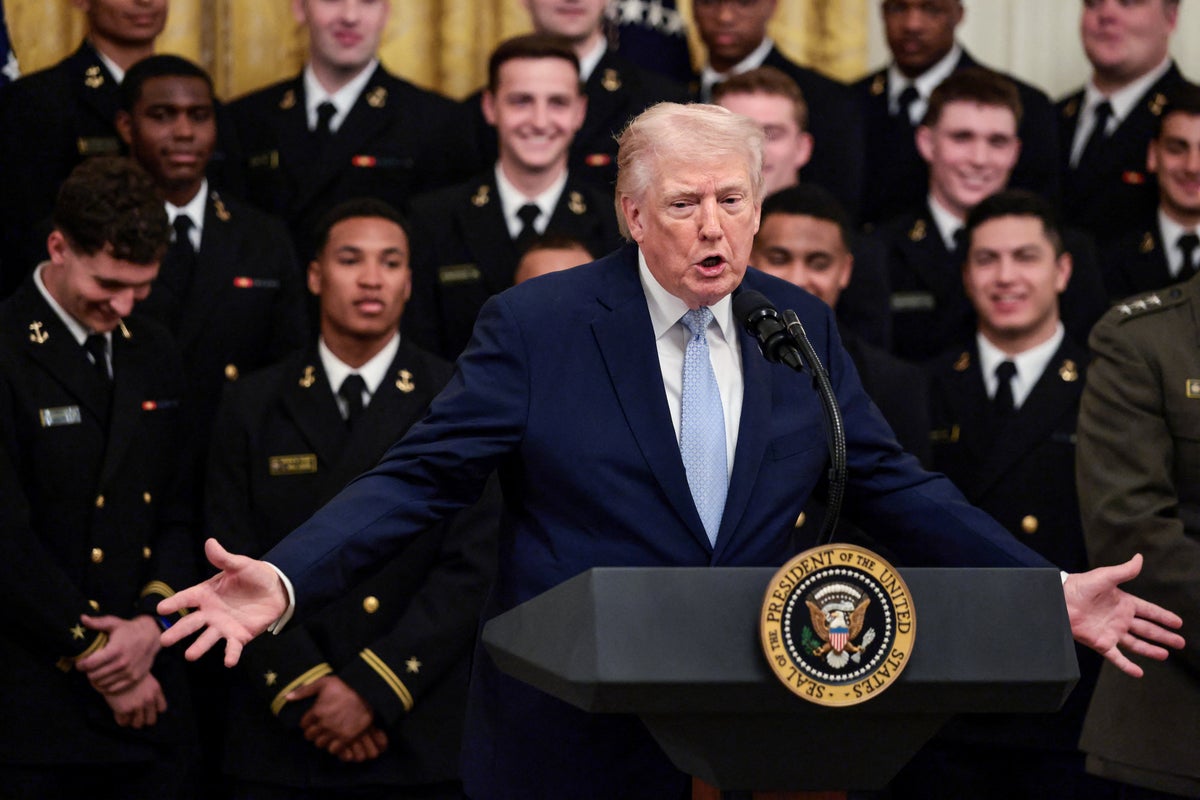
The air inside the room was thick with the scent of polished leather and expectations. Standing there were the young men of the Navy football team—athletes who have signed up for a life defined by precision, chain of command, and the somber weight of the sea. They are trained to find meaning in every syllable of an order. But on this afternoon, they found themselves navigating a different kind of terrain: the unpredictable, free-associative landscape of a Donald Trump monologue.
He stood before them not just as a former president or a current candidate, but as a performer who views every podium as a stage and every audience as a sounding board for his latest stream of consciousness. What began as a standard congratulatory visit quickly veered into a thicket of gender politics, physical stature, and a joke that hung in the air like a mistimed pass.
"Size does matter," he quipped.
The room rippled with the kind of uneasy laughter that occurs when the person holding the microphone breaks a social barrier you didn’t know was under threat. He wasn't talking about the displacement of a destroyer or the height of a linebacker. Or maybe he was. With Trump, the literal and the metaphorical don't just blur; they collide and fuse into a singular, confusing mass of rhetoric.
The Weight of the Word
To understand why a simple "size" joke matters, you have to look at the faces of the midshipmen. These are individuals coached in the art of the "fixed gaze." They are taught that discipline is the bridge between goals and accomplishment. When the Commander in Chief—even one with the "former" prefix—starts riffing on the biological advantages of men in sports while standing in a room defined by military decorum, the friction is palpable.
The core of the rambling address touched on a nerve that has been twitching in the American psyche for years: the role of gender in competitive athletics. Trump has made "protecting women's sports" a cornerstone of his campaign rallies, usually delivered with a mix of firebrand populist energy and observational comedy. But here, in the sanctuary of Navy football, the message got tangled.
He moved from praising the physical prowess of the players to a disjointed critique of transgender athletes, often losing the thread of his own argument mid-sentence. It is a rhetorical style his supporters call "the weave"—a sophisticated tapestry of interconnected ideas. To his critics, it looks more like a map with no legend, a series of turns that eventually lead back to the speaker’s own reflection.
The Geometry of the Ramble
Consider a hypothetical freshman on that team. Let’s call him Miller. Miller has spent his morning studying fluid mechanics and his afternoon hitting a blocking sled until his shoulders burned. He expects a speech about sacrifice, about the "Thin Blue Line" of the ocean, or perhaps the storied history of the Army-Navy rivalry. Instead, he is watching a 78-year-old man navigate a verbal labyrinth about who belongs in which locker room.
The irony is thick. The military is perhaps the most structured environment on earth. Everything has a place. Every person has a rank. Every uniform is inspected down to the millimeter. Into this world of extreme order comes a man who thrives on chaos. Trump’s power has always been his ability to ignore the script. While the Navy operates on "Standard Operating Procedure," Trump operates on "Standard Operating Impulse."
This creates a fascinating, if jarring, human moment. You see it in the way the players shift their weight. It is the physical manifestation of a cognitive disconnect. They are trained to respect the office, but the person currently occupying the space of the "leader" is speaking in a dialect of grievance and locker-room humor that feels light-years away from the deck of a carrier.
The Invisible Stakes
Why does it feel so heavy? Because these aren't just jokes. For Trump, the "size" comment and the gender-war rhetoric are tools used to build a specific version of American masculinity. By standing with the Navy team—the literal embodiment of state-sanctioned strength—he is attempting to graft his personal brand onto their institutional prestige.
But the graft is messy.
The Navy, like all branches of the armed forces, has been quietly grappling with its own internal evolutions regarding gender, identity, and inclusion. It is a slow, grinding process of cultural shift. Trump’s comments act as a wrench thrown into those gears. He isn't interested in the nuance of Department of Defense policy; he is interested in the "vibe." He wants the roar of the crowd, even if the crowd is a group of disciplined officers who are legally required to keep their composure.
The danger of the ramble isn't just that it’s confusing. It’s that it reduces complex, human struggles—like the rights of athletes or the identity of soldiers—into punchlines. When he confuses the specifics of the gender debate, it reveals a fundamental lack of interest in the "why" of the policy. He is only interested in the "who"—specifically, who is cheering and who is laughing.
The Echo in the Hall
As the speech wound down, the "size does matter" joke lingered longer than the praise for their win-loss record. It became the headline, eclipsing the achievements of the young men in the room. This is the recurring theme of the Trump era: the gravity of his personality is so intense that it bends the light around everyone else.
The midshipmen will go back to their studies. They will go back to the grueling practices where the only size that matters is the size of their heart and the depth of their lungs. They will live in a world of absolute clarity—black and white, win or lose, orders followed or orders broken.
But for sixty minutes, they were forced to live in the grey. They were the silent witnesses to a performance where the facts were fluid and the rhetoric was a jagged circle. It wasn't just a political speech; it was a reminder of the widening gap between the institutions that hold the country together and the individuals who seek to lead them.
The room eventually emptied. The echoes of the laughter faded. The leather balls were put back in their racks. In the silence that followed, the weight of the office seemed a little heavier, and the path forward a little more obscured by the fog of a thousand unscripted words.
One might wonder what remains when the spectacle leaves the building. The Navy remains. The players remain. The mission remains. But the words—those strange, wandering, pointed words—they stick to the walls like a residue, a reminder that in the modern theater of power, the truth is often just a byproduct of the performance.
The sunset over the academy grounds cast long, distorted shadows of the goalposts. From the right angle, they looked like giants. From another, they looked like nothing at all.