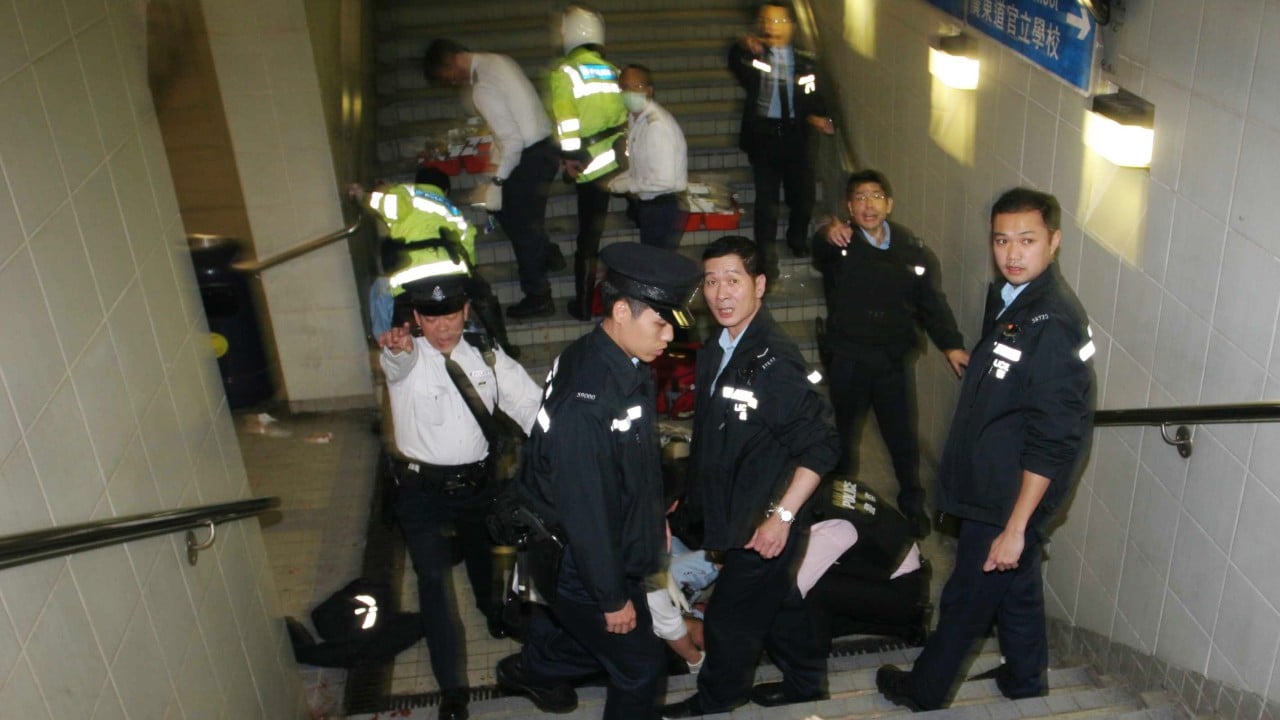
The air inside the pedestrian underpass at the junction of Salisbury Road and Canton Road doesn’t move. It lingers, thick with the smell of damp concrete and the faint, metallic tang of the harbor nearby. At 1:15 AM on March 17, 2006, that air shattered.
Hong Kong is a city built on verticality and light, but its true nervous system is underground. The subways and walkways are supposed to be the safest arteries in the world. They are brightly lit, tiled in sterile whites and greys, and monitored by the unblinking eyes of a thousand cameras. Yet, in a narrow staircase leading toward the Tsim Sha Tsui Star Ferry, three men met in a collision of violence so brief and so perforated by mystery that it would take years for the city to breathe normally again.
When the echoes of the gunshots finally died down, the silence that followed was heavier than the noise.
The Midnight Patrol
Sin Ngai-kan and Tsang Kwok-hang were not looking for a fight. They were "walking the beat," a foundational ritual of the Hong Kong Police Force. Sin was 28, young and alert. Tsang was 33, a steady hand. They were doing what thousands of officers do every night: checking doors, nodding to the occasional late-shift worker, and signing the patrol books hidden in the shadows of the city’s infrastructure.
They stepped into the underpass. It was a routine transit.
Then they saw him.
A man stood near the marble-clad pillars, his face obscured by a rusty-colored hoodie and a face mask. In a city where mask-wearing wasn’t yet a global norm, he looked like a shadow that had gained mass. There was no dialogue. There was no "Halt, police." There was only the sudden, visceral realization that the predator had been waiting for the prey.
The stranger drew a weapon. He didn't fire like a panicked amateur. He fired with the cold, mechanical precision of a man who had practiced the rhythm of a kill.
Ten Seconds of Absolute Chaos
In the space of ten seconds, the underpass became a pressurized chamber of lead and cordite. Sin Ngai-kan was hit almost immediately. A bullet tore into his face, shattering his jaw and sending him spiraling into a world of crimson shock. He fell, his body failing him before his brain could process the betrayal of the quiet night.
But Tsang Kwok-hang, despite taking a fatal round to the neck, did something that defies the standard biological response to trauma. As the blood began to drain from his life-force, as his lungs struggled to pull in the smoke-filled air, he drew his service revolver.
He didn't just fire back. He anchored himself.
Tsang emptied his weapon into the man in the rusty hoodie. Five shots. Every single one found its mark. The stranger collapsed, the life evaporating from him even as he hit the tiles. Tsang, having fulfilled the ultimate duty of a protector, succumbed to his wounds shortly after.
When the backup arrived, they found a scene that looked like a choreographed nightmare. Three men down. Two dead. One clinging to a thread of life. And in the middle of it all, a single, rusted Smith & Wesson revolver that shouldn't have been there.
The Devil in the Ranks
The horror of a shootout is usually mitigated by the capture of a villain. We like our monsters to be recognizable—outsiders, criminals, the "other." But as the forensics teams began to peel back the mask of the dead assailant, the city felt a collective chill that surpassed the cold of the morgue.
The man in the hoodie was Tsui Po-ko.
He wasn't a triad member. He wasn't a desperate drifter. He was a veteran police officer.
Imagine the psychological whiplash. The man who had just murdered a brother-in-arms and nearly executed another was a man who wore the same uniform, swore the same oath, and walked the same beats. This wasn't just a crime; it was a systemic infection.
The investigation that followed peeled back the layers of Tsui’s life like a forensic autopsy of a soul. They found a man obsessed with "the perfect crime." They found a man who felt slighted by the bureaucracy of the force, a man who viewed himself as a Nietzschean superman trapped in the body of a low-ranking constable.
But the most haunting discovery wasn't who he was—it was what he had done before that night in the tunnel.
The Ghost of 2001
The Smith & Wesson found at the scene was a ghost. Ballistics confirmed it was the same weapon used to kill Constable Leung Shing-yan five years earlier in 2001. Leung had been lured to a phony noise complaint in a housing estate, where he was ambushed and executed for his sidearm.
For five years, that gun had been missing. For five years, the department had been haunted by the "unsolved" murder of one of their own. It turned out the killer had been sitting in the precinct the whole time, perhaps even attending the memorial services, his stolen trophy tucked away, waiting for the right moment to surface.
The same gun was also linked to a daring bank robbery later that year, where a security guard was gunned down with clinical indifference. Tsui Po-ko wasn't just a murderer; he was a serial predator who used his knowledge of police tactics to remain invisible. He knew where the cameras weren't. He knew how the patrols were timed. He knew how his colleagues thought.
He was the hunter who lived inside the lodge.
The Invisible Stakes of the Badge
We often view the police as a monolith—a wall of blue. We forget that the wall is made of individual bricks, each one susceptible to the cracks of ego, madness, or despair.
The shootout in Tsim Sha Tsui changed the way Hong Kong looked at its protectors. It introduced the terrifying concept of the "Lone Wolf" within the ranks. It forced a conversation about the mental health of officers who are expected to be pillars of steel in a city that never sleeps.
But more than the policy changes or the psychological screenings, the legacy of that night lives in the silence of the underpass.
People still walk through that tunnel. They hurry toward the ferry, eyes glued to their phones, headphones dampening the sound of their own footsteps. Most have forgotten the names of Sin, Tsang, and Leung. They don't see the invisible scars on the walls where the tiles were replaced.
Yet, for those who remember, the tunnel is a reminder of how fragile the peace truly is. It is a reminder that the line between the protector and the predator can sometimes be as thin as a shadow in a rusty hoodie.
In the end, Tsang Kwok-hang’s final act wasn't just a return of fire. It was a refusal to let a monster stay hidden. In those dying seconds, he traded his life to pull the mask off a ghost, ensuring that the darkness would finally have a name.
The ferry still runs. The city still glows. But beneath the pavement, in the quiet corners of the transit routes, the air still holds the weight of a debt paid in full.