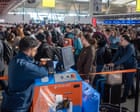
The Department of Homeland Security (DHS) shutdown has hit the six-week mark, and the damage isn't just theoretical anymore. It’s visible in the exhausted faces of officers and the miles of luggage snaking through terminals. Nearly 500 TSA officers have quit since this standoff began in mid-February. They didn't just "call out" or "go on leave." They walked away from their careers because they can't pay for gas or childcare while working for free.
If you’re planning to fly anytime soon, the reality is grim. We aren't just looking at "inconvenient" wait times. We’re watching the slow-motion collapse of the country’s aviation security infrastructure.
Why TSA Officers are Quitting in Record Numbers
It’s easy to look at a government shutdown as a distant political chess match in D.C., but for a TSA officer, it’s a math problem that doesn't add up. Most transportation security officers (TSOs) live paycheck to paycheck. When the DHS funding lapsed on Valentine’s Day, it wasn't just a political statement; it was a pay freeze for over 61,000 "essential" workers.
The current exodus of 458 officers—and counting—is a direct result of financial desperation. During a recent House hearing, Acting TSA Administrator Ha Nguyen McNeill described the situation as "dire." The numbers back her up.
- Unscheduled absences: On Sunday alone, more than 3,450 officers called out.
- Peak Call-out Rates: Some airports are seeing 40% of their scheduled staff missing.
- The "Double Hit": Many of these workers are still recovering from the 43-day shutdown that happened just last fall. They already drained their savings and maxed out their credit cards.
When you're asked to show up at 4:00 AM to deal with angry travelers, but you can’t afford the gas to get to the airport, quitting isn't a choice. It’s a necessity.
Ground Zero: The Airports Feeling the Most Heat
Not every airport is suffering equally, but the major hubs are becoming disaster zones. Houston’s George Bush Intercontinental (IAH) has become the poster child for this crisis. At one point this week, only two out of eight checkpoints were open. People were waiting four hours just to get to a bin.
If you're flying out of these cities, prepare for the worst:
- Houston (IAH & HOU): Call-out rates hit 40%. PreCheck and CLEAR lanes have been shuttered intermittently because there aren't enough bodies to man them.
- Atlanta (ATL): The world’s busiest airport saw a 42% call-out rate.
- New Orleans (MSY): Matching Atlanta with a 42% shortage, leading to "hotspots" where operations nearly grind to a halt.
- New York (JFK): Absenteeism is hovering around 37%.
Even perks like TSA PreCheck aren't a guarantee anymore. When staffing levels drop below a certain threshold, managers have to consolidate lanes. That means your "fast" pass might land you in the same line as the guy who forgot he had a literal gallon of water in his backpack.
The ICE Deployment "Band-Aid"
In a move that has infuriated union leaders, President Trump ordered Immigration and Customs Enforcement (ICE) officers to supplement airport security. If the goal was to lower wait times, the results are mixed at best. If the goal was to improve morale, it’s been a total failure.
ICE agents are still being paid. TSA officers are not.
Walking into work and seeing someone in a different uniform doing a version of your job—while they get a paycheck and you don't—is a slap in the face. Union president Everett Kelley called the move "giving a person dying of pneumonia a teaspoon of cough syrup." ICE agents aren't trained for the specific nuances of passenger screening. They can monitor a line, but they can't effectively run a high-tech X-ray machine or conduct a proper pat-down without specialized training. It’s a visual deterrent, not a functional solution.
The Looming Threat to the 2026 World Cup
The timing couldn't be worse. The U.S. is set to host the FIFA Men's World Cup this June. Security experts are sounding the alarm because you can't just "hire more people" to fix a staffing hole three months before a global event.
It takes months to background check, hire, and train a new TSA officer. Even if the shutdown ended tomorrow, we’ve lost hundreds of experienced veterans. Replacing them is a slow, bureaucratic process that usually takes at least six months. We’re bleeding talent right as the most significant security challenge in a decade is looming on the horizon.
How to Protect Your Travel Plans
If you have to fly while the DHS is shuttered, you can't rely on the old "two hours early" rule. That rule is dead.
- Check terminal-specific updates: Most airports have stopped providing live wait times on their websites because the staffing changes too fast. Check the airport’s official X (formerly Twitter) feed instead.
- Fly mid-week: Tuesday and Wednesday are slightly less chaotic, but only slightly.
- Arrival times: For major hubs like Houston or Atlanta, arrive at least four to five hours early. It sounds insane, but missing a flight is worse.
- Refundable tickets: If you're traveling for business, don't book non-refundable fares. The "cascading delays" mentioned by airlines mean your flight might be canceled simply because the crew couldn't get through security on time.
The political standoff in Washington shows no signs of breaking. Democrats want reforms on immigration enforcement; Republicans want the funding clean. Until one side blinks, the people keeping our skies safe are the ones being used as leverage.
Pack your patience, but more importantly, pack some empathy for the officer at the bin. They’re working for free, and they’re probably wondering how they’ll pay their rent on the first of the month.