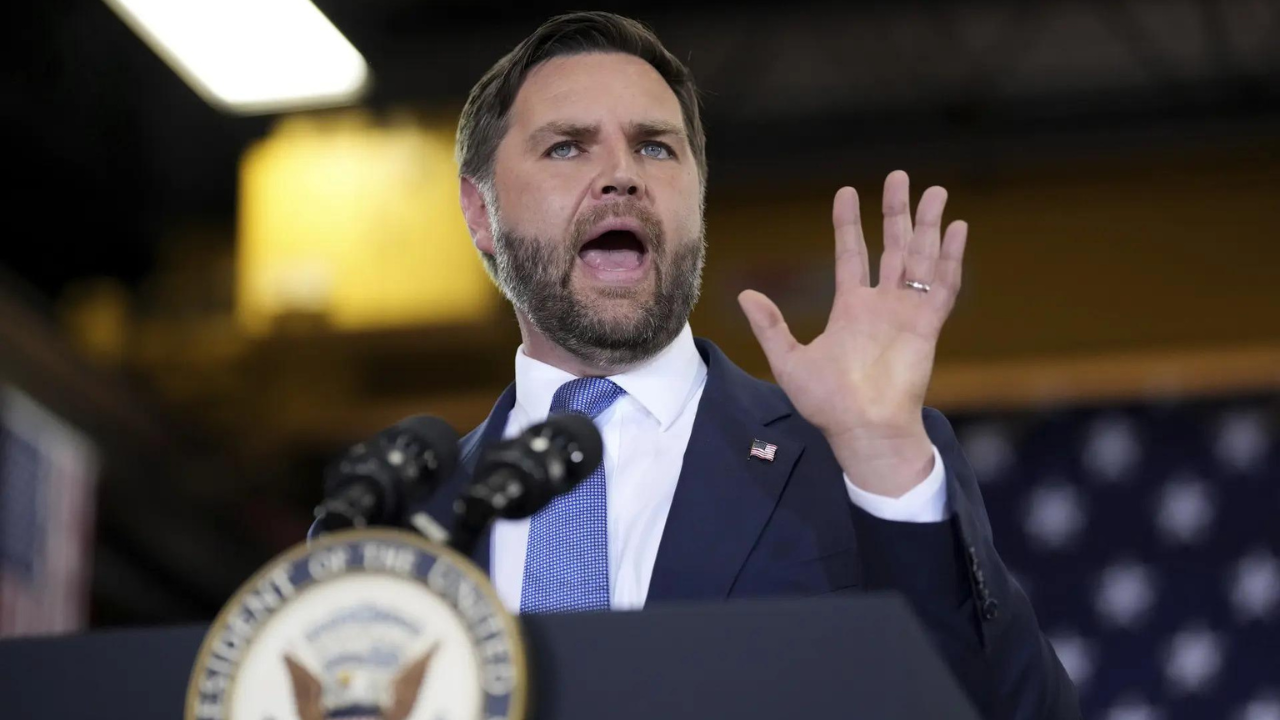
The intersection of national security policy and metaphysical interpretation represents a fundamental shift in the American legislative approach to Unidentified Anomalous Phenomena (UAP). When JD Vance characterizes UAP through the lens of "demonic" or supernatural frameworks, he is not merely employing religious rhetoric; he is shifting the classification of the unknown from a purely materialist intelligence problem to a cultural and ontological security threat. This strategic pivot aims to bypass the traditional bureaucratic inertia of the Department of Defense (DoD) by framing disclosure as a moral imperative rather than a technical one.
The Tri-Lens Framework of UAP Interpretation
The current debate over UAP within the federal government is governed by three distinct analytical models. Understanding these models is essential for predicting how future policy will be drafted and how funding will be allocated to organizations like the All-domain Anomaly Resolution Office (AARO). You might also find this related story interesting: Strategic Asymmetry and the Kinetic Deconstruction of Iranian Integrated Air Defense.
- The Kinetic-Technical Model: This is the default stance of the intelligence community. It views UAP as physical objects—likely adversarial surveillance assets (drones, balloons, or electronic warfare signatures) originating from terrestrial competitors like China or Russia. The primary objective here is identification and neutralization.
- The Extraterrestrial Hypothesis (ETH): This model posits that UAP represent non-human intelligence (NHI) utilizing propulsion systems that exceed current human understanding of physics, such as Alcubierre-drive-style space-time manipulation or trans-medium travel.
- The Ontological-Supernatural Model: This is the framework recently elevated by Vance. It suggests that these phenomena may not be "aliens" in the biological, planetary sense, but "interdimensional" or "spiritual" entities. By labeling them "demons," the discourse moves from a question of "What are they?" to "What is their intent?"
The Mechanics of Bureaucratic Obfuscation
The core of the political friction lies in the "Classification Chokepoint." The United States government utilizes a tiered security system—Confidential, Secret, Top Secret, and Special Access Programs (SAPs)—that creates a functional information silo.
The mechanism of secrecy in UAP data is not necessarily a single "cover-up" but a byproduct of Programmatic Compartmentalization. When a sensor on an F-35 captures a UAP, the data is often classified not because of the object itself, but because the sensor’s capabilities are a protected military secret. Revealing the clear image of a UAP would simultaneously reveal the exact resolution, frequency range, and sensitivity of the radar or FLIR (Forward-Looking Infrared) system. As highlighted in detailed reports by BBC News, the implications are significant.
Vance’s vow to "uncover secrets" targets the over-classification of these technical artifacts. From a consultant’s perspective, the "cost function" of this secrecy is the loss of scientific peer review. Because the data cannot be shared with the broader academic community, the rate of discovery is limited to the small number of cleared personnel within the defense industrial complex.
The Demon Label as a Political Lever
Labeling UAP as "demonic" serves three distinct strategic functions in a legislative context:
1. Moral High Ground and Urgency
By framing the phenomena as malevolent or "spiritual," the actor removes the option of "benign neglect." If an object is a drone, it can be monitored. If an object is "demonic," it is an existential threat to the soul or the fabric of society, which justifies more aggressive transparency measures and potentially larger budget outlays for "defense" against the non-physical.
2. Alignment with Constituent Worldviews
A significant portion of the American electorate views the world through a theological lens. By translating UAP—a topic often dismissed as science fiction—into theological terms, Vance bridges the gap between fringe "UFOlogy" and mainstream religious conservatism. This creates a powerful voting bloc that demands disclosure on religious and ethical grounds.
3. De-legitimatizing the Scientific Establishment
If the phenomena are indeed beyond the scope of traditional physics, then the current scientific establishment (NASA, academic physics departments) is technically "wrong" or "inadequate." This allows political actors to challenge the authority of these institutions, suggesting that a more "intuitive" or "faith-based" approach is required to understand the full scope of the reality being hidden.
The Probability of Technical Breakthroughs vs. Cultural Shifts
We must distinguish between the Information Disclosure Rate and the Scientific Discovery Rate.
- Information Disclosure: This is a political variable. It depends on the passage of legislation like the UAP Disclosure Act, which seeks to use eminent domain to seize "biological evidence" or "recovered craft" from private aerospace contractors.
- Scientific Discovery: This is a physical variable. It depends on the $I_{sp}$ (specific impulse) of the observed craft or the gravitational metrics of their flight paths.
If we apply the principles of the Dyson-Harrop Satellites or other theoretical energy-gathering structures to the behavior of UAP, we see a mismatch. UAP often demonstrate "instantaneous acceleration" and "low observability" without the expected heat signature or sonic boom.
$$F = ma$$
In standard physics, the force required to accelerate a physical mass to the speeds observed in UAP sightings would result in a massive thermal output. The absence of this output suggests one of two things:
- The objects are not "mass" in the way we understand it (holograms, plasma, or interdimensional projections).
- They are utilizing a method of propulsion that manipulates the local gravitational constant $G$.
By moving toward a "demonic" or "non-material" explanation, Vance is essentially siding with the first option: that these are not nuts-and-bolts machines, but something that bypasses the laws of thermodynamics entirely.
Strategic Risks of the Theological Approach
The primary bottleneck in this strategy is the risk of Institutional Alienation. The Department of Defense and the Intelligence Community operate on logic, data, and repeatable observation. Introducing "demons" into a briefing room creates a fundamental language barrier.
The second limitation is Definition Drift. If everything unexplained is labeled "demonic," the term loses its analytical utility. It becomes a catch-all for "that which we cannot yet measure." This creates a "God of the Gaps" scenario where the "demon" label is simply a placeholder for a lack of sensor data.
The Economic Impact of Disclosure
The "UAP Economy" is currently worth billions, hidden within "Black Budgets" and Internal Research and Development (IR&D) funds of major defense contractors. A total disclosure—forced by the political pressure Vance is applying—would cause a massive market correction.
If a contractor like Lockheed Martin or Northrop Grumman is found to possess "off-world" technology, their stock value would theoretically skyrocket, but they would also face immense legal scrutiny regarding how they obtained and funded the study of such materials without congressional oversight. The legal framework of "Eminent Domain" mentioned in recent UAP legislation suggests a plan to nationalize these assets, which would be a radical departure from the current private-public partnership model.
The Legislative Roadmap
The path forward for this narrative follows a predictable sequence of operational steps:
- Weaponized Declassification: Utilizing the "demonic" or "high-threat" narrative to force the release of multi-sensor data (radar, satellite, and sonar) that corroborates pilot testimony.
- Whistleblower Protection Expansion: Strengthening the legal shield for individuals within SAPs to come forward without fear of losing their security clearances or facing prosecution under the Espionage Act.
- The Shift to Civil Oversight: Moving the UAP portfolio out of the DoD and into a new, more transparent civilian-led agency that acknowledges both the physical and "anomalous" (metaphysical) aspects of the phenomena.
The pivot toward theological language is not a descent into superstition, but a calculated expansion of the Overton Window. It prepares the public for a reality that is potentially weirder than "aliens from Mars," suggesting instead a reality that is "other" in a way that our current scientific paradigms cannot yet categorize.
Legislators should prepare for the integration of Metaphysical Risk Assessment into standard national security briefings. If the phenomena are indeed non-material, then traditional kinetic defense systems are obsolete. The focus must shift toward Cognitive Security—protecting the human perception and the societal psychological state against an "adversary" that operates outside the four-dimensional spacetime manifold.
The strategic play is to monitor the upcoming Senate Intelligence Committee hearings for a shift in terminology. If terms like "Non-Human Intelligence" (NHI) are replaced or supplemented by "Interdimensional" or "Ontological Shock," the Vance framework has successfully permeated the executive branch's decision-making apparatus.