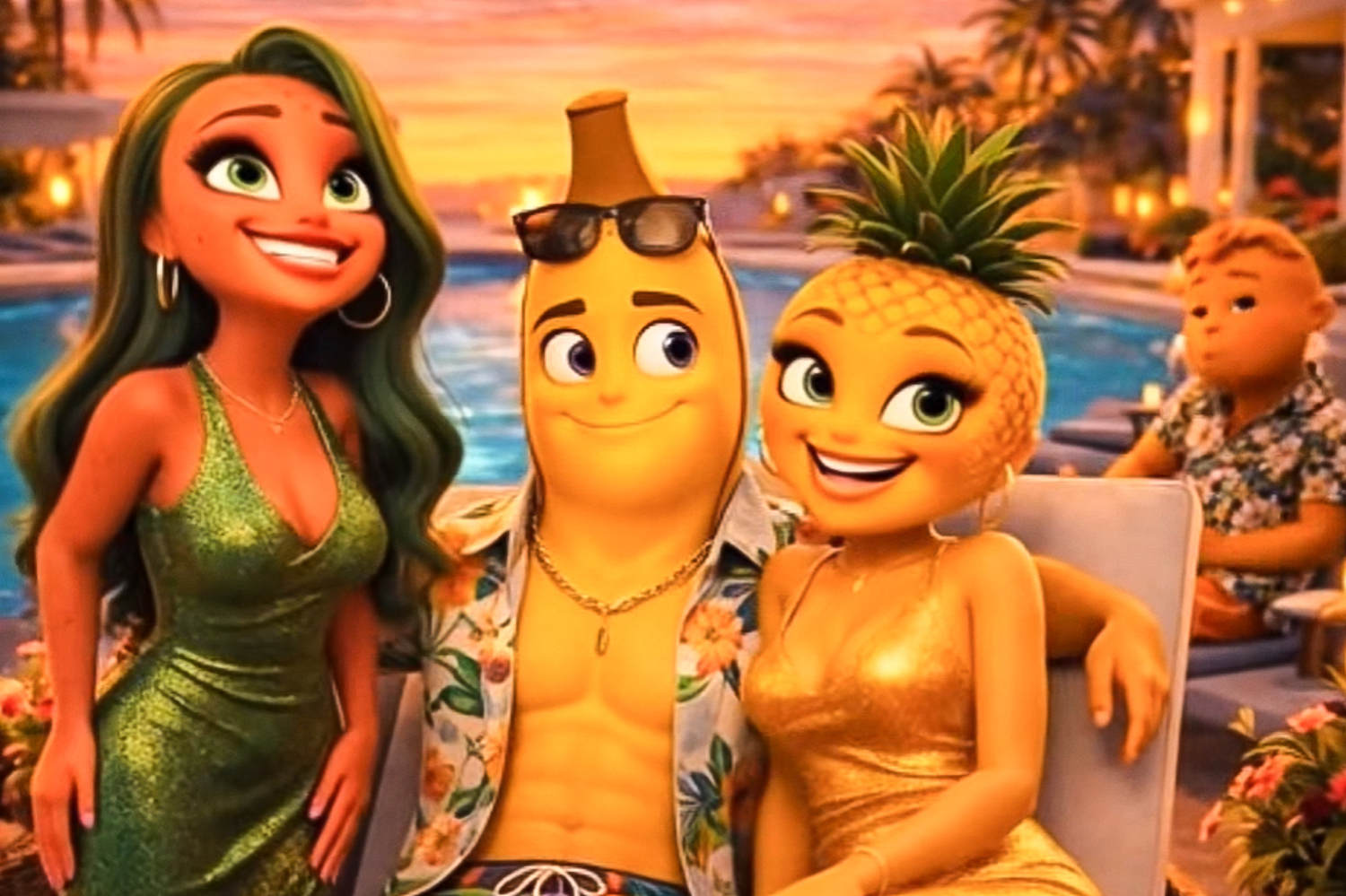
TikTok has a bizarre obsession with fruit that doesn't exist. If you have spent more than ten minutes scrolling through the app lately, you have likely encountered them. Cobalt-blue strawberries dripping with metallic juice. Watermelons that open to reveal intricate, honeycomb interiors. Grapes that glow with the bioluminescence of a deep-sea jellyfish. These images are not just weird. They are the frontline of a massive, automated engagement trap designed to hijack the human brain’s most basic biological wiring.
The mechanism is simple. Humans are evolutionarily primed to notice vibrant colors and unusual food sources. It is a survival trait. TikTok creators—or more accurately, the operators of automated content farms—are using generative AI to exploit this instinct. They aren’t just sharing "cool art." They are conducting a high-stakes experiment in algorithmic manipulation, turning the platform into a digital funhouse mirror where reality is increasingly optional.
The Architecture of the Visual Glitch
The surge in "AI fruit" content is not an accident of the zeitgeist. It is a calculated response to how TikTok’s recommendation engine prioritizes "watch time" and "re-watch frequency." When a user sees a blue strawberry, their brain experiences a micro-second of cognitive dissonance. They stop. They stare. They wonder if it is real. That hesitation—that tiny fraction of a second—is the only metric the algorithm needs to decide that the content is "high value."
The technical barrier to entry has vanished. Using tools like Midjourney or Stable Diffusion, a single operator can generate thousands of these hyper-realistic images in an afternoon. They don't need a camera. They don't need a kitchen. They don't even need a fruit.
Once the images are generated, the "creators" wrap them in a specific layer of social proof. They add trending lo-fi beats or ASMR sound effects of crunching ice. They often pair the visuals with "hacks" or "tutorials" on how to grow these impossible species. "Just soak your seeds in blue Gatorade," one caption might claim. It is a lie, obviously. But the comments section immediately explodes with a mix of gullible fans asking where to buy the seeds and skeptics calling out the hoax.
To the algorithm, a comment is a comment. Rage-bait is just as profitable as genuine curiosity.
Why the Hoax Works
We are living through a period of "sensory inflation." Because we are exposed to thousands of images every day, our threshold for what constitutes an "interesting" visual has moved. Standard red strawberries are boring. They are background noise. To get a user to actually engage, the content has to be "super-normal"—a psychological term for a stimulus that is an exaggerated version of a real thing.
Think of it like junk food. A potato is natural, but a flavored chip is engineered to hit every neural reward center at once. AI fruit is the flavored chip of the visual world. It uses saturation levels that don't exist in nature and textures that defy physics to create a visual "hit" that the human eye cannot ignore.
The Profit of Confusion
There is a financial engine humming beneath these neon pineapples. Most of these accounts are not run by bored teenagers. They are "faceless" brand accounts designed to build massive follower counts quickly. Once an account hits 100,000 or 500,000 followers by posting nothing but AI-generated "nature," it becomes a valuable piece of digital real estate.
The owner can then:
- Sell the account to a marketing agency.
- Pivot to dropshipping questionable garden supplies.
- Run "affiliate" links for seeds that will never grow into the promised neon fruit.
- Collect "Creator Fund" payouts based on millions of views generated for pennies.
This is the commodification of wonder. These operators are strip-mining the user’s sense of curiosity for fractions of a cent per view.
The Erosion of the Visual Record
The danger here isn't just that someone might be disappointed when their blue strawberry seeds turn out to be regular weeds. The real issue is the steady degradation of our collective ability to trust our eyes. We are training ourselves to accept that a video is not evidence of reality.
In the past, a "fake" image required a skilled hand and hours of Photoshop work. It was an intentional act of deception. Today, deception is the default setting of the software. When we fill the public square with millions of images of impossible things, we create a "noise floor" so high that real, authentic experiences struggle to be heard.
Consider the impact on younger users. For a generation that consumes the majority of its information through short-form video, the line between the physical world and the generated world is becoming dangerously thin. If you grow up seeing bioluminescent lemons every day on your phone, the actual, dusty, imperfect world of real agriculture starts to look "broken" or "boring."
The Feedback Loop of the Absurd
The AI models themselves are now being fed on a diet of their own nonsense. This is what researchers call "model collapse." As AI-generated fruit images become the most popular images on the internet, they are scraped and used to train the next generation of AI models.
We are entering a recursive loop. The AI is learning what a "fruit" looks like by looking at images of what an AI thinks a fruit looks like. Eventually, the digital representation loses all connection to the biological original. We are building a library of human culture that is increasingly based on a hallucination of a hallucination.
Beyond the Screen
The fix isn't as simple as a "label." While TikTok has implemented tags for AI-generated content, they are easily bypassed or ignored by users who are already deep in the scroll. The real solution requires a shift in how we value "engagement."
If a platform rewards a "glitch" more than a "truth," the glitch will eventually become the only thing we see. We have to stop treating every "view" as an equal unit of human attention. A view gained through a deceptive visual trick is not the same as a view gained through a meaningful connection or a shared fact.
The next time you see a fruit that looks like it was grown on a planet with three suns, don't comment. Don't share it to mock it. Don't even let the video finish playing. Every second you give to the synthetic harvest is a second stolen from the real world.
Go to a grocery store. Buy a real peach. It might be bruised, it might be slightly dull, and it definitely won't glow in the dark. But it exists, and in an era of digital ghosts, that is the only thing that actually matters.