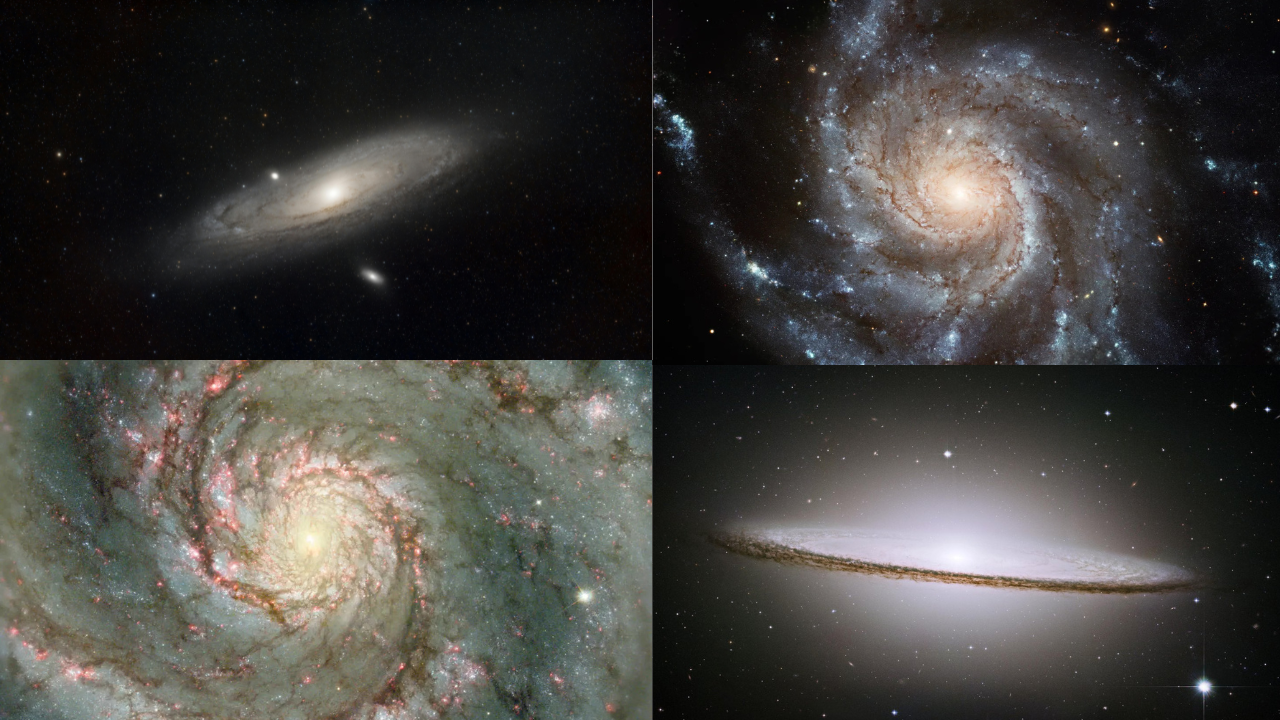
NASA spends billions to show us the ghosts of a dead universe. While casual observers scroll through social media feeds admiring the shimmering violets of the Pillars of Creation or the golden hexagonal mirrors of the James Webb Space Telescope (JWST), they rarely see the raw, ugly data that makes these images possible. These are not photographs in any traditional sense. They are highly processed, data-driven reconstructions designed to bridge the gap between cold mathematics and human emotion. The "beauty" of the cosmos is a curated product, manufactured by specialized image processors who decide which invisible wavelengths of light deserve to be seen and which should remain in the dark.
The Invisible Factory Behind the Pretty Pictures
Space is dark, cold, and mostly invisible to the human eye. Most of the most stunning features of our universe exist in wavelengths—infrared and ultraviolet—that our retinas simply cannot register. When NASA releases a "new" image of a distant galaxy, they aren't showing you what you would see if you were standing there. You would see nothing but a faint, gray smudge.
The process begins with raw data. This data arrives at Earth as strings of ones and zeros, representing the intensity of light hitting specific pixels on a digital detector. To make this data digestible, scientists use a process called "chromatic ordering." They assign the shortest wavelengths of light (like X-rays or ultraviolet) to blue, medium wavelengths to green, and the longest (like infrared) to red.
It is a translation. Like translating a poem from a language you don't speak, some meaning is always lost, and some is added by the translator. The shimmering blues of the Carina Nebula aren't "real" in a literal sense; they are a visual shorthand for the presence of oxygen. The deep reds are a proxy for sulfur. We are looking at a chemical map disguised as a landscape painting.
The Billion Dollar Branding of Deep Space
There is a pragmatic, almost cynical reason for the high-saturation beauty of these images. NASA is a federal agency that must justify its existence to a fickle Congress and a public with a short attention span. Beauty is the ultimate lobbying tool.
In the early 1990s, the Hubble Space Telescope was a laughingstock. It launched with a flawed mirror that produced blurry images, a literal $2.1 billion oversight. When the first crisp images finally arrived after a high-stakes repair mission, they had to do more than prove the telescope worked; they had to save the agency's reputation. The "Pillars of Creation" image, released in 1995, did exactly that. It turned a scientific instrument into a cultural icon.
The JWST continues this tradition but with higher stakes. At $10 billion, the project was years behind schedule and billions over budget. The first images released in 2022 were a masterclass in public relations. They weren't just scientific data; they were "the most beautiful things ever seen." By focusing on the aesthetic "wow" factor, NASA ensures that the next time they ask for a massive budget increase for a flagship mission, the public remembers the golden swirls of a spiral galaxy rather than the spreadsheet of a budget overrun.
The Problem with Visual Perfection
This obsession with beauty creates a skewed perception of the universe. When we look at the "Cartwheel Galaxy," we see a perfect, glowing ring of star formation. We don't see the violent, catastrophic collision that stripped the galaxy of its gas and doomed it to a slow death. The processing often smooths over the "noise" of the data—the cosmic rays and sensor artifacts that are part of the reality of space exploration.
By scrubbing these images clean, we risk turning the universe into a series of screensavers. We lose the sense of the "sublime"—that mix of beauty and terror that 18th-century philosophers used to describe the vastness of nature. The universe isn't just pretty; it is indifferent, radioactive, and incomprehensibly large.
The Technicians of the Sublime
The people who create these images are not just scientists; they are digital artists. They work in a basement or a quiet office at the Space Telescope Science Institute (STScI) in Baltimore, adjusting contrast levels and color balances. They have to make difficult choices. If a certain part of a galaxy is too bright, it will "blow out" the image, hiding the faint details of the dust lanes behind it. They use "dynamic range compression" to squeeze the massive brightness difference of a galaxy into something a computer monitor can display.
- Luminosity Layering: Scientists often take a high-resolution black-and-white image to capture detail and then "paint" it with color data from other filters.
- Noise Reduction: Deep space images are peppered with "hot pixels" and cosmic ray hits that must be meticulously removed to prevent them from being mistaken for stars.
- Stretching: The raw data is often "flat." Technicians must mathematically "stretch" the values to bring out the faint wisps of gas that would otherwise be invisible.
This is a delicate balance. Push the processing too far, and the image looks like a neon cartoon. Don't push it enough, and the public ignores the discovery. The industry calls this "representative color," a term that sounds scientific but hides the subjective artistry involved.
Why the "Most Beautiful" Label is a Trap
Articles that rank galaxies by their "beauty" do a disservice to the physics involved. The Sombrero Galaxy is famous for its thick dust lane, which looks like the rim of a hat. But that dust isn't there for our visual pleasure; it is a graveyard of old stars and a nursery for new ones. When we focus purely on the aesthetic, we stop asking the hard questions about galactic evolution.
We are currently in a "Golden Age" of astrophotography, but it is an age defined by algorithms as much as by optics. The AI-driven processing tools now being developed can "guess" what a blurry patch of light should look like based on thousands of other images. This creates a feedback loop where our telescopes start seeing what we expect them to see, rather than what is actually there.
The Threat of the Perfect Image
As our technology improves, the line between observation and simulation blurs. We have reached a point where we can generate "hyper-real" images of galaxies that are more detailed than the actual data supports. In the pursuit of the "most beautiful" shot, there is a temptation to enhance features that are barely at the edge of detection.
This isn't just about PR; it’s about the integrity of the record. If we prioritize the "wow" factor, we risk losing the "why" factor. Every photon captured by a telescope like JWST is a piece of a 13-billion-year-old puzzle. When we treat those photons like paint on a canvas, we are essentially rewriting history to suit our visual tastes.
The Reality of the Void
The next time a headline screams about the "most beautiful" galaxy ever found, look past the colors. Look for the gaps. Look for the areas where the light doesn't reach. The true story of the universe isn't found in the glowing clouds of gas that look like rose petals or butterfly wings. It is found in the dark matter we can't see, the black holes that swallow light, and the cold, empty spaces between the stars.
The beauty of a galaxy isn't in its color palette; it's in the fact that we can see it at all. We are a collection of atoms on a small rock, using a giant honeycomb of gold-plated beryllium to peer back to the beginning of time. That is far more impressive than a pretty picture.
Stop looking for the most "beautiful" galaxy and start looking for the most improbable one. Demand the raw data. Ask why a certain hue was chosen over another. The universe doesn't owe us a spectacular view, and the fact that we've manufactured one says more about us than it does about the stars.
Check the raw FITS files on the Mikulski Archive for Space Telescopes if you want to see the universe without its makeup on.