The US Supreme Court just handed down a decision that has everyone from Wall Street to Main Street talking, and for good reason. For months, legal scholars and political junkies braced for a seismic shift in how the executive branch handles trade. Instead, we got what looks like a strategic retreat. It’s a classic move from a Court that’s increasingly aware of its own approval ratings. By side-stepping the most radical arguments about presidential power and tariffs, the justices didn't just rule on a case. They sent a message about their own survival in a heated political climate.
If you’ve been following the headlines, you know the term court-packing is back in the zeitgeist with a vengeance. This isn't just academic theory anymore. It’s a looming shadow over every major conservative ruling. When the Court "blinks" on a massive issue like sweeping trade authority, it’s not necessarily because they’ve had a change of heart on the law. It’s often because they’re reading the room. Recently making waves lately: Finland Is Not Keeping Calm And The West Is Misreading The Silence.
The Tariff Fight That Almost Broke the System
At the heart of this mess is the question of who actually gets to tax Americans. The Constitution says it's Congress. But for decades, the executive branch has been using "national security" loopholes to slap tariffs on everything from steel to washing machines. This latest case was supposed to be the moment the Supreme Court reined that in—or, conversely, gave the President a blank check.
Instead of a definitive "yes" or "no," the Court took a middle path. They upheld the specific tariffs in question but did so on narrow, procedural grounds. They didn't touch the underlying "Non-Delegation Doctrine," which is the legal white whale for conservatives who want to dismantle the administrative state. By keeping that tool in their pocket, the justices avoided a direct confrontation with a White House that is already frustrated with judicial overreach. Additional information on this are detailed by NBC News.
This "blink" is a calculated maneuver. If the Court had gutted the President's ability to respond to global trade wars, the outcry would have been deafening. By playing it safe, they’ve managed to lower the temperature, if only for a few months.
Partisan Justice and the Public Trust Problem
Let's be real. Nobody looks at the Supreme Court as a neutral referee anymore. We see them through a red or blue lens because that’s how the appointments work. When the Court rules on something as economically sensitive as tariffs, the public immediately looks for the partisan angle.
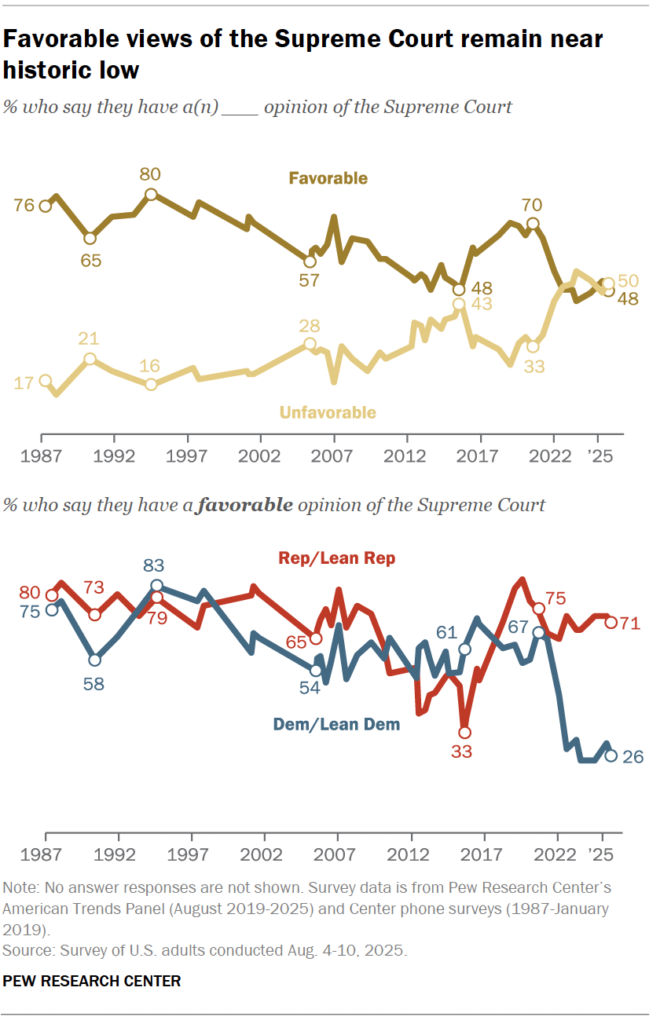
Data from the Pew Research Center has shown a steady decline in public confidence in the Court over the last few years. This puts the conservative supermajority in a tough spot. If they push too hard and too fast on their ideological agenda, they risk making themselves the central issue of the next election cycle.
- They know that a massive, unpopular ruling on trade could be the tipping point for legislative reform.
- They understand that their power relies entirely on the public’s willingness to follow their orders.
- They’re aware that "term limits" and "expansion" are no longer fringe ideas.
The recent ruling reflects this anxiety. It’s an attempt to prove they aren't just "politicians in robes," even if the timing of their moderation feels suspiciously convenient.
Why Court Packing is the Elephant in the Robing Room
You can’t talk about these rulings without talking about the threat of court-packing. It’s the ultimate "nuclear option" for a frustrated Congress. While it hasn't happened since the 1860s, the rhetoric around it has changed. It’s gone from a progressive pipe dream to a standard talking point for mainstream lawmakers.
Critics argue that adding seats to the Court would destroy the judiciary's independence. Supporters say the independence is already gone, and the Court has been "packed" through decades of strategic vacancies and stalled appointments. When the Court "blinks" on a high-stakes case like the tariff dispute, they are effectively trying to de-escalate this specific threat.
Think of it as a pressure valve. If the Court gives the executive branch a "win" here and there—especially on issues that affect the pocketbooks of millions of voters—they buy themselves some breathing room to be more radical in other areas, like environmental regulations or voting rights.
The Economic Reality of Judicial Hesitation
Trade isn't just about law; it's about money. Lots of it. Businesses hate uncertainty. When a case regarding billions of dollars in tariffs hangs in the balance, investment slows down. Companies don't know if their supply chains will be legal next Tuesday.
By failing to provide a sweeping, definitive ruling, the Supreme Court actually prolonged the uncertainty. We’re left in a grey area where the President has enough power to be dangerous, but not enough for businesses to feel secure in the long-term rules of the game. This isn't just a legal "blink"; it's an economic stalemate.
Many small business owners I've spoken with don't care about the Non-Delegation Doctrine. They care about the 25% price hike on their raw materials. For them, the Court’s refusal to set a hard limit on executive trade power feels like a betrayal of the idea that we live under a government of laws, not of men.
How to Navigate This New Judicial Era
Waiting for the Supreme Court to "fix" the trade landscape is a losing strategy. The justices have shown they are more interested in preserving their own institutional standing than in providing clear, predictable rules for the global economy.
If you're a business leader or an investor, you need to stop assuming the Court will act as a check on executive overreach. They might, or they might blink again if the political stakes get too high. Diversifying your supply chain away from regions heavily impacted by executive orders is the only real defense.
You should also keep a close eye on the "Shadow Docket." This is where the Court makes quick, often unexplained decisions on emergency stays and injunctions. Lately, more real "law" is being made there than in the big, televised oral arguments. If you want to see where the Court is actually heading, look at what they do when they think no one is watching.
The era of the "unpredictable" Court is here. They've shown us that they'll trade ideological purity for political survival when the heat gets turned up. Don't get caught flat-footed thinking the law is settled just because a conservative majority is on the bench. They're playing a much longer, much more survivalist game than most people realize.
Check your contracts for "force majeure" clauses that specifically include government-imposed trade barriers. If your current legal counsel isn't briefing you on how judicial shifts impact your specific industry tariffs, it’s time to find a firm that understands the intersection of constitutional law and global commerce. The days of treating the Supreme Court as a distant, predictable entity are over.