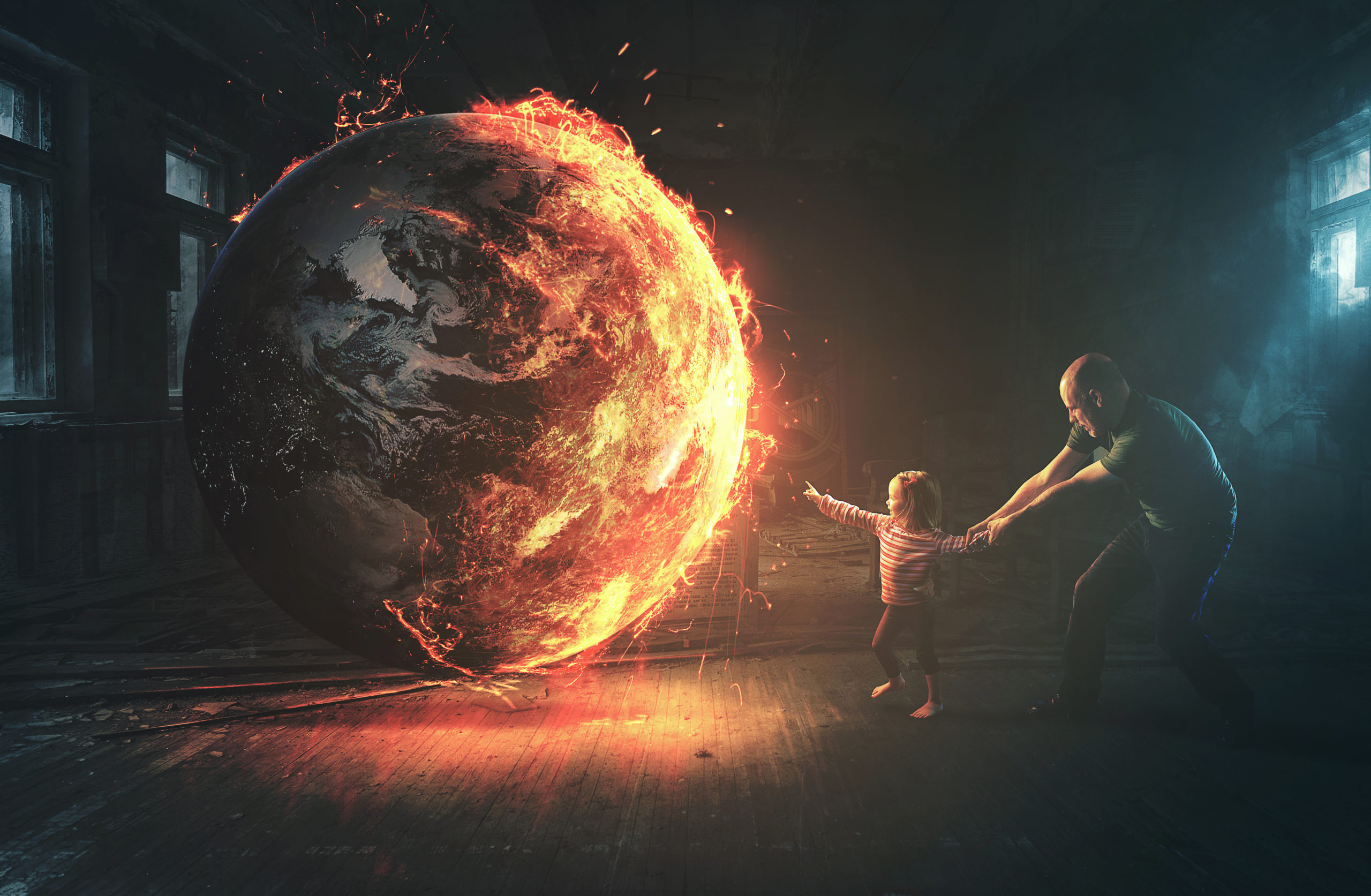
It feels like a sick joke from nature. You're told the planet is warming at an alarming rate, yet you’re standing in your driveway at 6:00 AM chipping two inches of ice off your windshield in a state that hasn't seen a "real winter" in decades. Critics of climate science love these moments. They point to the snow and ask where the global warming went.
The truth is that Freezing During Global Warming isn't a contradiction. It’s a direct consequence.
When we talk about climate change, we’re talking about energy. We’ve trapped so much extra heat in our atmosphere that the traditional systems governing our weather are breaking down. This isn't just about a slow crawl upward on the thermometer. It’s about volatility. It’s about the Arctic losing its grip on the cold air it’s supposed to keep locked away at the top of the world.
The Polar Vortex Is Losing Its Mind
To understand why you’re freezing, you have to look at the jet stream. Think of the jet stream as a high-altitude river of air that separates the cold polar air from the warmer air in the mid-latitudes. When the temperature difference between the Arctic and the equator is huge, the jet stream stays tight, fast, and straight. It keeps the cold north.
But the Arctic is warming four times faster than the rest of the planet. This phenomenon, known as Arctic Amplification, is the culprit. As the North Pole heats up, that temperature contrast disappears. The jet stream loses its energy. It starts to wander.
Instead of a tight circle, the jet stream becomes wavy and slow. It develops massive loops that dip far south, dragging "beasts from the east" or "polar plunges" into places like Texas, Tennessee, or Southern Europe. While you're shivering in a record-breaking cold snap, someone in Greenland is probably experiencing an unnervingly warm day. The cold didn't vanish. It just moved to your house.
Why More Heat Leads to More Snow
It sounds counterintuitive, but a warmer planet is actually better at producing massive snowstorms. Physics tells us that for every $1^{\circ}C$ of warming, the atmosphere can hold about $7%$ more water vapor.
Warm air is thirsty. It sucks moisture out of the oceans. When a wobbly jet stream pushes a pocket of Arctic air down into this moisture-rich environment, you don't just get a light dusting of snow. You get a "bomb cyclone." You get the kind of "Snowmageddon" that shuts down entire cities for a week.
The Great Lakes are a perfect example. Usually, these lakes would freeze over by mid-winter, cutting off the moisture supply for lake-effect snow. Now, because the air stays warmer longer, the lakes remain open water. When a stray cold front finally hits that open water, it dumps feet of snow on places like Buffalo. This isn't "cooling." It’s the result of a system with too much heat and no balance.
The Atlantic Ocean Is Slowing Down
If you live in Europe, the freezing threat is even more specific. There’s a massive system of ocean currents called the Atlantic Meridional Overturning Circulation (AMOC). This is the "conveyor belt" that brings warm water from the tropics up to the North Atlantic, keeping places like the UK and Scandinavia much warmer than they should be based on their latitude.
Research from institutions like the Potsdam Institute for Climate Impact Research shows the AMOC is at its weakest point in over a millennium. Freshwater from melting Greenland ice is pouring into the ocean, diluting the saltiness and stopping the water from sinking, which is what drives the current.
If this conveyor belt stalls or collapses, the "Freezing During Global Warming" reality becomes permanent for Europe. We could see a localized drop in temperatures of $5^{\circ}C$ to $10^{\circ}C$ in a matter of decades, even as the rest of the world continues to bake. It's a terrifying irony.
Stop Falling for the Snowball Trick
In 2015, a U.S. Senator famously brought a snowball onto the Senate floor to "disprove" climate change. It’s a cheap stunt that works because our brains struggle to separate "weather" from "climate."
- Weather is what's happening outside your window right now. It's the mood.
- Climate is the long-term trend. It's the personality.
A person can be generally happy (the climate) but still have a really bad afternoon (the weather). One blizzard doesn't negate thirty years of record-breaking summer heatwaves. In fact, the data shows that while winter low-temperature records are still being broken, they're being outpaced by record highs at a ratio of roughly 2-to-1. We’re losing the cold, but the cold we have left is becoming more chaotic.
Protecting Your World From the Dip
Since these extreme cold swings are becoming the new normal, you can’t rely on old assumptions about your local climate.
Start by auditing your home's "thermal envelope." Most houses in southern latitudes aren't built for sub-zero temperatures. Pipes aren't buried deep enough. Insulation is thin. When the 2021 freeze hit Texas, the primary cause of death wasn't the cold itself, but the failure of infrastructure that wasn't designed for a "wavy" jet stream.
- Insulate beyond the code. If you’re in a region that’s seeing more frequent "polar plunges," treat your home like it’s 200 miles further north.
- Back up your power. Cold snaps put immense strain on the grid. Solar with battery backup or a dual-fuel generator is no longer a luxury for preppers; it’s a basic safety net.
- Watch the Arctic oscillation. Don't just check the 7-day forecast. Follow climate scientists who track Arctic air movements. When the vortex stretches, you usually have about two weeks of warning before the deep freeze hits.
We have to stop thinking of global warming as a peaceful transition to a tropical paradise. It’s a violent destabilization of the world we built. The next time you're shoveling snow in April, remember that you aren't seeing a return to the "good old days." You're seeing a planet that’s lost its thermal brakes.
Check your home's insulation levels today and ensure your emergency kit has enough supplies for a five-day grid failure. The cold isn't gone; it’s just getting more unpredictable. Don't let a "warm" year trick you into being unprepared for a killer winter.