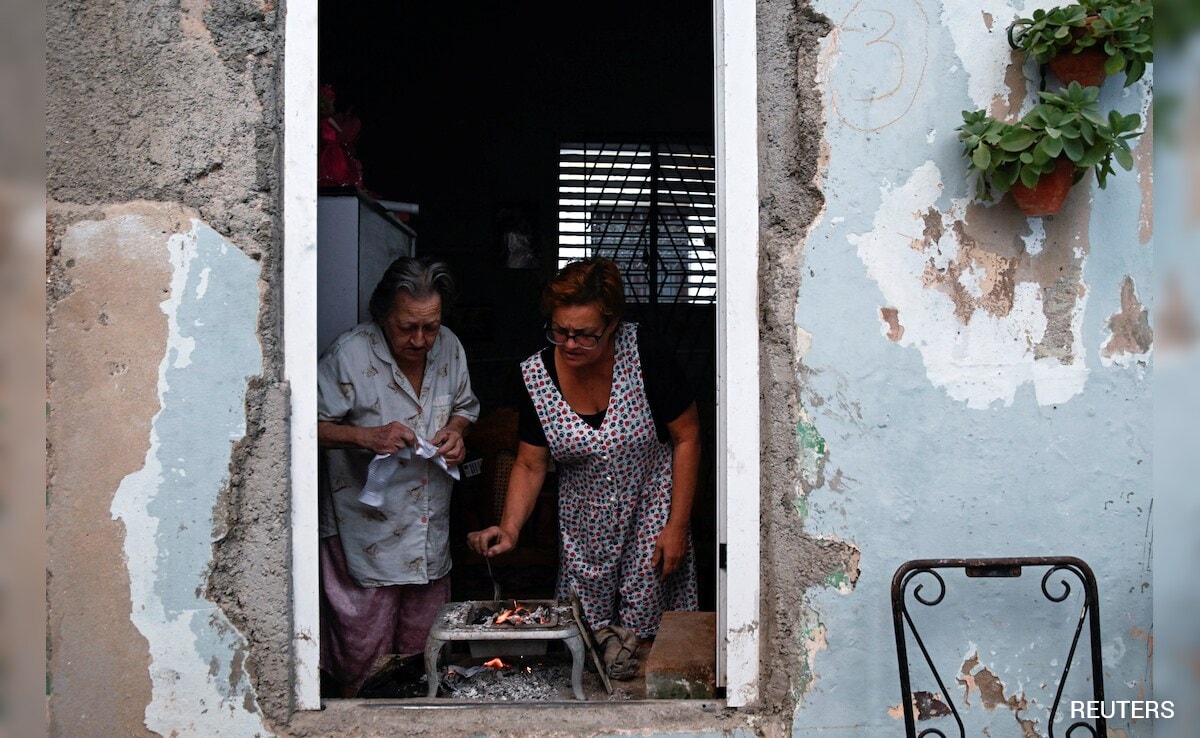
The collapse of the Cuban national electric system (SEN) is not an isolated mechanical failure but the mathematical certainty of a system operating beyond its thermodynamic and economic margins. When a grid enters a state of total blackout (zero generation), the "black start" recovery process is governed by a precarious synchronization of thermal plants, floating power ships, and distributed generation nodes. The current crisis, exacerbated by the failure of the Antonio Guiteras plant and subsequent failed synchronization attempts, represents a systemic breach where the rate of infrastructure decay has finally outpaced the state’s capacity for stop-gap interventions.
The Triad of Systemic Failure
The Cuban energy crisis is defined by three intersecting vectors: critical fuel insolvency, thermal exhaustion of base-load assets, and the logistical friction caused by external trade restrictions. Each vector compounds the others, creating a feedback loop that makes standard grid management impossible. Meanwhile, you can explore related events here: The Cold Truth About Russias Crumbling Power Grid.
1. The Fuel Supply Bottleneck
The Cuban grid relies heavily on liquid fuels—heavy fuel oil (HFO) and diesel—for its distributed generation units and many of its larger thermal plants. The disruption of supply lines from traditional partners like Venezuela and Mexico has forced a shift toward spot-market acquisitions, which are hindered by the U.S. embargo and a lack of hard currency.
This creates a high Cost of Carry for every megawatt-hour produced. Without a steady, predictable inflow of fuel, the grid cannot maintain the "spinning reserve"—the extra generating capacity that must be available to handle sudden spikes in demand or the sudden loss of a generation unit. When the reserve margin hits zero, the smallest frequency deviation can trigger a cascade of protective shutdowns across the entire island. To understand the bigger picture, check out the excellent article by USA Today.
2. Thermal Exhaustion and Maintenance Deficits
The backbone of the SEN consists of Soviet-era thermal power plants (TPPs) that have exceeded their 30-year design life by decades. These plants require "capital maintenance"—deep overhauls involving the replacement of boiler tubes, turbines, and control systems.
The maintenance gap can be quantified by the Energy Availability Factor (EAF). As EAF drops, the frequency of "forced outages" (unplanned shutdowns) increases exponentially. In a healthy system, maintenance is scheduled during low-demand periods. In the Cuban context, the system is so fragile that operators are forced to skip maintenance to keep the lights on, which leads to catastrophic failures like the recent breach at the Matanzas-based Guiteras plant.
3. Synchronization Instability
A national grid is essentially a single, giant machine that must rotate at exactly 60 Hz. When the grid is "dark," engineers must restart small units (usually diesel generators or gas turbines) and then carefully add larger plants. This is the Synchronization Challenge.
If a large plant like Antonio Guiteras tries to come online and its output is not perfectly matched to the load (the amount of electricity being used), the frequency will fluctuate. If the frequency drops too low, the plant’s protection relays will automatically disconnect it to prevent the turbine from being destroyed. The second blackout occurred precisely because the "load-to-generation" balance was too tight; the system lacked the inertia to absorb the shock of a single unit tripping.
The Logistics of the US Oil Blockade
The impact of the U.S. embargo on Cuba's energy sector is primarily a Logistical Friction Multiplier. It does not make oil "impossible" to get, but it makes it significantly more expensive and difficult to transport.
- Shipping Premiums: Tankers that touch Cuban ports are often barred from U.S. ports for six months. This narrows the pool of available vessels and forces Cuba to pay higher freight rates (the "Cuba Premium").
- Financial Intermediation: Because Cuba is on the State Sponsors of Terrorism list, international banks are hesitant to process payments. This forces the use of third-party intermediaries, adding layers of fees and delaying the speed of transactions.
- Parts Sourcing: Much of the modern equipment in the grid, including control systems and certain turbine components, contains U.S.-patented technology. The inability to buy directly from manufacturers necessitates "gray market" sourcing, which is slower and lacks technical support from the Original Equipment Manufacturer (OEM).
The Decentralization Paradox
To mitigate the failure of large thermal plants, Cuba heavily invested in "Distributed Generation" (DG)—thousands of small diesel and fuel-oil generators spread across the country. While this was intended to provide resilience, it created a new set of vulnerabilities.
Efficiency vs. Resilience
Large thermal plants are more efficient but represent single points of failure. Distributed generators are more resilient but are significantly more expensive to operate. The heat rate ($BTU/kWh$) of a small diesel engine is far worse than that of a massive steam turbine.
Furthermore, DG units require a vast, truck-based fuel distribution network. In a fuel-scarce environment, the logistics of trucking diesel to thousands of sites is a massive drain on the very fuel they are meant to burn. This is the Operational Catch-22: to keep the grid resilient, the state must consume more of the resource (fuel) that is currently most scarce.
Mathematical Realities of the Recovery
The restoration of the SEN is a race against Systemic Entropy. Every hour the grid is down, the "cold start" requirements become more difficult.
- Thermal Stress: Restarting a cold boiler causes massive thermal expansion stress on aging metal. The more times a plant is cycled (turned off and on), the more likely it is to suffer a pipe burst.
- Water Chemistry: Thermal plants require ultra-pure demineralized water. During extended outages, maintaining the chemistry of this water is difficult, leading to internal corrosion that may not be apparent until the plant reaches full pressure.
- Human Capital Depletion: The technical expertise required to "hand-stitch" a broken grid back together is immense. Years of economic crisis have led to a "brain drain" of specialized electrical engineers and plant operators, leaving the SEN with a skeleton crew of overworked personnel.
The Role of Floating Power (Karpowerships)
Cuba has increasingly relied on leased Turkish "powerships"—floating power plants moored off the coast. These ships provide a critical "plug-and-play" capacity. However, they are a temporary bandage rather than a cure.
- Payment Volatility: These are private contracts that require consistent hard currency payments.
- Grid Integration: These ships are concentrated in a few ports (Havana, Mariel). Transmitting that power to the eastern provinces (Santiago de Cuba) through an aging, high-voltage transmission line results in significant Line Losses.
If the transmission lines between the western and eastern halves of the island fail, the grid "splits," creating two separate energy islands. This makes synchronization even harder because the smaller island (the East) has even less inertia to stabilize its frequency.
Strategic Path Forward
The path to a stable Cuban grid requires a fundamental shift in the Energy Mix Matrix. The current reliance on imported liquids is an unsustainable strategy.
Transition to Natural Gas and Renewables
The conversion of existing plants to natural gas (if local extraction can be scaled) would lower the carbon intensity and potentially the cost. However, the immediate need is for Utility-Scale Battery Energy Storage Systems (BESS).
In a grid with low inertia, batteries can provide "synthetic inertia," reacting in milliseconds to frequency drops that would otherwise trip a thermal plant. Without the capital to install massive battery arrays, Cuba remains tethered to the physical limitations of 50-year-old spinning steel.
Micro-Grid Insulation
The most logical survival strategy for essential services (hospitals, water pumps, food storage) is the aggressive decoupling from the national grid into independent micro-grids. By utilizing localized solar PV coupled with battery storage, these "islands of stability" can function even when the SEN enters a total blackout state. This reduces the "social cost" of grid failure even if the "industrial cost" remains high.
The immediate priority for the Cuban energy ministry must be the stabilization of the "Western Ring" (Havana-Mariel-Matanzas). By creating a stable core, they can then slowly extend power to the rest of the island using the "step-restoration" method, where blocks of load are added only when generation capacity is confirmed stable. Any attempt to rush the restoration to meet political deadlines increases the risk of a third, and potentially more damaging, systemic collapse.