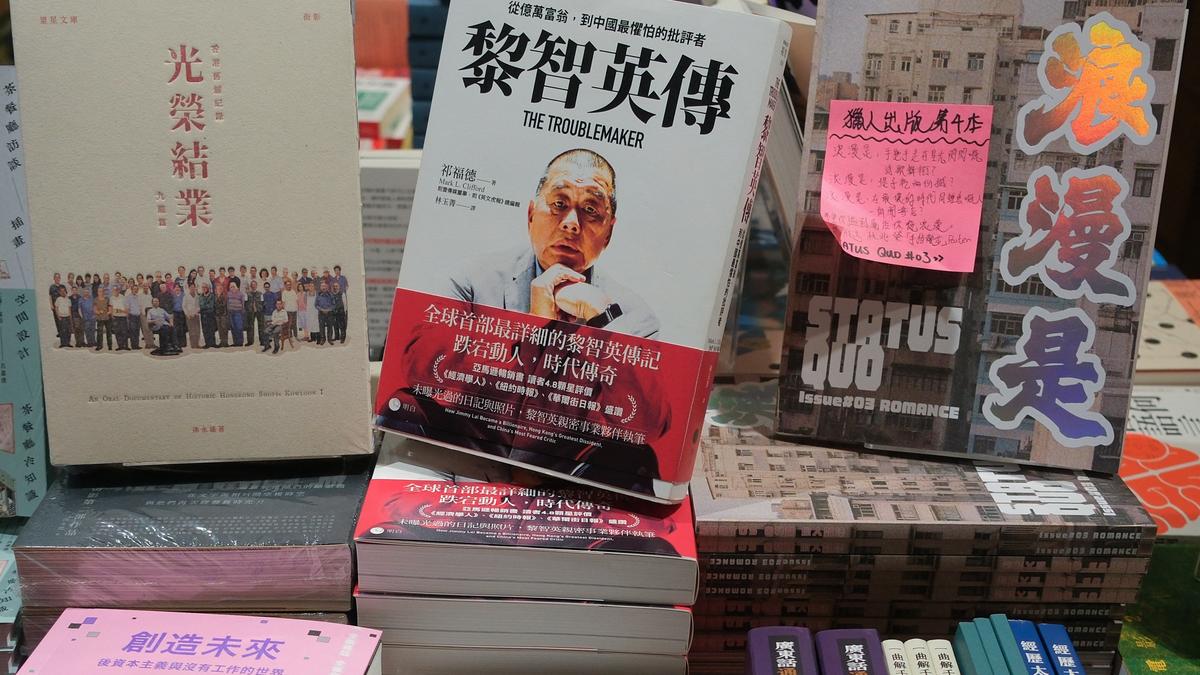
The recent arrest of individuals connected to independent bookstores in Hong Kong serves as a definitive case study in the transition from rule of law to rule by law. This shift is not merely a change in judicial policy; it is a systematic reconfiguration of the city's operational risk profile. By targeting the distribution nodes of intellectual capital—specifically independent booksellers—the state is implementing a strategy of information bottlenecking. This creates a high-friction environment for the exchange of non-sanctioned ideas, effectively raising the "cost of dissent" to a level that prohibits participation for the average citizen.
The Mechanism of Deterrence: Psychological and Legal Elasticity
The current legal environment in Hong Kong operates through the strategic use of elastic definitions. Under the National Security Law (NSL) and the recently enacted Article 23 (Safeguarding National Security Ordinance), terms such as "sedition" and "state secrets" are not strictly defined by specific actions, but by the perceived intent and the potential effect on social stability.
This elasticity functions as a force multiplier for state power. When the boundaries of legality are opaque, individuals engage in preemptive self-censorship. In a data-driven sense, this is a more efficient method of social control than mass incarceration. It offloads the cost of policing from the state to the individual.
The arrest of bookstore staff for possessing or distributing "seditious" publications creates a ripple effect across three distinct layers of the information economy:
- The Supply Layer: Publishers and authors cease production of sensitive material to avoid litigation.
- The Distribution Layer: Physical and digital storefronts remove "high-risk" inventory to maintain business licenses and avoid raids.
- The Consumption Layer: Readers stop purchasing or holding specific texts due to the risk of "possession with intent," a legal threshold that has become increasingly easy for the prosecution to meet.
The Cost Function of Dissent
To analyze the current climate, one must view dissent through an economic lens. In a liberal democracy, the cost of expressing an opposing view is typically low (reputational risk, social friction). In the post-2020 Hong Kong landscape, the cost function has shifted to include:
- Direct Costs: Legal fees, loss of employment, and asset freezes.
- Opportunity Costs: Time lost during pre-trial detention, which can extend for years without a conviction.
- Systemic Costs: The loss of professional accreditation or the inability to secure future travel visas.
The state’s strategy relies on making the expected utility of political expression negative. If the probability of arrest ($P$) multiplied by the severity of the punishment ($S$) exceeds the perceived benefit of the action ($B$), the behavior ceases. By increasing both $P$ (through high-visibility arrests of soft targets like booksellers) and $S$ (through expanded sentencing guidelines), the state effectively deplatforms the opposition without needing to engage in the discourse itself.
The Digital Panopticon and Information Asymmetry
The "dystopian" label often applied by rights groups is technically a reference to the asymmetry of information. The state utilizes advanced surveillance and data scraping to identify networks of association. When a bookstore is raided, the primary value for the state is not the books themselves, but the customer records, digital footprints, and social graphs of those who frequent the establishment.
This data collection feeds into a broader system of algorithmic governance. While Hong Kong does not yet have a unified "Social Credit System" identical to the mainland, the integration of police databases with financial records and public transport data (Octopus cards) creates a de facto monitoring system.
The Infrastructure of Surveillance
- Financial Chokepoints: The use of anti-money laundering (AML) laws to target the funding of civil society organizations.
- Digital Forensics: The extraction of data from seized devices to map "co-conspirators" who may have merely shared a link or liked a post.
- Physical Presence: The proliferation of high-definition CCTV with facial recognition capabilities in high-traffic areas, reducing the anonymity required for grassroots organizing.
The Decoupling of International Recognition and Domestic Control
A critical miscalculation by external observers is the assumption that Hong Kong’s status as a global financial hub acts as a "shield" for civil liberties. Logic suggests that the state would avoid actions that damage its international reputation. However, the current administration has demonstrated a clear prioritization of sovereign security over economic optics.
The "Two Systems" component of the "One Country, Two Systems" framework has been functionally subsumed by the "One Country" mandate. This represents a strategic pivot where the perceived risk of a "Color Revolution" or foreign interference is viewed as an existential threat that outweighs the risk of capital flight or a "brain drain."
The data suggests a bifurcation of the workforce. While high-level finance professionals may remain due to high compensation, the intellectual and creative classes are exiting. This results in an "Expertise Gap" where the city remains technically proficient in capital management but loses its capacity for innovation and social self-correction.
The Fragility of the "New Normal"
The state’s current dominance is built on the suppression of visible friction. However, this creates a structural fragility. When a system lacks feedback loops—such as a free press, independent unions, or vocal bookstores—the government loses the ability to gauge genuine public sentiment.
This absence of data creates a "black box" effect. Policies are implemented in a vacuum, and resentment, rather than being expressed and dissipated through political channels, accumulates beneath the surface. The state is then forced to increase its security spend ($G_{s}$) to manage the potential for sudden, non-linear social movements.
Strategic Realignment for Civil Society
For those remaining in the Hong Kong market—whether businesses, non-profits, or individuals—the strategy must shift from advocacy to resilience. This involves:
- Data Decentralization: Moving sensitive information to decentralized, offshore storage solutions that are outside the jurisdiction of local warrants.
- Operational Security (OPSEC): Treating all digital communication as compromised and utilizing end-to-end encrypted platforms with self-destructing messages as a default.
- Legal Hedging: Structuring organizations as smaller, modular entities that can be dissolved quickly, rather than large, centralized targets.
The arrest of booksellers is the closing of a specific chapter in Hong Kong’s history, but it is also the opening of a more sophisticated, subterranean era of engagement. The state has successfully raised the walls, but in doing so, it has forced the evolution of its critics into more elusive, technically proficient actors.
The immediate priority for international stakeholders is the establishment of "Information Corridors"—secure, high-bandwidth channels that allow for the continued flow of data and intellectual capital into and out of the city, bypassing the state’s domestic bottlenecks. This is no longer a battle of rhetoric; it is a battle of infrastructure. Those who control the flow of data will ultimately determine the viability of Hong Kong as anything more than a managed financial outpost.
The move toward a "dystopian" state is not a final destination but a constant, resource-intensive process of enforcement. The sustainability of this model depends entirely on the state’s ability to maintain a high-pressure environment without triggering a systemic economic collapse—a balancing act that becomes more precarious with every new arrest of an intellectual gatekeeper.