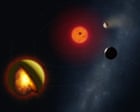
The headlines are currently obsessed with "molten, mushy" worlds, treating the discovery of ultra-hot, low-density exoplanets as a whimsical scientific curiosity. They call them a "new type of liquid planet." This is not just a misnomer; it is a desperate attempt to force the chaotic reality of the universe into the neat, suburban filing cabinets of 19th-century planetary science.
We are not looking at a "new type" of anything. We are looking at the spectacular failure of our own definitions.
For decades, the planetary science community has clung to a rigid triad: rocky, gas giant, or ice giant. When we find something that doesn't fit—a world so close to its star that its silicate mantle is a bubbling soup and its atmosphere is vaporized rock—we scramble to invent a cute nickname. We call them "Synestias" or "Magma Oceans." In reality, these are transition states that prove the term "planet" is rapidly becoming a useless relic of a pre-Kepler era.
The Myth of the Solid Ground
The "lazy consensus" in recent reporting suggests these liquid worlds are a rare, exotic state of matter. I’ve spent years looking at orbital resonance and tidal heating data, and I can tell you: fluidity is the default, not the exception, for a massive chunk of the galaxy.
We suffer from a profound "Earth-bias." Because we live on a cooled, crustal anomaly, we assume that "solid" is the natural state of a planetary body. It isn’t. If you look at the energy budgets of planets orbiting M-dwarf stars—the most common stars in the universe—you realize that tidal locking and extreme stellar flux keep a significant portion of these bodies in a permanent state of partial melt.
They aren't "planets" in the way we understand them. They are massive, gravitationally bound heat exchangers.
When researchers talk about a "mushy" state, they are describing a high-viscosity fluid dynamic that defies the standard geological models used for Mars or Venus. In these environments, the core-mantle boundary isn't a hard line; it’s a chemical gradient. We are trying to use the physics of a billiard ball to describe the behavior of a lava lamp.
Stop Asking if They Can Support Life
One of the most frequent "People Also Ask" queries regarding these molten worlds is whether they could eventually cool down to support life. This is the wrong question. It assumes a linear, teleological progression toward "Earth 2.0."
The reality is more brutal. Many of these "mushy" worlds are in a state of terminal evaporation. The sheer heat required to keep a silicate mantle liquid often exceeds the energy threshold required to strip an atmosphere into space via hydrodynamic escape.
- Scenario: Imagine a planet with 1.5 times Earth's mass orbiting a Sun-like star at 0.02 AU.
- The Result: The surface temperature stays above $2000$ K. The "atmosphere" is literally composed of $SiO_2$ and $Mg$ vapors.
You aren't looking at a cradle for life. You are looking at a world that is slowly turning itself inside out and blowing its guts into the interstellar medium. Calling it a "liquid planet" makes it sound like a giant water park. It’s actually a pressurized, radioactive blast furnace.
The Mathematics of the Mush
To understand why the "mushy" descriptor is scientifically lazy, we have to look at the Rayleigh number, which characterizes the regime of convection in a fluid.
$$Ra = \frac{g \alpha \Delta T d^3}{\nu \kappa}$$
In a standard terrestrial planet, the viscosity ($\nu$) is high enough that convection is slow, happening over millions of years. In these molten worlds, the viscosity drops by orders of magnitude. The heat transport isn't just "mushy"; it’s violent. We are seeing planetary-scale turbulence that would make a Jovian storm look like a light breeze.
The industry insiders who actually process the radial velocity and transit data know that these planets challenge our understanding of the "Mass-Radius" relationship. If a planet is molten, its radius increases due to thermal expansion. If we don't account for the "mush factor," we miscalculate the density, leading us to falsely claim we’ve found "water worlds" or "sub-Neptunes" when we’ve actually just found a very hot, very puffed-up rock.
The High Cost of Scientific Branding
I have seen research teams spend millions in grant funding trying to shoehorn these discoveries into the "Habitable Zone" narrative because that’s what gets clicks and secures more funding. It is a dishonest cycle. By calling these "liquid planets," we are selling a version of space that is familiar and digestible.
The truth is far more alien and, frankly, terrifying.
We are discovering that the gap between a "star" and a "planet" is a crowded, messy spectrum. There are objects out there that are essentially "failed" stars that look like planets, and "overheated" planets that look like small stars. These molten worlds sit right in the crosshairs of that identity crisis.
If we want to actually progress as a spacefaring species, we need to stop naming things based on how they look to our primitive eyes and start naming them based on their thermodynamic reality.
The Brutal Truth of Discovery
If you’re waiting for a "mushy" planet to become a new home, stop. These bodies are a warning. They represent the extreme limits of what gravity can hold together in the face of stellar radiation.
The downsides of my contrarian view? It makes the universe feel a lot less "friendly." It removes the hope of finding a million Earths just waiting for us to arrive. But it replaces that false hope with a hard, crystalline truth: most of the universe is actively hostile to the concept of "solid ground."
We need to abandon the "planet" label for these objects entirely. They are Stellar-Coupled Fluid Masses. They don't belong to the category of Earth or Mars. They belong to a category of chaos that we are only just beginning to map.
Quit looking for a beach on a liquid planet. You’ll only find a shore of vaporized iron and a sky that is literally falling.
Stop trying to make the galaxy make sense through the lens of your own backyard.
Accept the mess.