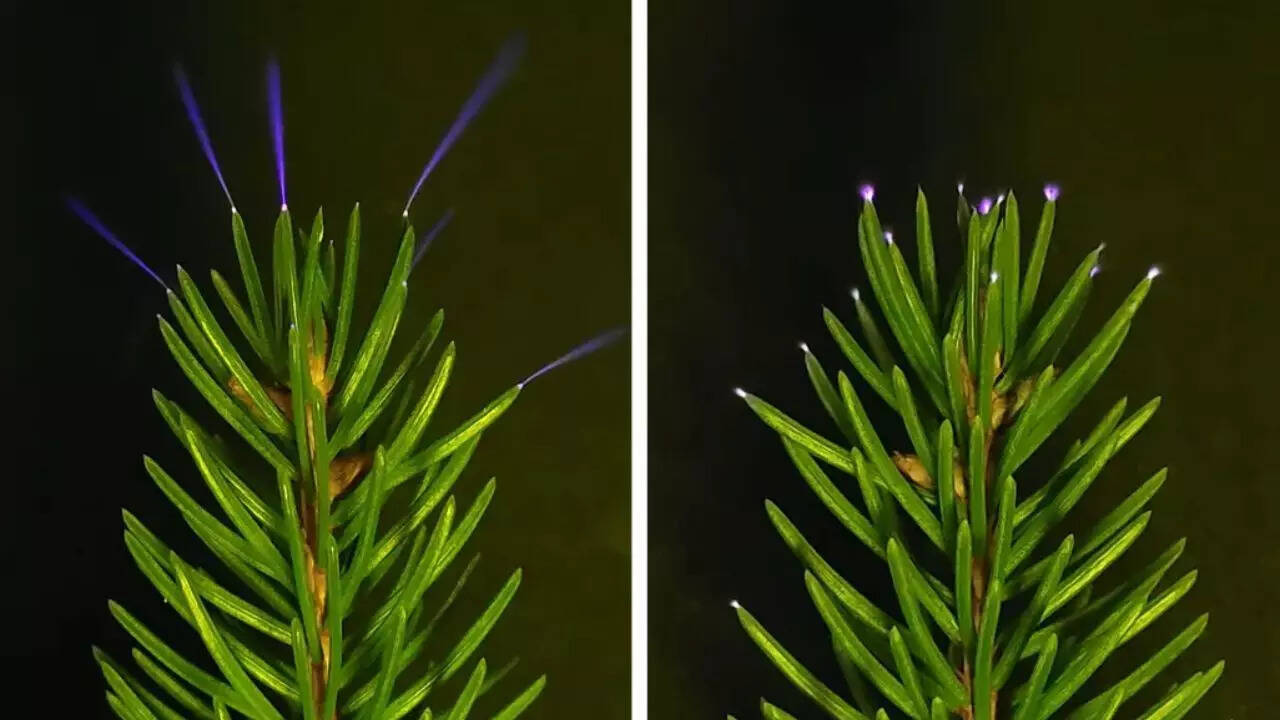
For decades, we viewed trees as passive observers of a storm. They were merely victims of lightning or beneficiaries of rain. Recent high-speed imaging and field data have shattered that narrow view. When a thunderstorm rolls in, the forest floor transforms into a massive, biological electrical grid. Trees don't just stand there; they actively generate "streamers," which are faint, blue, branch-like discharges of plasma that reach toward the sky. This phenomenon, known as the corona discharge, means that before a lightning bolt ever strikes, the trees are already "glowing" with electricity.
This isn't a poetic metaphor. It is a measurable physical reality with profound implications for atmospheric chemistry and our understanding of forest ecology. When the electrical field between the clouds and the ground becomes sufficiently intense, the sharp points of leaves and needles concentrate that energy. This triggers a localized breakdown of air molecules, ionizing the atmosphere and creating a visible, if faint, electrical aura around the canopy. Building on this topic, you can find more in: Stop Blaming the Pouch Why Schools Are Losing the War Against Magnetic Locks.
The Physics of the Forest Plasma Grid
To understand why a tree glows, you have to look at its architecture. Every leaf, every pine needle, and every jagged edge of bark acts as a natural lightning rod. In a high-potential electrical environment—the kind created by an approaching thundercloud—these points become focal sites for a process called corona discharge.
Unlike a lightning bolt, which is a massive, sudden surge of current, a corona discharge is a continuous, low-level leak of electricity into the air. It happens when the electric field strength at the tip of a leaf exceeds the dielectric strength of the air. This creates a localized plasma field. The "glow" that scientists have recently captured is the result of these excited air molecules (mostly nitrogen and oxygen) returning to their ground state and emitting photons in the process. Experts at CNET have shared their thoughts on this matter.
This process is not uniform. A broad, flat leaf might not trigger a discharge, while a sharp pine needle acts as a perfect conduit. This means that different types of forests—coniferous versus deciduous—interact with the atmosphere in fundamentally different electrical ways. We are looking at a planetary-scale circuit where the biological composition of the land directly modulates the electrical state of the sky.
Beyond the Visual Spectacle
The glow is the headline, but the chemistry is the story. When trees emit these electrical streamers, they aren't just losing energy. They are actively altering the air around them. This ionization process breaks apart molecules of nitrogen and oxygen, leading to the formation of hydroxyl radicals ($OH$) and nitric oxide ($NO$).
These chemicals are the "detergents" of the atmosphere. They react with pollutants like methane and other greenhouse gases, breaking them down and effectively cleaning the air. If thousands of square miles of forest are generating these discharges during every major storm, we have been catastrophically underestimating the natural filtration capacity of the planet. We have focused on carbon sequestration—how trees pull carbon out of the air—but we have ignored their role in active, electrical atmospheric scrubbing.
The Competitive Edge of High Speed Imaging
For years, this phenomenon was mostly anecdotal. Pilots reported "Saint Elmo's Fire" on their wings, and hikers sometimes mentioned a buzzing sound or a faint blue light in the woods before a storm. But capturing it on camera in a forest setting was nearly impossible because the discharges are faint and the lighting conditions of a storm are chaotic.
The recent breakthrough comes from using ultra-high-speed cameras capable of thousands of frames per second, coupled with ultraviolet sensors. These devices revealed that trees start "firing" streamers long before a lightning strike occurs. In fact, many of these discharges never lead to a strike at all; they are simply the forest bleeding off the electrical tension of the atmosphere.
This data suggests that the forest acts as a massive buffer. By leaking charge back into the atmosphere through millions of tiny points, trees may actually be preventing some lightning strikes from occurring by neutralizing the potential difference between the ground and the clouds before it reaches a breaking point.
The Downside of the Glow
While the atmospheric cleaning is a benefit, there is a hidden danger. These discharges are hot. While not as hot as a lightning bolt, the plasma in a corona discharge can reach temperatures sufficient to ignite volatile organic compounds (VOCs) emitted by the trees themselves.
Trees like eucalyptus and pine are notorious for their oily, flammable secretions. During a dry thunderstorm—where there is high electrical activity but little rain—these faint glows could be the unseen ignition source for forest fires that seem to start "out of nowhere." We have long attributed "lightning-caused" fires to direct strikes, but it is highly probable that many are actually caused by these low-level electrical leaks in the canopy.
A New Map of the Invisible Forest
If we accept that forests are electrical actors, we have to rethink land management. A monoculture of spruce trees, for example, is an entirely different electrical entity than a diverse old-growth forest. The spruce forest, with its millions of sharp needles, will have a much higher rate of corona discharge and atmospheric ionization than a forest of broad-leaved oaks.
Research Gaps and the Path Forward
Current climate models don't account for the electrical output of forests. This is a massive blind spot. We are calculating global chemical cycles while ignoring a primary driver of atmospheric hydroxyl radicals.
- Atmospheric Impact: We need to quantify exactly how much $OH$ and $NO$ are produced during a typical storm cycle across different biomes.
- Fire Prediction: We need sensors that can detect the "buzz" of corona discharges in real-time to predict fire risk in dry-lightning scenarios.
- Species-Specific Electrical Profiles: We need a database of which tree species are the most "electrically active."
The technology to do this exists, but the funding has been slow to move from traditional "green" ecology into this weird, hybrid field of "electro-biology."
The Strategic Reality
For the analyst, the takeaway is clear: the forest is not a passive carbon sink. It is an active, electrical component of the Earth's climate system. Companies involved in carbon credits and environmental monitoring should be looking closely at this. If the "value" of a forest includes its ability to electrically scrub the atmosphere of methane, the economic case for preservation becomes even stronger.
We are entering an era where we can no longer look at a tree and see only wood and leaves. We have to see an antenna. We have to see a chemical factory powered by the friction of the clouds. The blue glow in the dark woods isn't just a curiosity; it is the visual signature of a planet-sized machine working to maintain its own balance.
The next time you are in the woods and the air starts to feel heavy and charged, listen for the hiss. It’s the sound of the trees fighting the storm.
Monitor the upcoming data from the National Oceanic and Atmospheric Administration's new lightning mapping arrays to see if your local forest is one of these hidden electrical hubs.