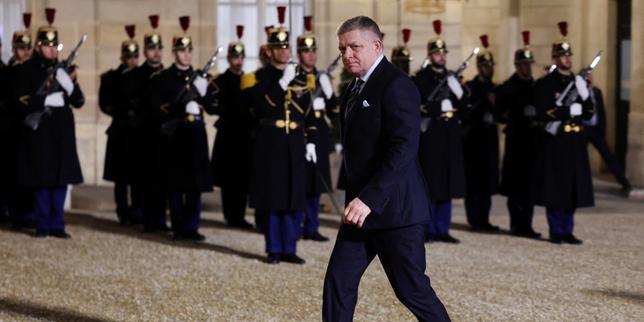
Robert Fico did not blink, but he did calculate. The eleventh-hour decision by Bratislava to withdraw its threat to block the renewal of European Union sanctions against Russia was not a victory for continental unity. It was a cold-blooded accounting exercise. For weeks, the Slovakian government signaled a willingness to upend the consensus that has defined the West’s response to the invasion of Ukraine since February 2022. By ultimately stepping back from the ledge, Slovakia avoided a catastrophic freeze of its own development funds while simultaneously proving that the EU’s sanctions regime is held together by increasingly frayed threads.
The core of the dispute centered on the semi-annual renewal of the restrictive measures targeting Russian individuals and entities. Unlike the introduction of new "packages," the renewal of existing sanctions requires absolute unanimity among all 27 member states. This creates a recurring window of vulnerability. Any single capital can hold the entire bloc’s foreign policy hostage to extract domestic concessions. Slovakia’s momentary defiance highlights a shifting power dynamic in Central Europe where Brussels’ leverage is being tested by leaders who view geopolitical alignment as a tradable commodity.
The Price of Dissent
Slovakia’s recent posture is a radical departure from its role in the early days of the conflict. In 2022, the country was one of the first to send S-300 air defense systems to Kyiv. Today, under Fico’s fourth term, the narrative has shifted toward "sovereign foreign policy." This shift is not merely ideological. It is a tactical response to a domestic economy struggling with high energy costs and a government that won an election on the promise of ending military aid.
The "in extremis" nature of the climbdown suggests that the European Commission used the only tool it has left: the purse strings. Reports from the corridors of the Berlaymont indicate that the threat of triggering the "rule of law" mechanism—which can freeze billions in EU funds—was the primary driver for Bratislava’s reversal. Fico knows that a small, export-oriented economy like Slovakia cannot survive a prolonged financial war with Brussels. He chose to live to fight another day, likely during the negotiations for the next major budget cycle or the inevitable debate over Ukraine's eventual accession to the union.
Energy Dependence as a Weapon of Statecraft
One cannot understand Slovakia’s hesitation without looking at the pipelines. While much of Western Europe has successfully decoupled from Russian hydrocarbons, Central Europe remains tethered to the East. The Druzhba pipeline continues to deliver crude to the Slovnaft refinery in Bratislava. For the Fico administration, sanctions are not an abstract moral imperative; they are a direct threat to industrial competitiveness.
Slovakia, along with Hungary and the Czech Republic, secured exemptions for pipeline oil when the initial embargoes were drafted. However, those exemptions are perpetually under fire from hawks in the Baltics and Poland. By threatening to block the entire sanctions list, Slovakia was effectively firing a warning shot. It served as a reminder that if the EU moves to close the remaining loopholes for Russian energy, the internal resistance will move from quiet grumbling to active sabotage.
The Hungarian Shadow
Budapest has long been the primary agitator against the EU’s Russia policy. For years, Viktor Orbán acted as the lone dissenter, often winning concessions in exchange for his "yes" vote. The emergence of a sympathetic government in Bratislava changes the math. One dissenter is an outlier; two constitutes a bloc.
This burgeoning alliance creates a "security in numbers" effect. When Hungary stood alone, it was easy to isolate. With Slovakia providing rhetorical cover, the cost of punishing dissenters becomes higher for the European Commission. They cannot easily sideline two member states without risking a total breakdown of the Council’s functioning. This coordination is the real story behind the headlines. It is a slow-motion pivot toward a Central European "neutrality" that benefits Moscow by slowing the momentum of Western pressure.
The Erosion of the Unanimity Principle
The recurring drama in Brussels reveals a structural flaw in the European Union’s founding treaties. The requirement for unanimity in foreign and security policy was designed for a smaller, more homogeneous group of nations. In a union of 27, it has become a tool for obstruction.
There is now a growing movement, led by Germany and France, to shift toward qualified majority voting (QMV) for certain foreign policy decisions. The argument is simple: the EU cannot be a global actor if it can be paralyzed by the domestic political whims of a nation with five million people. However, changing the voting rules itself requires—ironically—unanimity. Small states see their veto as the ultimate equalizer, the only thing preventing them from being steamrolled by the "Big Two."
Slovakia’s near-veto has breathed new life into this debate. Critics argue that the current system allows Russia to exert influence over the EU through its weakest links. By applying pressure to a single capital, the Kremlin can effectively stall the collective policy of the world’s largest trading bloc.
The Fatigue Factor
Beyond the technicalities of voting, the Slovakian hesitation is a symptom of a deeper "Ukraine fatigue" permeating the continent. In the early months of the war, public support for sanctions was sky-high. Now, with inflation persistent and the frontline in Ukraine largely static, the political cost of sanctions is rising.
The sanctions themselves are a blunt instrument. They have not collapsed the Russian economy as some predicted in early 2022. Instead, Russia has successfully pivoted its trade to India, China, and the "shadow fleet" of tankers. For a leader like Fico, this provides a powerful talking point: why should Slovakian citizens suffer higher prices for a policy that isn't working as advertised?
This skepticism is not limited to Bratislava. Across Europe, right-wing and populist parties are gaining ground by questioning the long-term viability of the current strategy. The Slovakian incident was a dress rehearsal for the battles that will occur when the next major sanctions package—targeting Russian LNG or the nuclear sector—is put on the table.
The Corporate Lobby Behind the Scenes
While politicians grab the headlines, the role of industrial interests in the sanctions debate is often overlooked. Slovakian industry is deeply integrated into the German supply chain. However, it also relies on cheap energy inputs that have historically come from the East.
Steel and chemical plants in eastern Slovakia are among the country's largest employers. These firms have been lobbying the government to ensure that any renewal of sanctions does not inadvertently trigger Russian retaliatory measures that could cut off gas or oil flows. The Fico government’s "renunciation" of its veto likely came with private assurances that the current exemptions for essential commodities would remain untouched. This is the reality of European diplomacy: loud moralizing in public, and quiet, desperate horse-trading in the dark.
The Credibility Gap
The EU's ability to present a united front is its primary weapon in the geopolitical arena. Every time a member state threatens to break ranks, that weapon is dulled. The Kremlin monitors these cracks with surgical precision. To Moscow, the Slovakian climbdown isn't a defeat; it is a proof of concept. It demonstrates that the consensus is brittle and that enough pressure, applied at the right time, can nearly shatter it.
The danger for Brussels is that the "Slovakian model" of brinkmanship becomes the standard operating procedure for any nation seeking a better deal. If sanctions renewal becomes a biannual bazaar for side-payments and policy concessions, the entire mechanism loses its legitimacy. The United States, which coordinates closely with the EU on these measures, is watching this internal friction with increasing concern. If Europe cannot keep its own house in order, the transatlantic alignment against Russian aggression becomes much harder to sustain.
The Illusion of a Permanent Solution
The resolution of this specific standoff solves nothing in the long term. The sanctions are renewed for another six months, but the underlying tensions remain. Slovakia has not had a change of heart; it has merely conducted a tactical retreat.
As the war continues into its third or fourth year, the divide between the "moralists" (the Baltics, Poland, Scandinavia) and the "pragmatists" (Hungary, Slovakia, and increasingly, elements within the German and Italian governments) will only widen. The "pragmatists" argue that a long-term frozen conflict in Ukraine requires a sustainable, lower-cost economic policy. The "moralists" believe that any easing of pressure is an existential threat to European security.
Slovakia's maneuver was a test of the EU's institutional resilience. Brussels passed this time, but the cost was an admission that the union is only as strong as its most reluctant member. The focus must now shift to how the EU can insulate its foreign policy from this kind of internal blackmail.
Mapping the Next Conflict Points
The next major hurdle will be the proposal to use the interest generated by frozen Russian assets to fund Ukrainian defense. This is a far more legally and politically complex issue than a simple sanctions renewal. If Slovakia was willing to threaten a veto over a routine extension, the fight over asset seizure will be a bloodbath.
We are moving into an era where "European unity" is no longer a given. It is a product that must be purchased anew every few months, and the price is going up. Fico's retreat was not a sign of weakness; it was a signal that the era of easy consensus is over.
If you want to understand where the next fracture will appear, stop looking at the battle maps of the Donbas and start looking at the balance sheets of the Central European energy companies. That is where the war is being won and lost for the soul of the European Union.