The border between Belarus and Ukraine is a place of cold concrete and heavy silences. On a September night in 2020, a black van pulled up to the No Man’s Land of the Alexandrovka checkpoint. Inside was Maria Kolesnikova. Masked men, the kind of men who do not have names in official reports, had abducted her off the streets of Minsk a day earlier. They gave her a choice that wasn't a choice: leave your country forever or face a cage.
They pushed her toward the Ukrainian border. They handed her her passport.
In that moment, the logic of the state was simple. A person without a document is a ghost. A person across a border is a memory. But Maria Kolesnikova did something that was not in their script. She took the small book of her identity, the paper that granted her passage to safety, and she shredded it. She tore it into pieces and threw them out the window into the dust. Then she climbed out of the car and started walking back toward her own country.
She chose the cage.
Today, Maria sits in a prison cell, serving an eleven-year sentence for "conspiring to seize power." But while her body is confined, her name has traveled to the ancient city of Aachen, Germany. There, she has been awarded the International Charlemagne Prize. It is an honor usually reserved for presidents, popes, and kings—men and women who move the borders of Europe with pens and treaties. This time, it belongs to a professional flutist who decided that a torn passport was a more powerful instrument than any symphony.
The Weight of a Heart Gesture
To understand why a music teacher and arts manager became the greatest threat to a thirty-year dictatorship, you have to look at her hands.
In the heat of the 2020 protests, when the air in Minsk tasted like ozone and fear, Maria didn’t carry a weapon. She didn't even carry a megaphone most of the time. She stood before lines of riot police, men encased in black armor and shields, and she raised her hands to form the shape of a heart.
It was a devastatingly simple tactical move.
Violence is a language the state speaks fluently. It knows how to respond to a rock or a fist; it responds with a baton. But it has no vocabulary for a heart. When Maria smiled—a genuine, radiant beam that seemed physically impossible given the snipers on the rooftops—she wasn't just being brave. She was performing an act of radical psychological warfare. She was reminding the men behind the shields that they were human, and that she was not afraid of them.
Fear is the currency of authoritarianism. By refusing to be afraid, Maria devalued the currency. She made the regime bankrupt in a single afternoon.
The Charlemagne Prize committee recognized this. They didn't just see a political dissident; they saw the embodiment of European values in their purest, most raw form. We often talk about "democracy" as if it is a dry set of rules or a specific way of counting paper ballots. We treat it like a software update. Maria reminds us that democracy is actually a physical sensation. It is the feeling of your spine straightening when someone tells you to bow.
The Invisible Stakes of a Cold Cell
There is a specific kind of silence in a forced labor camp.
Maria is held in Prison Colony No. 4 in Gomel. For long stretches, she has been kept in solitary confinement. Information trickles out like water through a cracked stone. We know she has suffered health crises. We know she was rushed to emergency surgery for a perforated ulcer. We know she is often denied the right to speak to her lawyer or her family.
The state wants her to be forgotten. They want the world to move on to the next crisis, the next headline, the next shiny thing. This is the "Invisible Stake." The battle isn't just about who sits in the presidential palace in Minsk. The battle is over the endurance of human memory.
When the city of Aachen bestows the Charlemagne Prize, they are performing a counter-abduction. They are pulling Maria out of the darkness of the Gomel colony and placing her back on the global stage. They are saying to the jailers: We see her. We still hear the music.
Consider the contrast between the venue and the recipient. Aachen Cathedral is a place of heavy stone, gold leaf, and a millennium of history. It is the resting place of Charlemagne, the "Father of Europe." It represents the establishment, the long view of history, and the power of the continent. Maria, meanwhile, likely spent the day of the ceremony in a grey uniform, perhaps allowed a few minutes of exercise in a courtyard surrounded by barbed wire.
The prize doesn't open her cell door. It doesn't heal her ulcer. But it validates the choice she made at the border. It confirms that the pieces of her passport she left in the dirt were more valuable than the intact documents of the men who tried to exile her.
The Flute and the Fortress
Before the revolution, Maria was a musician. She spent years in Germany, studying the flute, organizing festivals, and living the life of a cosmopolitan artist. She could have stayed in Stuttgart. She could have had a career of applause and quiet evenings.
Instead, she went back.
There is a common misconception that heroes are born with a lack of nerves. We imagine them as statues. But a musician understands something different. A musician knows that beauty is fragile. A single wrong note can ruin a movement. Harmony requires everyone to play their part, even when the conductor is a tyrant.
Maria applied the discipline of the orchestra to the chaos of the streets. She understood that if you want to change the song, you have to be willing to be the first one to play a different melody, even if the rest of the players are still stuck in the old, discordant rhythm.
The award is a heavy bronze medal. On one side, it depicts the city seal of Aachen; on the other, an inscription honoring the recipient's service to European unity. For Maria, "European unity" isn't about trade deals or fishing rights. It is about the refusal to accept that the eastern edge of the continent is a place where human rights go to die.
She bridged the gap between East and West not with a bridge, but with her own body.
Beyond the Headlines
If you read the standard reports, you will see her described as an "opposition leader." It is a title that feels too small, too bureaucratic. It suggests she is just someone who wants a different job in government.
She is something else. She is a proof of concept.
She proves that the human spirit has a breaking point, but it also has a "refusal point." That moment where the cost of submission finally exceeds the cost of resistance. For most of us, that point is theoretical. We like to think we would be brave. We imagine ourselves standing up to the bully, the boss, or the state. But Maria lived it. She stood at the literal edge of her world and decided that she would rather be a prisoner in a free country than a refugee in a broken one.
The Charlemagne Prize is usually a celebration of what has been achieved. It celebrates the founding of the Euro, the expansion of the Union, or the end of a war. But with Maria Kolesnikova, the prize is an act of hope for something that hasn't happened yet. Belarus is still in the grip of the same man. The prisons are still full. The heart gestures are still met with batons.
But the narrative has shifted.
The regime thought they were getting rid of a problem by throwing her in a van. Instead, they created a myth. They thought they were silencing a flute, but they ended up creating a resonance that vibrates through the halls of Aachen and into the conscience of anyone who believes that a border shouldn't be a cage.
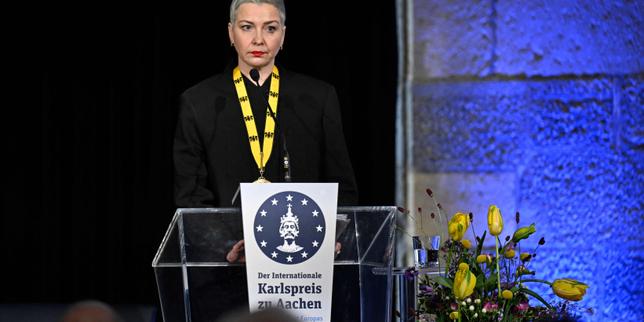
The ceremony in Germany was attended by her sister, Tatsiana Khomich. She stood where Maria should have stood. She held the weight of the bronze. In that moment, the room was full of diplomats and dignitaries, but the most important person was the one who wasn't there.
Maria remains in a cell where the walls are thick and the windows are high. She likely does not know the exact words spoken in her honor in the great cathedral. She doesn't need to. She already wrote her own speech on that September night at the border, without saying a single word, using nothing but the sound of tearing paper.
Imagine the wind picking up those scraps of blue and gold. Imagine them blowing back across the line, landing in the grass of a country that is still waiting to breathe. That is where the real prize is kept.
Would you like me to look into the current status of other Belarusian political prisoners or provide more details on the history of the Charlemagne Prize?