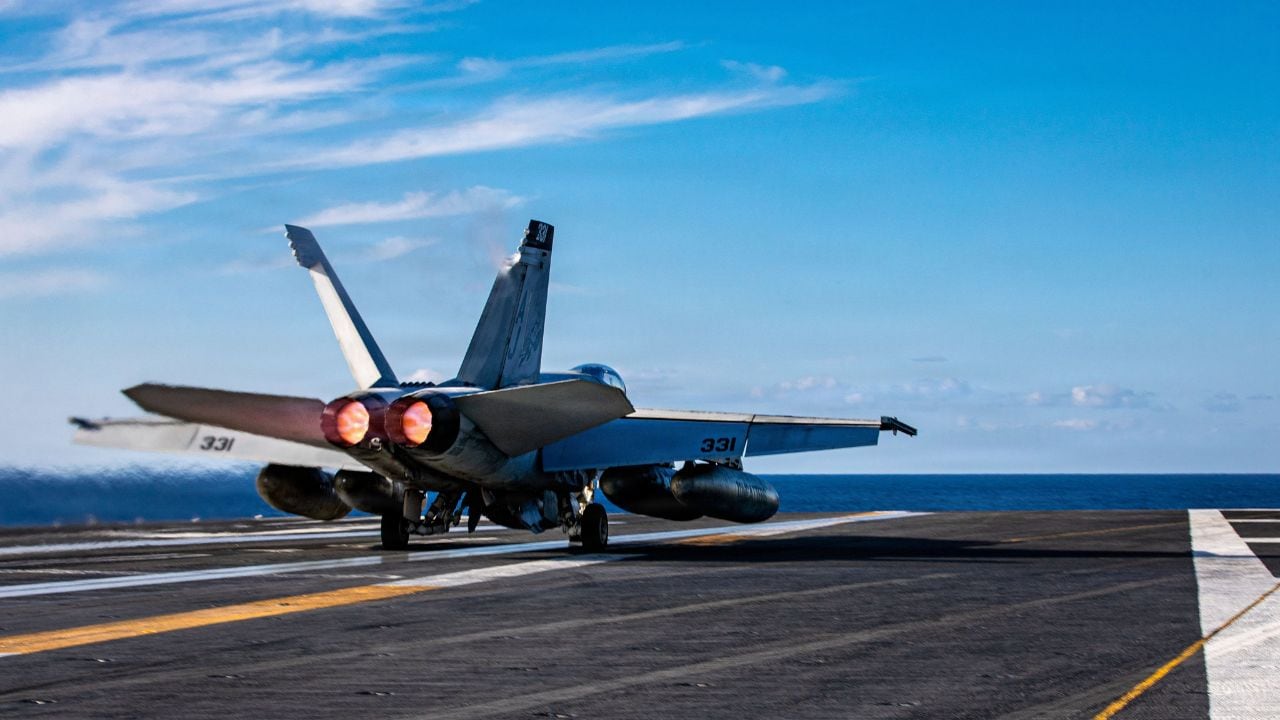
The cockpit of an F-15E Strike Eagle is not a place for the claustrophobic. It is a dense, high-stakes office of glass and titanium, where the air smells of bottled oxygen and the faint, metallic tang of electronics running at peak capacity. At twenty thousand feet, the world below looks like a muted map of ochre and dust. You are moving at hundreds of miles per hour, yet you feel suspended, held aloft by the invisible hands of aerodynamics and a pair of Pratt & Whitney engines that roar with the force of a small thunderstorm.
Then the warning tones start.
They aren't the rhythmic chirps of a microwave or the polite ping of a smartphone. These are jagged, piercing screams of audio designed to bypass your logic and hit your adrenaline directly. It is the sound of a radar locking on. It is the sound of a computer somewhere on the ground deciding that you are no longer a person, but a target.
In the chaotic choreography of modern warfare, we often assume that technology has stripped away the margin for error. We speak of "smart" bombs and "integrated" air defense systems as if they are infallible deities. We treat the battlefield like a chessboard where every piece is clearly marked. But the reality is far messier. The reality is that on three separate occasions, the very systems designed to protect a coalition of allies turned their sights on the wrong side.
USCENTCOM recently confirmed a series of incidents that haunt the halls of military aviation: Kuwaiti air defense units mistakenly shot down three American F-15E Strike Eagles.
The Ghost in the Machine
To understand how a multi-million dollar jet ends up in the crosshairs of a friend, you have to understand the sheer density of a modern combat zone. It is a saturated environment. The sky is crowded with drones, tankers, fighters, and transport planes, all weaving through a grid of invisible electronic boundaries.
Imagine a crowded room where everyone is wearing a blindfold. To find out who is standing next to you, you have to shout a specific code word. If they shout the right word back, they are a friend. If they stay silent, or if they give you the wrong word, you are trained to strike. This is the essence of IFF—Identification Friend or Foe.
It sounds simple. It isn't.
Systems fail. Signals get bounced off atmospheric layers. Sometimes, a pilot is so focused on the mission—the thermal signatures on the ground, the fuel levels, the radio chatter—that a transponder setting is missed by a single digit. Or perhaps the ground operator, staring at a flickering green screen for twelve hours straight, sees a blip that doesn't match the expected flight corridor. In those seconds, the human brain seeks patterns. If the pattern looks like a threat, the thumb moves to the launch button.
The F-15E is a beast of a machine. It is designed to dominate the sky. But even the most sophisticated predator is vulnerable when its own pack turns on it.
The Weight of the "Blue on Blue"
In military parlance, we call this fratricide, or more commonly, "Blue on Blue." It is a cold, clinical term for a tragedy that leaves scars across two nations. When the reports from USCENTCOM filtered through, they spoke of mechanical errors and communication breakdowns. They spoke of "mistaken" engagement.
But consider the operator in the Kuwaiti air defense battery.
That individual isn't a villain. They are likely a highly trained professional who believed, with every fiber of their being, that they were protecting their sovereign airspace from an intruder. They followed a checklist. They saw a target that failed to identify itself correctly. They felt the jolt of the missile leaving the rail. They likely felt a surge of pride as the radar return vanished, indicating a successful hit.
Then the radio goes quiet. Then the realization begins to sink in.
The "invisible stakes" of these incidents aren't just the loss of airframes—though at over $80 million a piece, the F-15E is a staggering loss of hardware. The real cost is the erosion of trust. When a pilot takes off, they have to believe that the "umbrella" of friendly air defense is a shield, not a sieve. The moment that trust wavers, the entire psychology of the mission shifts. You start looking over your shoulder at your friends more than you look ahead at your enemies.
The Geometry of a Disaster
Modern air defense is a feat of engineering that borders on the miraculous. A Patriot missile battery or a shorter-range surface-to-air system uses complex algorithms to calculate intercepts.
$$v_f = v_i + at$$
The physics are undeniable. If the velocity and acceleration are known, the outcome is a mathematical certainty. The missile doesn't have a heart. It doesn't know the difference between a hostile MiG and a friendly Strike Eagle. It only knows the coordinates it was fed.
When USCENTCOM investigated these three shoot-downs, they didn't find a conspiracy. They found a series of "Swiss Cheese" failures—a metaphor used by safety experts where multiple layers of protection all happen to have a hole in the exact same spot at the exact same time.
- A transponder glitch on the aircraft.
- A lack of real-time data sharing between the US and Kuwaiti command centers.
- An aggressive "rules of engagement" posture triggered by recent regional tensions.
When these three holes aligned, the result was a fireball over the desert.
The Human Cost of High-Tech War
We often talk about war as if it’s a video game played with high-resolution graphics from a safe distance. But for the crew of a Strike Eagle—the Pilot and the Weapon Systems Officer (WSO) in the back seat—the experience is visceral.
The F-15E is a tandem-seat aircraft. There is a profound bond between the two people inside that canopy. They speak a private language of shorthand and breathing patterns. When the missile hits, there is no "Game Over" screen. There is only the violent jerk of the ejection seat, the searing heat of the pyrotechnics, and the terrifying transition from being the master of the air to being a person dangling from a silk parachute, praying the wind blows them toward friendly lines.
Reports indicate that in these specific Kuwaiti incidents, the crews were forced to rely on their training to survive the unthinkable. Imagine the confusion of being shot down by the very people you were sent to assist. It creates a vacuum of logic.
In one of the instances, the aircraft was reportedly engaged during a period of "heightened alert." This is the euphemism for "everyone is terrified and twitchy." In that state, the human brain stops being a rational processor and starts being a survival engine. It prioritizes speed over accuracy. It chooses the "safe" option of shooting first and asking questions later.
But in the air, there is no such thing as a "safe" mistake.
The Silence After the Roar
The USCENTCOM disclosure isn't just a record of equipment loss. It’s a confession of the limits of our own brilliance. We have built machines that can see over the horizon and hit a target the size of a dinner plate from five miles up, yet we still haven't solved the problem of "who is who."
The friction of war, as Clausewitz called it, is the force that makes the simple difficult and the difficult impossible. It is the dust in the gears. It is the mistranslated word over a grainy radio link.
As we move toward even more automated battlefields, where AI and machine learning will make the "shoot" decision in milliseconds, these three lost Strike Eagles serve as a haunting prologue. They remind us that the more power we give to the machine, the more perfect our communication must be. If the "smart" system is fed the wrong data, it simply becomes a more efficient way to commit a tragedy.
The desert is vast, and it keeps its secrets well. Under the shifting sands of Kuwait, there are fragments of titanium and carbon fiber—shards of some of the most advanced machinery ever built by human hands. They are silent now. They don't emit IFF codes. They don't roar. They are just jagged reminders that in the heat of a conflict, the line between a brother-in-arms and a threat is as thin as a single pulse of electricity.
The pilots who climbed out of those cockpits and the operators who watched the blips disappear from their screens are forever changed. They carry the weight of the "mistake." They know that while the official reports will eventually be filed away in gray cabinets, the sky is never truly friendly. It is an arena where we are constantly fighting our own shadows, trying to make sure that the next time the warning tone screams, it’s for the right reason.
The sun sets over the Persian Gulf, casting long, dark shadows across the runways. Another flight of F-15Es taxis out, their engines whining in the humid air. The pilots check their transponders. They check them again. They look up at the deepening blue, knowing that somewhere out there, a radar is looking back, trying to decide if they belong to the world of the living or the world of the targets.
The tragedy isn't just that the planes fell. The tragedy is the lingering doubt that remains every time a friendly radar sweeps the sky, searching for a sign that says, "I am one of you."